
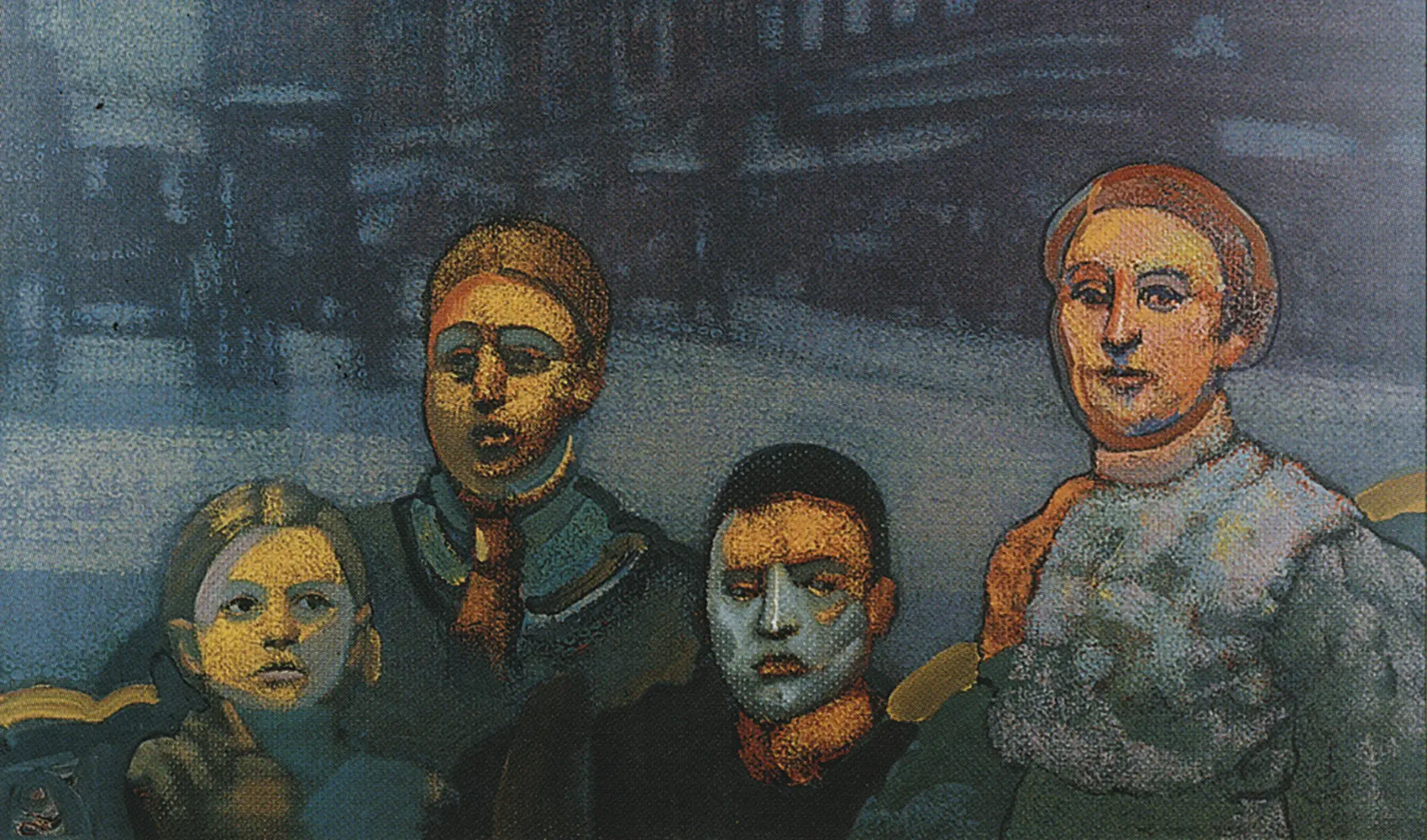
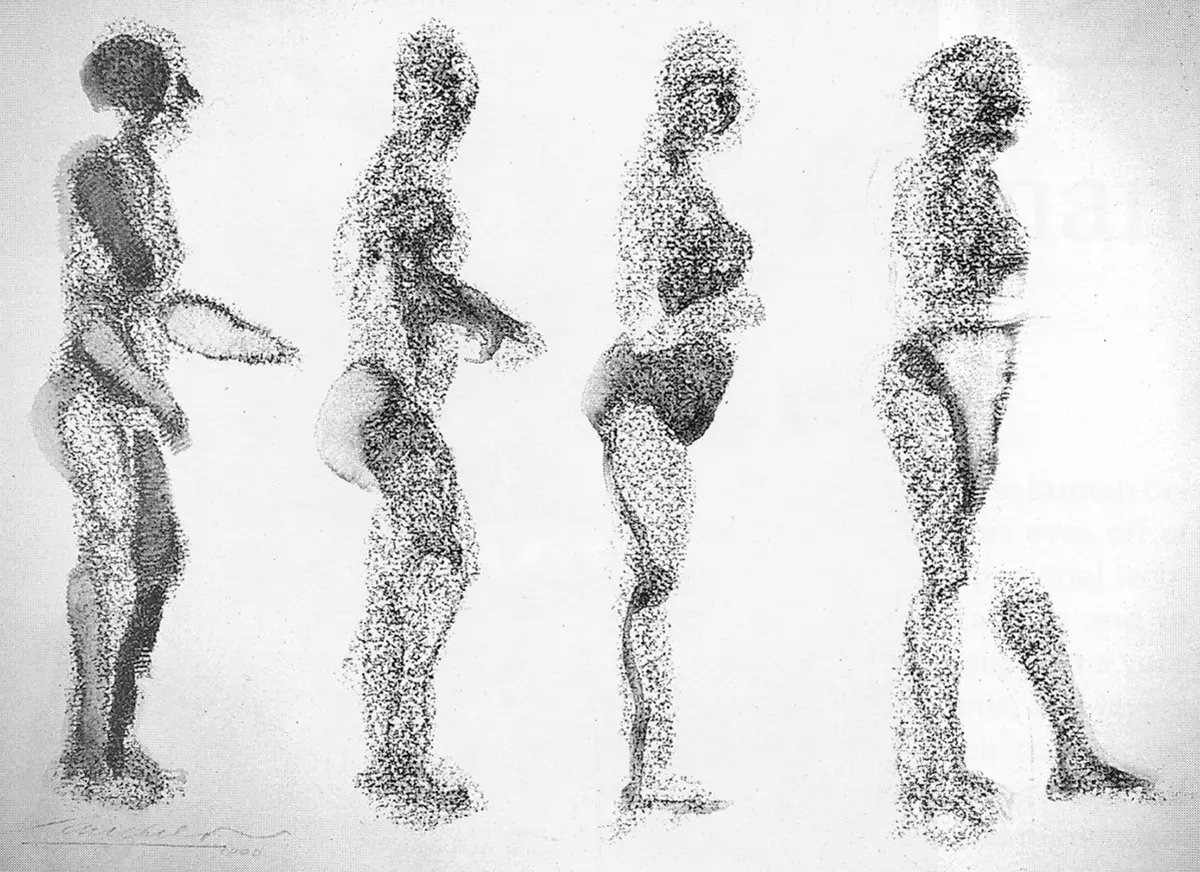
Venezuelan artist Édgar Sánchez (Aguada Grande, State of Lara, 1940) has developed over more than thirty years a career both exemplary and unique for the art of his country and Latin America. There are defining common threads in his work, such as the undeniable presence of the human being that does not take his eyes off of us. And there is a very personal technique that, both in drawing and in painting, creates in the support a very fine weave of lines, points, and layers of material, from which the figures emerge mysteriously, taking shape out of the very material of the pigments.
Édgar Sánchez has remained faithful to that humanist figuration that appeared in the ‘60s and, in Venezuela, he has renovated his images and forms in the so-called “boom” of drawing in the late ‘60s in which he had a lead role until coming to create a school of his own. From the ‘80s until today, Venezuelan art has taken other paths, some marked by a certain easiness and the local repetition of international tendencies and trends.
Meanwhile, one of Édgar Sánchez’s merits has been that of assuming dissidence, of continuing against the grain, exerting, as Marta Traba would have said, his capacity for resistance. Another merit has been and continues to be, that of his constant delving into the underlying coherence of his work.
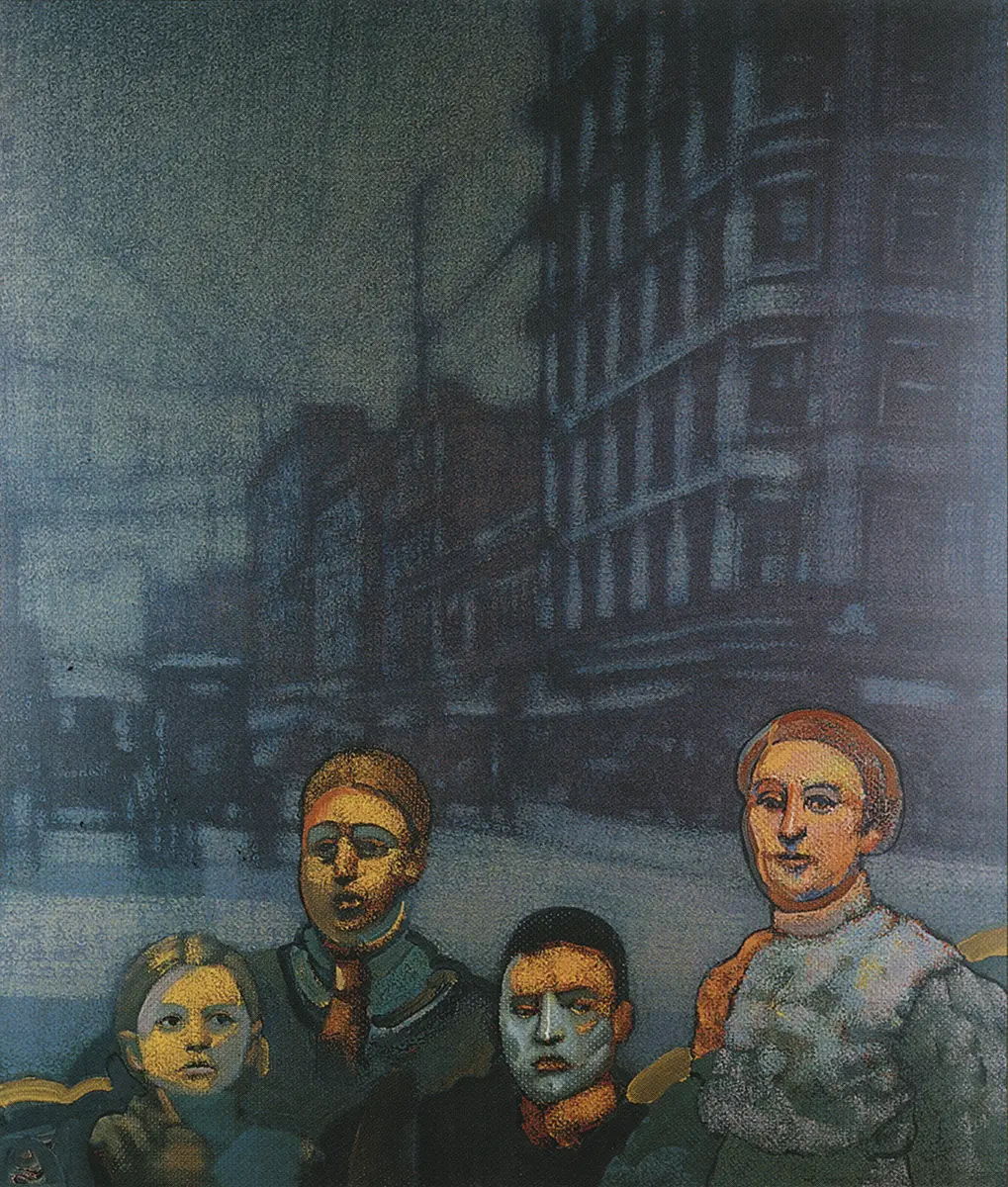
Noteworthy throughout the artist’s extensive production is his power for renovation based on elements already present in previous periods, along with the integration of new elements that are fused with the existing ones and predict those to come.
In 1965, after being awarded for his participation in various exhibitions of lesser importance, Édgar Sánchez made a pivotal entry onto the Venezuelan art scene: that year, at age 25 and with no formal study of plastic art under his belt (he studied architecture), he walked off with three of the prizes at the Salón Oficial Anual de Arte Venezolano. In 1968, at the Museum of Fine Arts, he carried out his first solo show. That same year, he won the Andrés Pérez Mujica award in the Salón Arturo Michelena at Valencia‘s Ateneo. These biographical data demonstrate that Sánchez immediately prevailed as a promising artist. However, the works of this first decade —a period of youth and normal indecisions— reveal diverse experiments: figuration, abstraction, drawing versus spot, grays versus chromatism. In 1965, Édgar Sánchez painted expressionistic figures, sticking to the emergence in the country of the new figuration led by his elders Alirio Rodríguez, Jacobo Borges, and Régulo Pérez. But already by 1968, he had undertaken much more personal investigations in the area of abstraction (a short period that would not reappear in his work), with very subtle and virtuous paintings made of lines that cross in an obsessive fashion. This framework is what he would later use, with great variants, throughout his oeuvre, already applied to figuration.
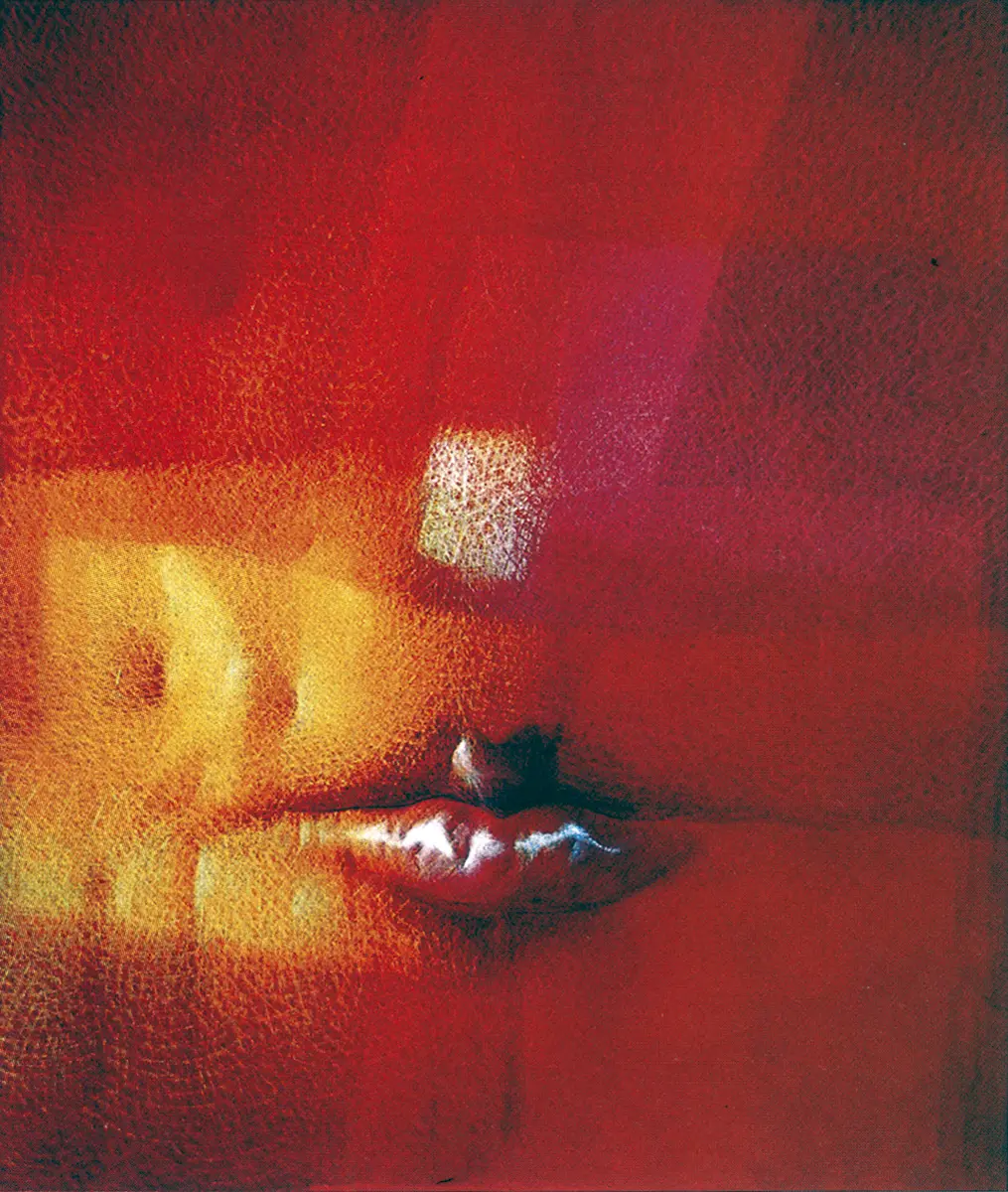
From 1974 on, having created a vocabulary of his own, Édgar Sánchez undertook an inquiry into the human being, which was to become his sole theme. Faces, fragments of faces in the foreground where a pore, a wrinkle, acquire monstrous proportions and seem to have a life of their own. Profiles, lips, and skins emerging from an inextricable network to which they belong, more than to a human body. With these works of overwhelming formal power and expressivity charged with a felt humanism, Sánchez, in the late ‘70s, came to be the leader of the “new drawing” that profoundly marked the Venezuelan art of those years. Nationwide, it was a time for exalting the human figure, returning to humanistic reflections, as well as for valuing the craft, the personal, and di- working within these same values for direct confrontation of the artist with his several years; he was a pioneer and, work, the paper and the pencil as mini- now at the end of the decade, a masmal resources for a maximum exprester. He received his first award in 1979 sion. But Édgar Sánchez had been at the Sal6n Nacional del Dibujo Nuevo, which symbolically came to mark the end of this period. Simultaneously, the artist gave his painting a variation and reinterpretation of his drawing. In his canvases of the time, the resources particular to drawing remain and are enriched with a refined chromatism that reveals a new facet of the creator. In the paintings, the characters appear full-length. They are anonymous, somewhat robotized, and treated with obsessive hyperrealism in the details of their clothing. These characters are surrounded by mysterious volumes, in steely blue, that we could call abstract, in contrast to the extreme figuration of the bodies. These volumes, although not identifiable, acquire through the quality of the painting a texture and some metallic reflections. They envelop the figures, which seem to insert themselves in the volumes, within a disturbing hybridization. A hostile world that wishes to absorb and mimic the human being is revealed.
In the early ‘80s, through the series Piel y personaje (Skin and character) and Piel y paisaje (Skin and landscape), Édgar Sánchez seems to discard some elements of his previous work and to privilege others. Thus the groundwork is now laid in the irregular, very tight network, which is confused with the texture of human skin and, at the same time, distances itself because the lines are no longer made up of the grays of the drawing, but rather by the infinite tones of the painting. These series make the greatest use of the ambiguities of vision. His large-format works appear as open fields of color on the surface of the canvas. But elements emerge from the fields that could either be details of the human skin or accidents of the earth. The human being and nature, freed from their environment, lose all identity and turn into a hybrid in the tactility of the painting that absorbs them as it reveals them.
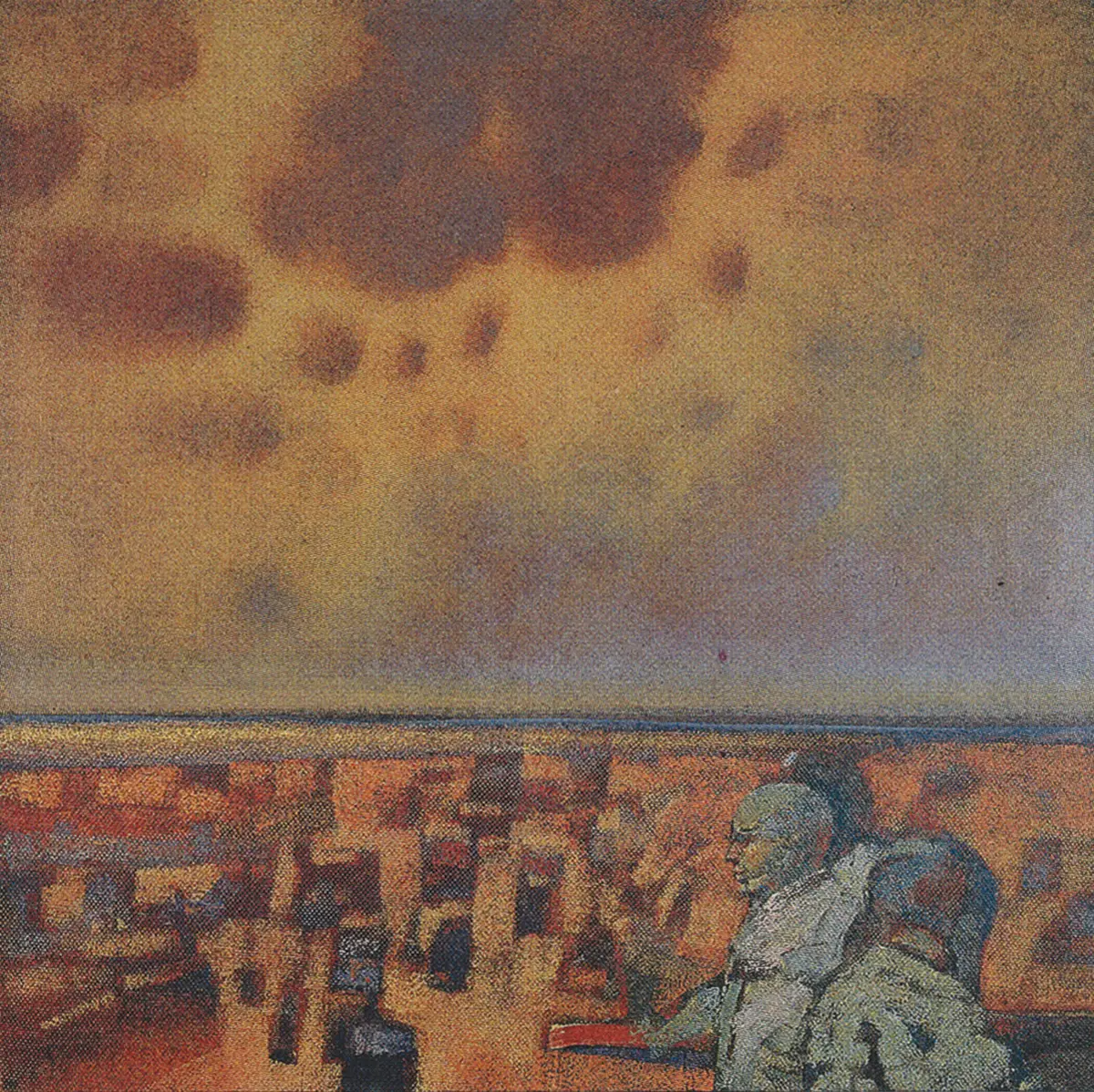
In 1985, with Piel y paisaje, Édgar Sánchez had reached a boundary point: the obsessive insistence on detail to the point of losing all real consistency, as well as the omnipresence of the framework that joins everything, had turned figuration into a paradoxical abstraction, naturally rich in semantic meanings. And something as central to Salnchez’s work as the reflection on the human being was about to vanish as if the lines had turned into a Saturn devouring his children. Thus the following stage of the artist came to have all the features of a recovery of reality. This process is crystallized in the series Pieles-Gestaciones (SkinsGestations), In it, we see solitary characters, both half-length and full-length. Synthetic aspects from his earlier periods appear to sort of balance it out: the framework as a unifying element of all his work; the human body before abstract volumes that reemerge from the paintings of the ‘70s; the faces of his drawings. And, at the same time, this series opens new perspectives in Édgar Sánchez’s work. For the first time, we find an almost abstract landscape, all sky, and plains, as a background in some canvases. And new plastic resources are also identified which, in a natural fashion, come to take their place next to those already established, such as language. The characters seem to come through the canvas, to emerge from the background in order to return to it. A figure-background relationship is established (both of which were previously confused in the framework) like that of Renaissance painting, which gives these works a vague timelessness, an air of “museum art.” There is a new sensuality: also in the style of great painting, an enjoyment of textures, cold and hot, smooth and rough; there are lights and shadows that underscore the complicity of the character with his environment.
This new approach to reality allows Édgar Sánchez to formulate, from the ever-humanistic stamp of his art, questions about the identity of being, the identity outlined, above all, as a relationship with the world. This concern seems to have guided his work for several years, culminating in a certain way in the series Imágenes, visión (Images, visión) and Rostros, visión (Faces, vision), exhibited in 1991. Both present solitary female faces that share the “conventional background” of the history of classical portraits the artist’s own framework. But profound differences between them also exist. Imágenes, visión has an atemporal atmosphere with subtle reminiscences of the art of the past, a nostalgic tone to speak of the serenity of a world that has already disappeared. Rostros, visión, on the other hand, refers to the world of today, as violent, and aggressive, in which the human being struggles for his space. This last series comes to constitute one of the most expressionistic moments of Sánchez’s production.
During the ‘90s, faithful to himself and to the plastic and existential formulations of his work, and following his eagerness to ground himself more deeply in his own achievements, Édgar Sánchez undertook a phase that was characterized by the importance given to the backgrounds, both in their themes and in their interaction with the subjects. In the series Pieles-Gestaciones, an undefined landscape had already appeared on a distant plane. Now the urban is made present like a backdrop that envelops the character in chromatic atmospheres. At the same time, it establishes with the character an ambiguous spatial relationship that seems to evoke his melancholic memories. Then added to the urban is a sort of desolate, desert landscape, which makes us see the city also as phantasmagoric, abandoned. This new phase (1996-1997) refers to the series Piel y paisaje from the early ‘80s, without overlooking the differences that rest, first and foremost, on the aforementioned series. Human skin and earth arrive at an osmosis, and the plastic result approaches abstraction, while in these recent pieces, the figure is reaffirmed and human beings and the eternal are once again separated. For their part, the similarities are found in the epidermal manner of treating the surfaces, in the arbitrary and unreal chromatism, in the patient work of layer upon layer, glaze upon glaze. The generally solitary figures stand out for their firm presence around a background with a very low or very high horizon, like in Renaissance portraits. Once more, this reference to classical art gives each piece an aura of grandeur and dignity, a majesty reinforced by the equally classical features of the faces. In the background, we might find a hypothetical city (although the artist states that it is Barquisimeto, with its colonial network), an empty landscape, or skies with heavy clouds. This landscape, treated with a rare density of lines and points that shape the characteristic framework, becomes almost skin-like, with the cracks and wrinkles that have always haunted the artist. Humanity exudes from these half-length characters and takes control of this environment, which is no longer a backdrop or a “conventional background.”
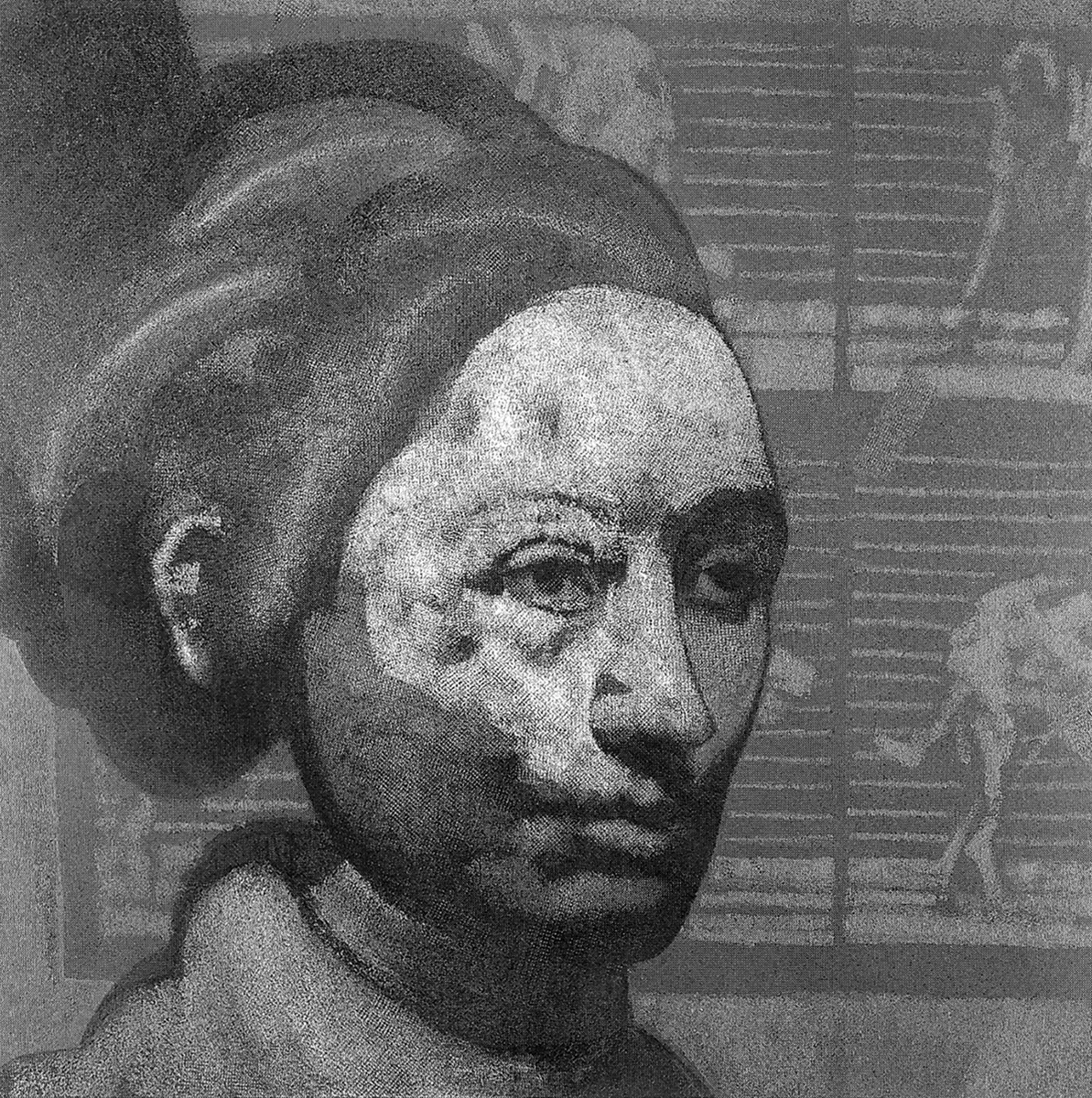
The lips barely outline the beginning of a smile; the eyes look off in the distance, daydreaming. A great serenity is detached from these figures—in this sense, they recall those of Imágenes, visión —a serenity that in successive waves communicates with the landscape of cities, plateaus, and clouds. However, as in some of Poussin’s pictures, everything looks like it is about to explode. With a great economy of media, both iconographic and plastic, and with no trace of exaggerated realism, Édgar Sánchez very subtly achieves a deaf tension, a menacing balance, a latent disquiet. In this sense, these pictures may be some discreet and disguised allegories of the scarce space that the world leaves for happiness today.
In his current production, carried out in 1998 in full process, Édgar Sánchez, following his very unique habit of reflecting on his own work in order to move forward, is retaking the urban views from 1996 as a background that assumes an ever-greater lead role. He seems to be achieving this always-moving and fragile harmony, which establishes full mastery of the means of expression when he speaks to us of the eternal themes of the human being.
FEDERICA PALOMERO