
For one of his earliest shows, Fabio Kacero wrote some autobiographical notes that were never published. They are interesting to read and reveal a peculiar way to be in the world:
"My teacher in the 4th or 5th grade organized a question-and-answer competition while we had lunch in the school cafeteria. Every participant would get a prize at the end. Mine was a book. My Wonderful Museum by Editorial Sigmar. It was a big hardbound book, with thematically organized reproductions: family, jobs and professions, the artist’s studio and light, dreams... Alongside Watteau’s Gilles, a crepuscular landscape by Claude Gellée, Pisanello’s Saint Eustace surrounded by animals in a mystical vision. Simple objects painted by Zurbarán, Vermeer’s studio.
Random and heterogeneous things like Scientific American magazine, Marcus Aurelius’ soliloquies, a decal-covered window, Adobe Illustrator, a piece of tapestry, John Barman unplugging HAL 9000, the “Historama “series, Eudoro Acevedo‘s journey to the future, or Rip Van Winkle‘s long sleep, continued an amplified those initial wanderings of mine."
At 39, Kacero’s work tends toward brevity, like the above text where details are skipped it doesn’t say a word about his many shows at the University of Buenos Aires Centro Cultural Rojas and at Galería Ruth Benzacar it doesn’t mention either his shows at the KravetsWehby in NewYork, or in ARCO the contemporary arts fair in Madrid.
The beautiful pieces on display recently at Ruth Benzacar have motivated Kacero to write again. This time, it’s a kind of list of 11 items, where the artist asks for silence so that he won’t be misunderstood. Item number three reads: “Beauty doesn’t think. At least, beauty is not sententious. It is not the braggart’s pretentious metaphor nor the well-intentioned man’s good conscience.”
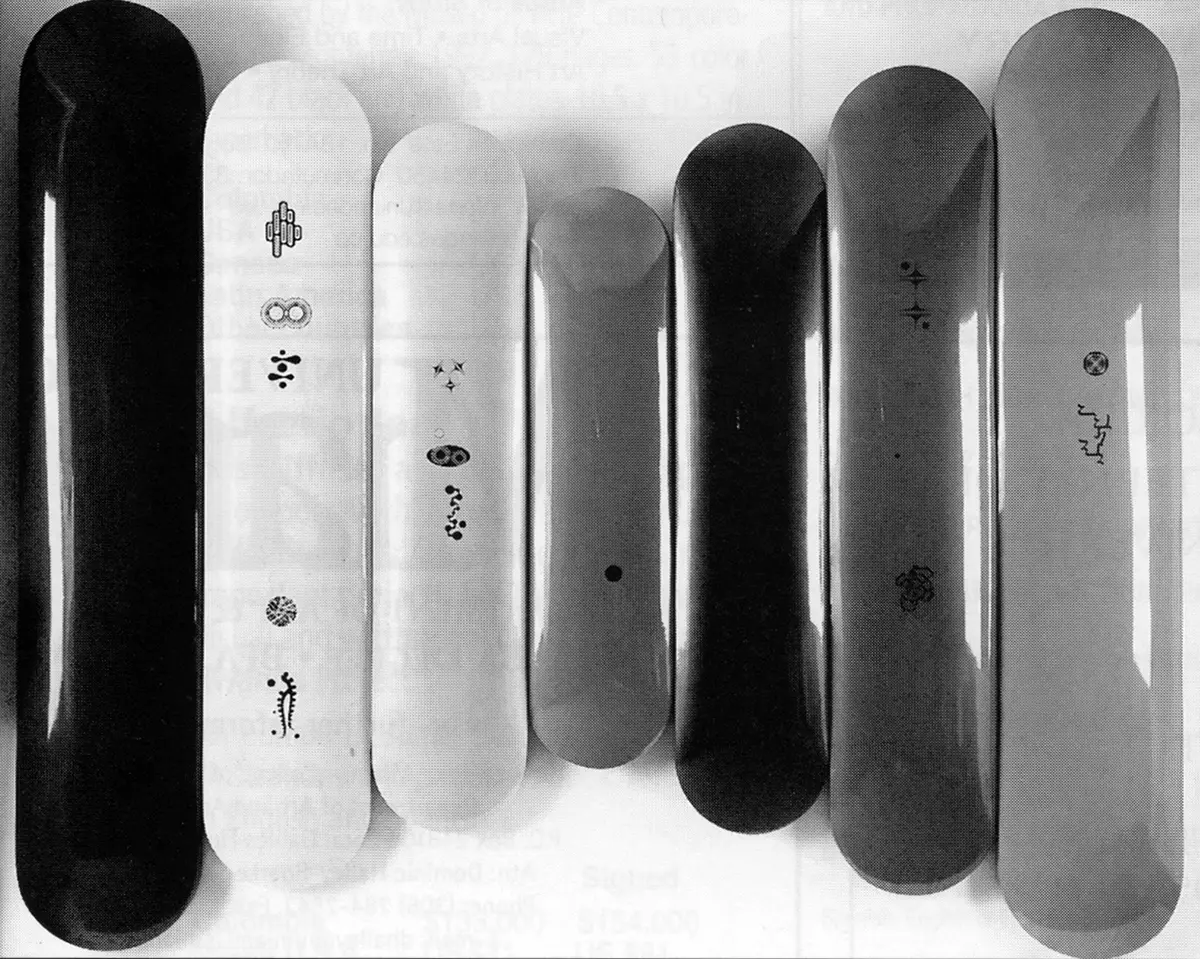
Beyond Kacero’s intentions, his work triggers questioning and reflection. The artist displayed two strands of his work; these are seemingly contradictory, but, in truth, they complement each other. In both his multicolor-padded paintings and in his tiny boxes containing graphic film, lighted, and printed in full color, the artist attempts to replace some of the painting’s gestures with objects. This synthesis appears both in his large-format padded pieces and in the small works made with transparencies. Opposite in size, these works share a center: a set of small figures or stickers designed by the artist on a Macintosh computer.
In their sophistication and in their presentation, these pieces display a bareness that is directly proportional to the complexity of their production process. Training for such detachment is hard work, and Kacero accomplishes it here. His padded paintings, made with shiny or opaque materials and impeccably designed, have a very techno look. In them, one doesn’t feel the artist’s hesitations.
The stickers, realized under the same program Kacero uses for his graphic films (five or six overlapped and framed in 6 x 6 cm), show fragments of something resembling signs, cerebral cortex circuitry, malfunctioning machinery, and elementary forms. These are neat, flawless compositions that imply freedom. The stickers are placed on the padded surface before sealing their fate with a packaging that distances and congeals them.
In his latest work, Kacero has radicalized the smallness. He brought volumes down, lowered the intensity of the shine, added color, and back-lighted the objects. The result is different and the same: pure form and design. But, as with the large-volume objects, where the dichotomy between the technological and the hand-crafted is still apparent, in Kacero’s graphic films the unity of the object emerges from each one of the small plaques. The distance between the materials is real, and Kacero emphasizes it.
The artist uses a heat-treated, transparent plastic material to hermetically wrap the segments of his large objects, and to seal the designs. Shiny and polished, this plastic invites touch. Lighted and delicate, the small boxes promise a fictitious closeness. Once again, a great visual appeal. Once again, a frustrated offer: “To be seen, not touched.”
The fourth item in Kacero’s list read as follows: “If the eye is spoken, the mouth’s steam dampens it.” (Nebridio). Of course, art reaches where words can’t. But it is impossible to dampen a show like this one.
VICTORIA VERLICHAK