
One night some time ago, just before getting to bed, I was reading in sequence Julio Cortázar’s Final del juego (End of Game) the one that begins with “Continuidad de los parques” (Continuity of the Parks), and I came across the story “Axolotl.” Slowly, the narrator becomes the strange animal he describes, and in the end, the reader is forced to look at his own hands, lying there on the bed alongside the open book, to verify that he is still a human being. Cortázar imprints in our imagination the pink, translucent little body of the axolotl; its large, round golden eyes lined with black, its hand-like limbs, its appearance resembling a Chinese figurine covered in rust after a long time underwater, its reddish gills growing at both sides of the head like tree branches that assert the animal’s quiet, inert nature; and so many other of the dreamlike creature’s characteristics.
The following afternoon, I was wandering the city streets, window-shopping without any particular purpose. And then I saw them. Two of them inside a medium-sized fishbowl, flanked by caged hamsters and cockatoos. I was startled by the very fact of their existence, by the realization that the axolotl are living creatures of this world. And, after the initial shock of finding the two fantastic animals I had been reading about for sale, I was surprised by what seemed their peculiar relationship to time. Time seemed to float in suspension around them, and they seemed arrested in the middle of their own existence, stopped at some half-point in their biological development. Like tadpoles, they are runts of a creature more dignified than the simple toad.
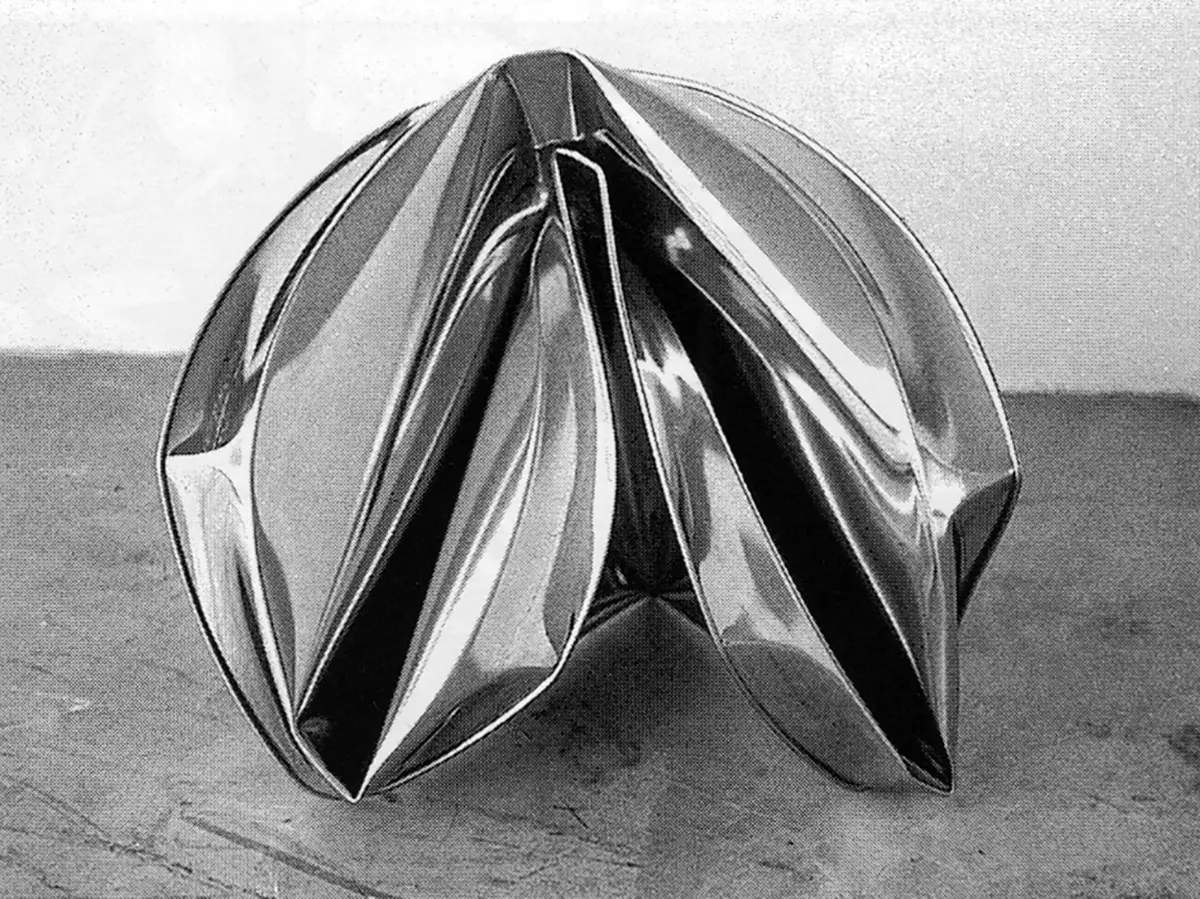
Another night, again before getting to bed, I found myself at Baró Senna Gallery looking into a different fishbowl full of axolotl-like creatures. Yes, since that first encounter, I have found them everywhere. Following some kind of reductionism, and in order to identify them with a short word, I use the name axolotl for any creature that seems to inhabit that same suspended time. Such as Franklin Cassaro’s Vulvas (Vulvas), silently gathered inside their glass cases as though looking outwardly, through a window, and in waiting. That collection of Vulvas metálicas (Metallic Vulvas) - resembling family groups with the smaller member sitting up front, as in the theater - looked at us as we entered the show. They welcomed us and offered us their farewells, and they would still be there, waiting for us, upon our return.
Looking at them, we understand the movements and foldings compressing the metallic planes and giving the material their present form. We can step back and deconstruct with our gaze those simple gestures, recreating the open circles that, in truth, are still there. Franklin Cassaro leaves that to our discretion, cutting and transforming generic metal pieces with everyday techniques, with movements we ourselves have made and are capable of recognizing. Thus, his vulvas look somewhat uncomfortable, constrained, and still unaccustomed to being, at the same time, what we see and what we know they are. Like the axolotl, the Vulvas seem trapped within the artificiality of an outstretched time, within an impossible permanence, inside a public aquarium. Hunched over, submissive, immobile, and outward-looking, almost calm and always at rest: because they will never be able to turn back or to move ahead.
As I continued to make my way into the gallery, passing under a larger Vulva, silvery and alone, seemingly lost atop a vertigo-inducing pedestal, [saw Templo (Temple).
It is an inflatable newsprint construction, miraculously standing by virtue of the air produced by common fans. Once again, Cassaro bares before us his materials and the trivial mechanisms he uses to build his dreamed creatures. Like the vulvas and the axolotl, Templo inhabits a more dilated time. Full of air, it rises from the floor as if in respiratory movements. But it is not constrained by any live being’s need to exhale and inhale; it is like an extremely light prehistoric animal, frightened or startled, seen just before it realizes there’s no danger and breathes again. An extremely extended instant.
Templo also has its own possibility of deflation since, given its simplicity and our habit, we know its parts all too well, and we recognize its previous states. We know what would happen if we turned a switch to cut off the flow of air. Templo is also a loose newspaper page, the news it contains, the breakfast table on which it is read, and the comments we make as we read it; the rise in the price of gasoline, a new film that just opened, the cure against cancer, the review of an art show in which sculptures are like “larval forms with gills, some kind of batrachian of the general amblistoma.”
CARLA ZACCAGNINI