
Nature in the so-called Green Belt, a treasure of Santo Domingo and its environs, with its unpolluted waters, flora, and fauna, rivers and banks, is rapidly disappearing in the name of urbanization and under the influence of powerful commercial interests.
José Cestero’s show Ozama gris, que te quiero verde (Grey Ozama, I Want You Green), is part of a larger ecologi papers, and visual arts. Cestero’s surely will be among the best individual shows of 2000, and the seductive powers of painting add its forceful commitment to a vital cause.
José Cestero is one of the Dominican Republic’s great artists. His immense talent, sensitive and subtle, is not acknowledged as often as it should —but it needs to be said that the first to commit this injustice is the artist himself who sometimes doesn’t seem to recognize the force of his own art. Years pass between his shows, and he disappears in the street while sought after for international expositions.
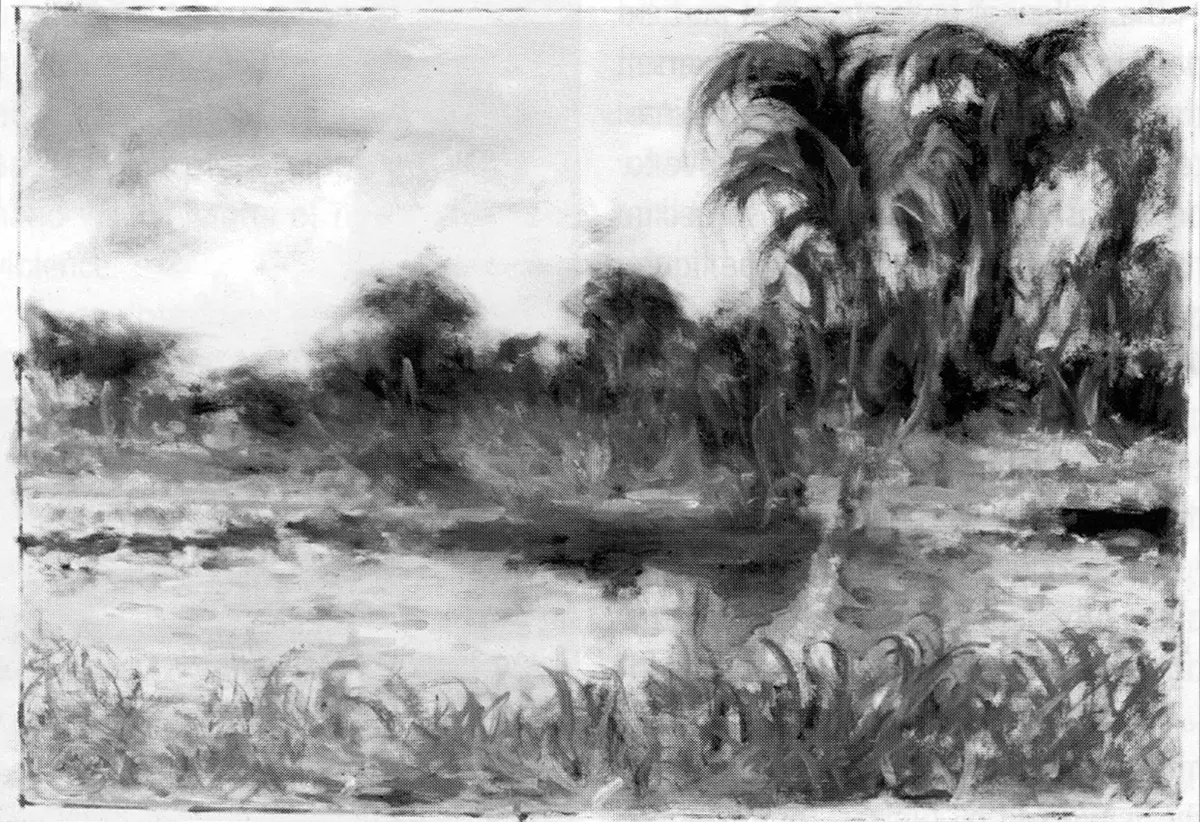
Luckily, Cestero is like a phoenix of the art world, always rising from his own plight and misfortune to surprise us, his vigor renovated, with new works. This is precisely what happened at Centro Cultural de España, through 16 canvases, mostly landscapes and some portraits. José Cestero traveled through the Green Belt and journeyed up the Ozama River, Isabela, Manatee Lake, and Cachón de Ia Rubia. Deeply moved, his memory registered his impressions from the trip.
The artist loves poetry and is a poet himself: his own notes within the paintings attest to that. He loves music and is a musician; here he followed the rhythms of The Rite of Spring and Paintings at an Exhibition. He loves humor and is a humorist, but his themes turned grave, allowing us only to discern quick, furtive smiles in his portraits. Nature’s drama doesn’t tolerate irony.
Cestero’s show centers around a large triptych, eloquent from its title to the scene it depicts: Cinturón verde agónico (Agonizing Green Belt). Cestero interpreted the environment from his own view of the world; he saw it, remembered it, and painted it, Signs are sowed on the canvas, a kind of writing made by hundreds of shacks invading the riverbanks. Green areas protest that vegetation still exists, and water attempts to preserve blue tones. , now blackened. It is perhaps the most pessimistic, anguished, and accusatory piece in the show.
Cestero doesn’t imitate what his eyes have seen. He gives new forms to the world. To nature’s spectacles, he adds his fantasy and interior life, as he’s done with city vistas and portraits. Cestero’s trees are fascinating metaphors. Waving his brush as a magic wand, the painter can—as he explains—change bushes into parakeets, a particularly endangered bird.
We shouldn’t label Cestero’s landscapes as neo-abstract, even if in several what we find is, rather than formal delimitations, vibrations to the green and bluish pulses. Taken to the canvas, the elements are real: lagoons, rivers, banks, woods. These are not pretexts for pure color or matter effects. Cestero brings back, reinventing it, a deep, radiant, and believable Nature, but one that now is full of sentiment, frightened, soulful. Dazzled, his conscience enters into a dialogue with the landscape itself. The message traveling through brush and pigment is at once artistic and ecological.
Now, within the liberty of treatment that Cestero controls with an interior frame for each scene, he expresses his wonder at the Tropic’s colors. He turns foliage and woods into giant emeralds while giving rivers and lagoons a bluish hue that trembles like a reflection. Sketching directly with a brush, Cestero’s strokes are fast but coherent, articulate, and solid.
Some portraits complete the show, a genre to which Cestero has dedicated entire shows in the past —offering a legion of characters among whom the ghosts of the past are as alive as the present’s protagonists. In this show, however, portraits— are secondary to the ecological cry of the landscapes. The painter gives us “idealized” portraits Cestero himself uses the adjective —worked with a more constrained fantasy and in less freedom than his visions of Nature, and even than many of the artist’s earlier portraits. Maybe the purpose of idealization generates a certain tension: heroes and friends are not presented here with Cestero’s well-known liberty.
Art does not turn its back on the community’s problems and needs, and José Cestero’s current work is committed to the preservation of Santo Domingo’s Green Belt…or what’s left of it, The artist’s cause, and that of those who fight to avoid an ecological disaster, involves us all.
MARIANNE DE TOLENTINO