
Considered one of the most important Argentinean artists of the 1980s —responsible with Marcia Schwartz, Osvaldo Monzo, and Guillermo Kuitca, among others, of the resurrection of painting— after developing all through the 1990s an extended series around the primordial figure of the vessel, Cambre surprised the public at Fundación Klemm with a very different group of works. While light is still the protagonist of his art —on the vessels, it had the ability to either emphasize them or make them almost invisible; now it enables us to access fragments of landscapes—, the turn is sufficiently striking to reveal a new direction in this artist’s production.
For the Fundación Klemm show, held in the same room where he had a strong individual exhibit back in 1998, Cambre fruitfully focused on the landscape genre, creating, through tremendously oblique perspectives, images that seem to suggest fragments of tree canopies. The hypothetical branches and leaves are, in these paintings, constructions of filtered light, in the manner of small circles and stains. The image arises from the potency of interstitial spaces; the form —in this case, the foliage— is an after-effect. A figural background mechanism allows these visions to be what they are, but it is impossible to determine their specificity. Was the artist creating a luminous background and the tress got in the way? Was he painting trees when light arose from the interstices, taking over the scene? It may be preferable not to know, and to let the sum of these parts to build, in some secret way, the work.
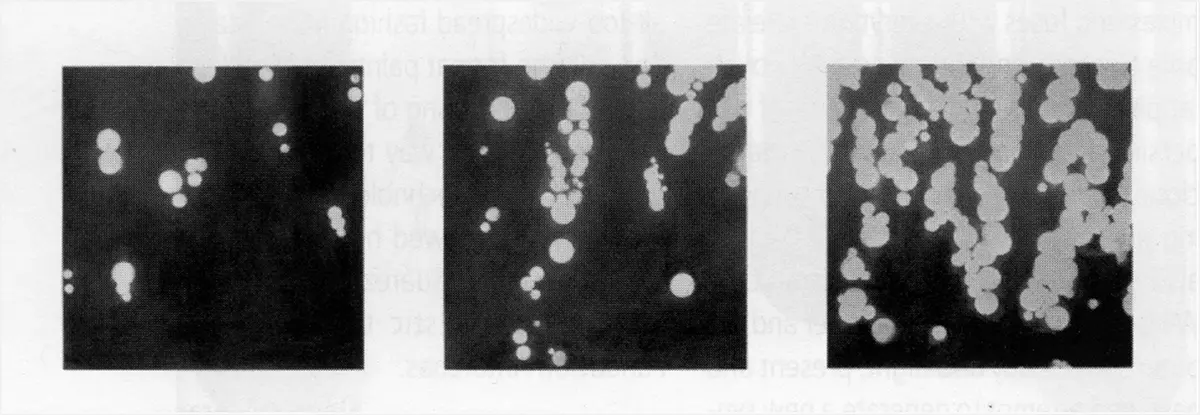
As in previous works, Cambre’s use of color is sober and austere. The artist refuses to overuse painting’s technical resources; he makes his simple discoveries and works on them tenaciously, with no need for grand gestures that would turn them into some kind of visual bait. The seductive power of Cambre’s work is born from his concentration on the painter’s craft; his unwavering focus translates into the subtle transformations of motifs or central themes as they move through a series.
In Cambre’s recent pieces, the compositional arrangements refer to the cinematographic technique of the close-up, and also to the panoramic framing format. Although his work is close to the field of "pure painting" —note the scarcity of expressive resources taken from other disciplines— some elements of film (in truth, of film photography) seem to have entered the current series. What Cambre offers are elongated fragments of shots depicting foliage, signs of branches, and leaves that won’t let us see the tree they belong to —and which, in consequence, won’t let us see the forest. But, again, the active qualities of light invite us to assume the existence of that context and to assume that it is dynamic even though here only an instant and a fragment have been captured. Diurnal and nocturnal landscapes, according to the preponderance of light or dark colors, silently inform the sequences of a film.
An insistence on vessels and containers had placed Cambre in the Line of a Morandi, with the motif of the deep dish concentrating within its limited boundaries the historical weight of the still life. The new series of minimalist landscapes can be related to the search for an expressive synthesis that characterizes the work of contemporary figurative painters such as Alex Katz or David Hockney. The kind of synthesis an artist can only attain after abundant attempts, trials, and research, seems to be Cambre’s now. Cambre has been showing his work nationally and internationally for over two decades. When the moment of synthesis comes naturally in this way, less is certainly more. The delicate simplicity of these landscapes confirms the artist’s maturity and his commitment to painting as light.
EVA GRINSTEIN