
Terror is like love: it is foretold by dizziness. Only love —a clear fall— can be as scary as a cliff or the ocean. And terror only falls. Without round abysses.
Ida Gramccko, 1964.
In a period of general social festivity, nationalist euphoria, profuse official rhetoric, and some certainty of collective wealth, one photographer ships through the crowd that attends the ritual of Holy Week near the Church of Santa Teresa in Caracas and captures, head-on, the event of life, the codes of the sacred, the persistence of old age, the semidarkness of the existential: the abyss, the bottom, the passion around the body and the gaze. That setting was ideal for the coming together of classes that temporarily lay down their antagonism for the sake of the illusion of the beyond. In the series that Luis Brito called Los desterrados (Exiles), originally exhibited in 1976, we find the first signs of a code that passes indistinctly from the aesthetic obvious both in his compositions and in his laboratory to a new dimension of the social from a perspective of photography, and that in praise of a critical and affective awareness of the image.
Los desterrados takes place outside the temple, among the isolated figures and family or public groups, among the passersby who divide us in spite of their proximity on the stage of faith. There in the street, in the temple square, on the sidewalks, are the distinguished ladies of society, alone, among friends, well-dressed, with dark glasses, aquiline profiles, and aristocratic bearing. And there too are the humble families, physically tired, sitting on the ground, exhausted in the tension of hope. For one older lady, two younger women, and a child, the only thing that remains of the procession is the social anguish of returning home.
The ironies are similar: the Christian woman who stops begging for a moment in order to position herself sensually, arrogantly, before the camera. Above, on a fragment of a sign, we can barely make out these words: No se paga entrada (Free admittance); down below, between her hands, is the basket for the merciful coin. The subtlety of chance is complemented by a character in the background, a woman with rough features who hikes others, and marches toward the entrance, but who turns and hooks at the photographer instantaneously. Thus, we shall always find in Brito’s photographs someone who, from behind, claims a head role and becomes present through his or her gaze, questions, and unbalances the harmony in the foreground.
Two other photographs show a nun dressed from head to toe, alone, monumental, authoritarian, very agitated, in the middle of a harangue, with one fist closed and in the other, held high, a jumble of bills. Light, full of gestures, semi-hidden face, and her screams accentuate the implacable raffle of a religious order. Finally, a fleeting street scene with people moving from side to side. Behind them, right in front of the camera, a man with an unpleasant, upset, and terrifying gesture, as if to remind us that the evils of the body and the spirit are in these streets of God, just like that. We would soon get to know that underworld, a dark place, separated, where only Brito’s touching gaze introduces us.
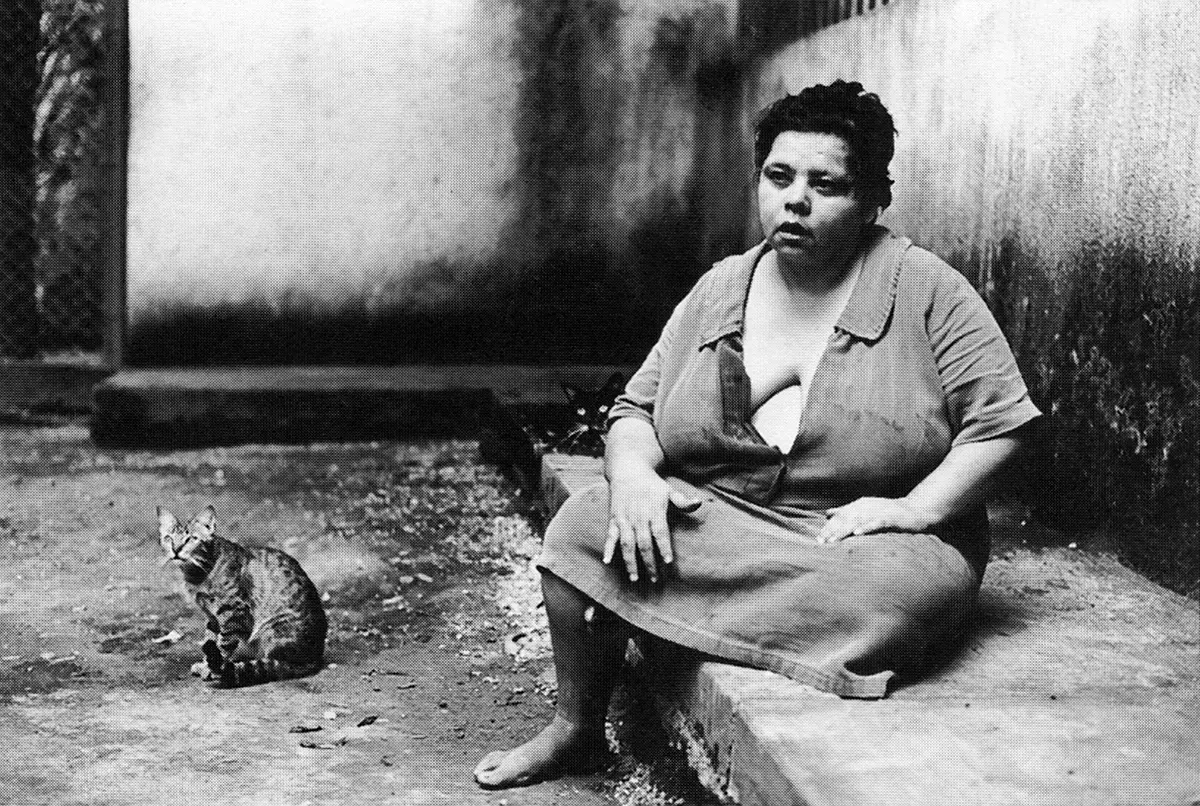
Visión de Anare (Vision of Anare, 1976, exhibited in 1977) represents the most dramatic chapter of Brito’s work. The artist was able to evade the hobby of the insane asylum ofAnare in order to portray its patients, their loneliness, their pain, and their existential void. In that Great Venezuela, in the middle of the graceful decoration of the kinetic arts, one photographer among others, burst onto the scene, raised a fundamental issue of the social order in grave artistic compositions, of a heart-breaking humanism, with some tormented models who were brutally thrown into society’s forgetfulness.
Insanity is an ever-present subject in the artist’s repertoire. Insanity is a complement to creation. Insanity is a recollection of childhood, since his school neighbored the asylum. Insanity appears not only in a spiritual decomposition but also in an unalterable social deterioration that characterizes our country.
Brito’s photos in Anare pay particular attention to the subject of absence. The individual is in total solitude. Only ghosts inhabit his or her mind. A cat may be the only carrier of human affection. The rest are beings on the floor, behind bars, distressingly rigid. And among them a woman brings her hands to her face, and the folds, the wrinkles, the nightmare of the skin, accentuate the impossibility of existence.
Bearing those experiences on his shoulders, Brito initiates a long consolidating journey of his sensibility, of his eye, of his photography in Rome, Cairo, and Barcelona. In his case, this is the time of maturing, of creation, and of the formulation of many masterpieces of photography. In his work between 1979 and 1983, humanity is a synthesis, an ear, a foot, a hand; the landscape will be oblique, and the torments of faith and bodily decadence are identical in one place or another. In focusing on one part of the work, he discards landscape, personal identity, and any implicit significance. He only heaves the explicit, the incommensurable, the minimum from which we approach totality.
The gaze and the skin are perhaps the decisive factors in the series of portraits that he captures in Europe. But the photographer transcends the immediacy of the body and delves into the spirit of survivors. La vida humana es así (That’s how human life is), Brito’s aphorism condenses in an elemental, poetic, and radical way a feeling and a raison d’étre. The subjects of humanity are there in the ghostly and in the plunder that transcends them.
Among the crackings of the skin, the closed silence of the faces which is so expressive nonetheless Brito allows for touches of tenderness, hike that image in which a lady brings a bouquet to her nose in such a way that she inserts a pause of peace among the dryness of her kind.
Through feet (1980) or hands (1982), we find the integral personality of the individual, his or her social rank, and certain ideas. Once again and l return to an aforementioned principle a fortunate link between the aesthetic and the social is produced. In these groups made in Europe, Brito turns to history, real or imaginary, from a minimal fact or detail, while the errancy of the human step lies in the idea of the foot.
Religion is the place where the photographer insistently returns. In the Holy Week of Seville (1986) he finds a medieval decoration that reconfigures types, conducts, attributes, and gazes in a scenographic majesty of power that changes extraordinarily through a small gesture of the officiants, and occurs in falsetto and becomes burlesque. There is a cardinal among priests who are wearing their capes; they hook resigned before the photographer unaware of his intentions. The result is solemnity in the pose of boredom. Then the dominion of the character and the gravity of the scene reach, in the acumen of the image, a farcical act of ritual nuisance, with scant conviction in the representation of the mystery of the Lord. Therefore, in the boredom or lethargy of the protagonists, the possibility peeks out that the represented may be an operetta, an event for hooking into what lies behind the faces of the social position.
In Italy, whether Rome or Venice, Brito opens onto the landscape. He now frames a larger space and we therefore see the city. A satirical poster says Guardati intorno, and that condenses his disposition of the period. The urban space is somber, the figures are silent, always grave. Although Brito works in the middle of the day, his compositions have a tenuous, silent light, and they reveal the mystery of life and creation. In the photos of Rome and Venice, real space appears as the site of the oneiric, of ghostly projections. This is where the “visual dimension of the imaginary” that Rosalind Krause has described takes place. Landscapes in black and white, some nighttime, hike those at the door of the daily newspaper II Tempo and others in the Dantean penumbra of the Venetian waters. Meanwhile, from the top of San Marcos, the spatial relationship of the individual is a metaphor for always unachievable greatness.
When Antolin Sánchez reflected on Brito’s photos, he pointed out that photography is an act of faith for it places us before the temptation of the occult. Human nature is a subject to unravel, and photography is nothing more than the image of a limitless feeling inasmuch as it transcends the immediacy of its subject.
In this repertoire of types, the gaze constitutes the unleashing factor of the image and its possible account, whether those same images are mocking, surly, painful, dark (through the lenses, and then it is the lines of the frown that reveal them), ironic, desolate, subdued, blinded, sensitive, or conditioned. In short, it does not matter how, since being is feasible from the image.
In his photographs of the nineties, the composition presents strong diagonals and, often, a vision toward the superior as if manifesting the supernatural of existence.
Since the 1990s, the artist has worked color in cybachrome and the urban scene, the city scene, is incorporated into his subject matter. Concise color in order to reveal once again a feeling of hived experience. Color in the spatiality of an angel in a cemetery (exhibition in 1989), of the metaphor of the figure and the sky; color in the urban exploration of Ciudad Bolivar (1994); color in Humboldt’s route along the Orinoco (1997), where light and water are tangible elements; and color in the geography of Puerto La Cruz (1999), when the city was built of gazes, according to Guillermo Barrios. All of those subjects are simple, expressly simple, in order to rehearse approaches with the viewer, convergences, emotivity, and a critical sense of what is seen.
Perhaps Luis Brito has done nothing other than photographing the ripping of human transit, which would be the only way of lifting or drawing us near the sky, that is, toward eternity.
JUAN CARLOS PALENZUELA