
Like many Argentine artists, Óscar Suárez is intrigued by the potential of digital images. But he doesn’t abandon painting, nor does he stop developing his sensibility as a painter. This is why his exhibition at Diana Lowenstein included paintings (acrylic on canvas) and hand-painted, electronically-printed photographs.
Although born in Mendoza in 1962, Suáaez adopted the city of Cordoba as his own during the 1980s, as Argentina underwent a democratic revival. In Cordoba he found a welcoming and fertile environment. He studied at Cordoba University’s Art School and became a member of groups devoted to organizing performances, installations, graffiti painting, and similar provocateur actions in public spaces. He also deepened his contact with music (from classical genres to minimalism), film (from Greenaway to Wenders), and comics. We could say that contamination by various artistic practices is at the origins of his work and that it continues, in a new fashion, to the present day.
Early Suárez works are close to theatrical scenography, as evidenced by A Las Tres (At Three O’clock), which used the music of Philip Glass to emphasize the dramatic narration. In that work, the artist depicted Juan Moreira’s assassination, placing the character of the assassin in a three-dimensional space. As the killer thrusts his spear into the well-known gaucho’s body, he is also attacking metaphorically painting as an aesthetic act traditionally limited by the plane. Uniting painting, object, and sculpture, Suárez demanded the crossing of disciplinary boundaries, and although his work remains today within planimetry, the combination of techniques of painting, photography, and digitalization continues to play a major role in his program.
Suárez’s recent work confronts the serenity of the classical gaze with the instability of the baroque gaze. If the former was fixed in a single direction, the latter attacks several at once. This is the gaze of a subject who registers a loss of integrity, of globality, of ordered systematization. It is the gaze for the vertiginous age of the video clip and of zapping.
By taking as his point of reference a permanently restless gaze, one that in the face of such excess, such insanity of seeing, can only not see, the artist posits the existence of an attentive eye, capable of capturing not only the serenity of the classics (which would mean turning the wheels of History back) but the fast-moving spectacle of our own daily world. He proposes a re-learning of vision, a difficult and demanding task, in the midst of a zapping culture and a zapping way of life.
The first thing is learning to stop and untangle a visual field where everything mixes and fuses with everything. We are able to see them, among so many overlapping images and as the fruit of our persistence, a branch, a bird, a patio, clouds, a painting, and an armchair supporting an anachronistic character. We can also see, unavoidable, a television box. We isolate momentarily the inner and the outer spaces, day and night, present and past, and attempt to generate a new synthesis. Our own gaze threatened with confusion, we find ourselves in the antipodes of Funes, that character of Borges’ who was capable of remembering with absolute precision everything he ever saw.
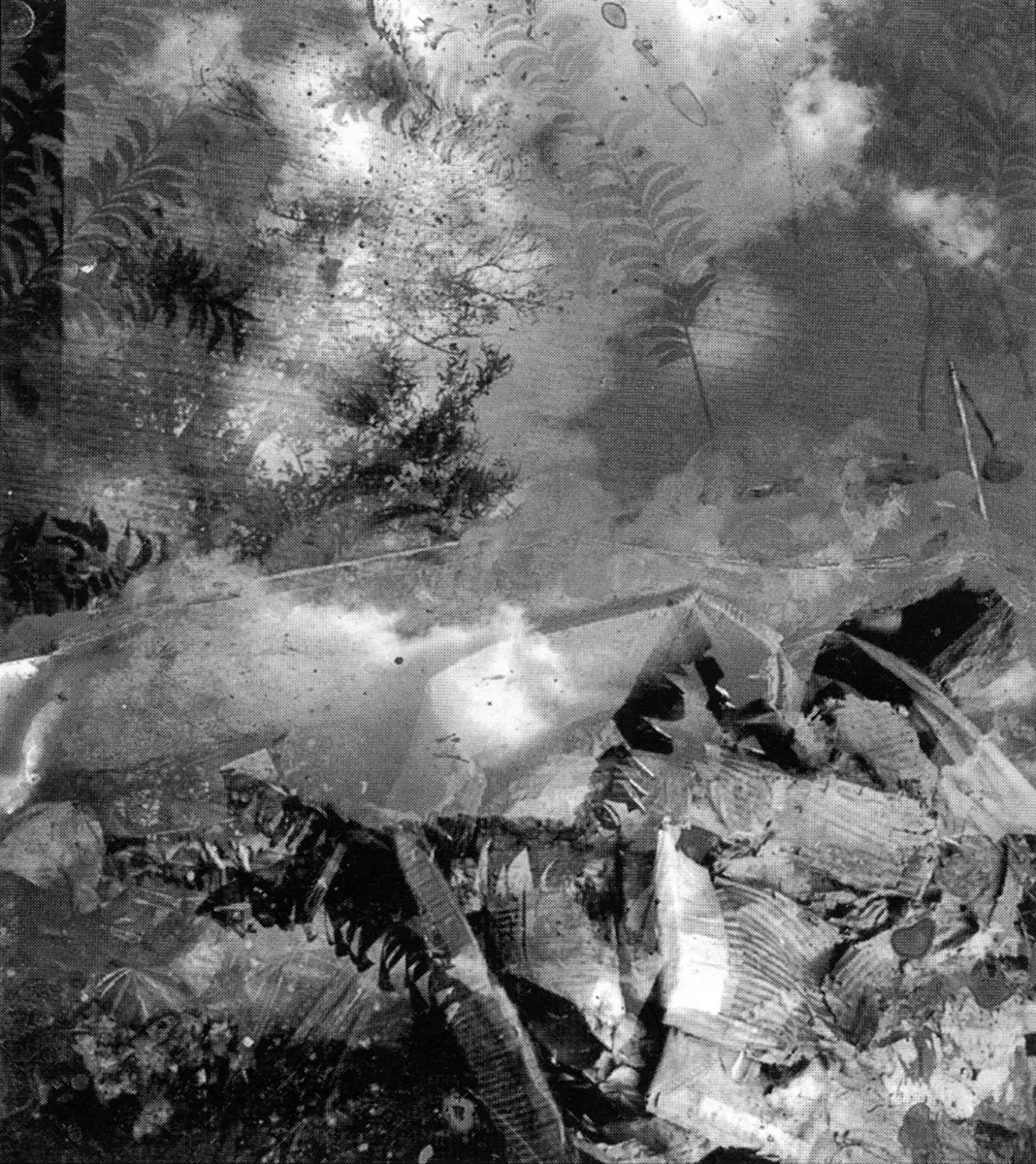
Suárez’s paintings and his digital images share a will to experiment with multidimensionality. The artist superimposes two or more shots in a single frame, or accumulates random stains on the piece’s surface such as those produced by humidity or the passage of time. His dexterity, in all cases, is the same.
Suárez is a virtuoso who goes beyond technology’s power to beguile and bewilder. He wants to appropriate new technologies in order to produce meaning that answers to his personal motivations. At a time when it has become an all-too-widespread fashion (like installation or large-format painting not so long ago, at the beginning of the 1980s), this is indeed the only way to legitimize the use of computer technology in the arts.
The show reviewed here is part of a project for which Suárez received a Fellowship for Artistic Creation from Fundaci6n Antorchas.
ELENA OLIVERAS