
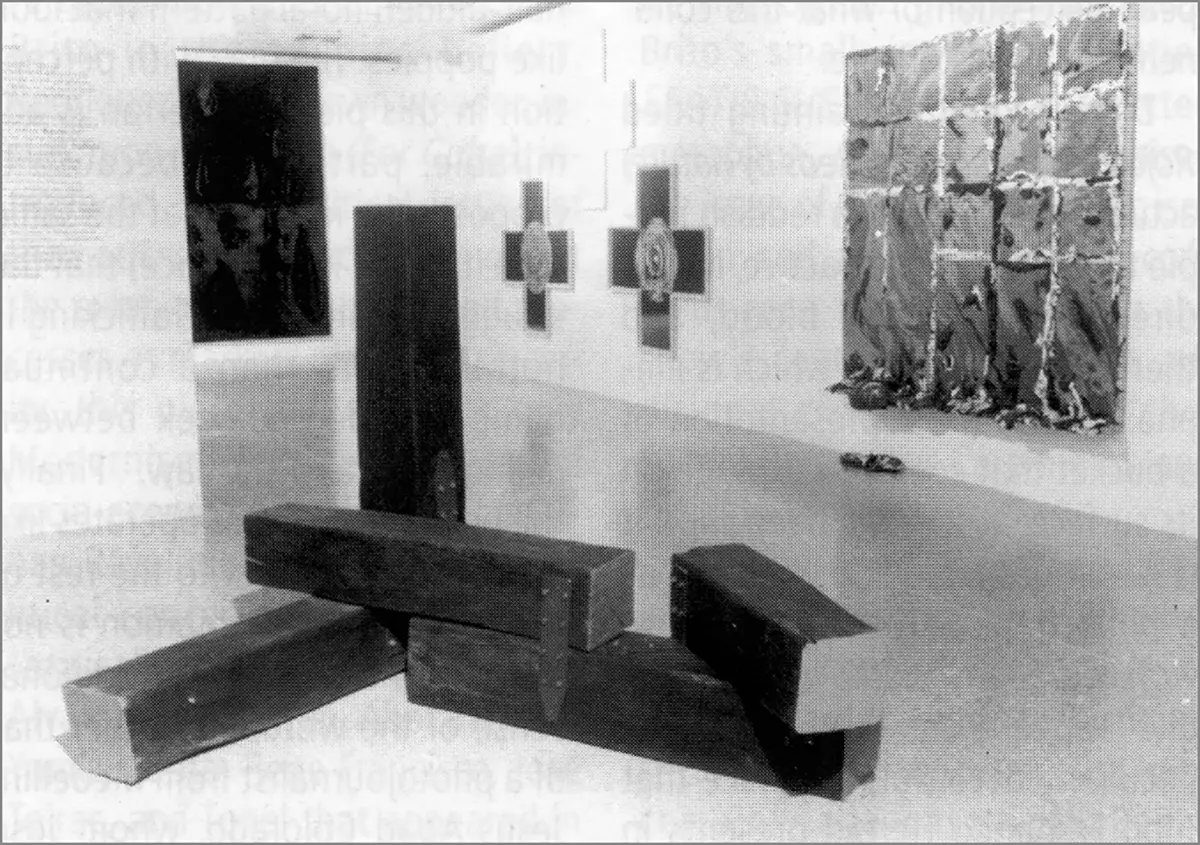
Once again, at the Art Museum of Maracay, the well-attended Salón de Aragua is taking place. Its concourse concerns the new promotions and artists of the intermediate generation. The entire museum is occupied by works of diverse disciplines, and a sense of installation and developments in museographical space imposes itself.
Even on the day of the opening, an artist, actor, or viewer (who knows?) walked among the large attendance with his face covered and a cord around his neck, representing the hanging of culture as a dramatic situation that is lived out in Venezuela when the central government decides not to deposit the corresponding budgets into the provinces, in order to force them to comply with one single political line. In this way, governments, and especially cultural activity, are paralyzed.
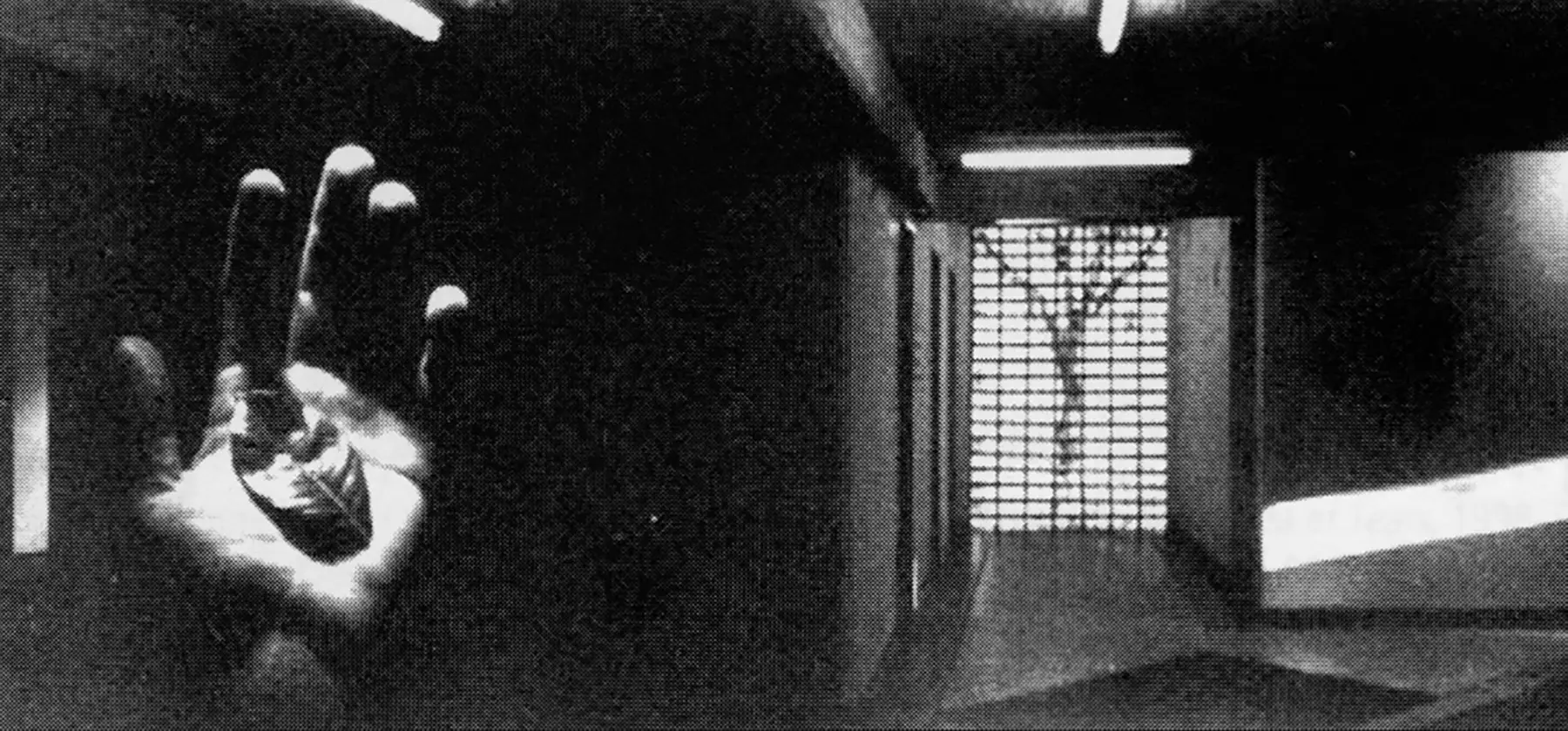
So it is that the organizers of the Salón de Aragua have had to manage in order to get the resources that would allow them to mount a new group show. This year’s winner was photographer Antolín Sánchez; other participating photographers in Aragua include Enrique Hernández d’Jesús, Alexis Pérez Luna, Antonio Briceño, and Ricardo Mariño.
Antolín Sánchez uses the city as his theme, its contrasts, and urban situations. On this occasion, he meditates on the rays of light in a basement/parking lot, in a composition where black is a factor that is dynamic, flat, and profound, all at the same time.
In a simple fashion, Eduardo Molina draws some figures that begin to be emblematic of his plastic phrasing. He does this on glass, lamps so that when he turns them on, both the motif and the color reach another dimension.
Jaime Moroldo sustains his exploration on the face and a painting that comes from the depths, from darkness. Ernesto León surprises us with a large canvas on which he has created a totally free and monochromatic composition. The sculpture Gaudi Esté shows an enormous, seated figure in the man/animal metamorphosis. On the very walls of the museum, Roberto Echeto draws a comic-strip-like series titled La celulitis no se quita con nada (Nothing removes cellulite), a message and a story that is rounded out by the following ending: y las estrías tampoco (or stretch marks). Among his drawings, we also find a baseball player through which he may be alluding to the President of the Republic, who so often appears playing ball on television.
Carola Bravo works coordinates, cartographies, and other imaginary boundaries throughout the floor and the walls, in stone, paper, and strings. Mercedes Elena González occupies a large space in which she develops an ambitious project: a vision of the cosmos, of the micro and the macro. Maria Teresa Torrás combines elements like flowers in metal structures, always clean in their making and repertoire. Antonio Marcano puts white spots on a white wall, thus creating one of the simplest and most complex works of the exhibition and a very rich beginning of his career.
Elio Caldera is an etcher who brings the result to three-dimensional levels. In his series of plastic columns, he never loses the notion of plane, of graphics, of multiple, but each time it is more “volume” and installation.
Solange Núñez is another young artist interested in accumulation, the manual, and the manufactured. Her work is ironic and occasionally alludes to the politicians currently in power in Venezuela.
Mariana Monteagudo connects little idols in space, while Luis Romero barely mentions the subjects that make up his plastic and conceptual interest. Romero draws in pentimento.
Finally, we mention two painters, Sigfredo Chacón and Teresa Gabaldón, two prominent authors whose presence among the young exhibitors was stimulating. Both transmit energy, dimension of material, large formats, and the persistence of painting on the boundary of the representative.
JUAN CARLOS PALENZUELA