
The last retrospective of Brazilian photographer Sebastião Salgado, installed in Paris since 1974, had a considerable public impact. Called The hand of man, the exhibition of one of the photographer’s most important was presented in the French capital in 1993 at the National Center of Photography. Dedicated to the artisanal and industrial activities that the work of man implies, the exhibition showed a man in diverse situations and in the four corners of the planet with his determination, inventiveness, imagination, and hopelessness. But he was also subjected to exploitation and alienated by poverty and misery.
The exhibition at the European House of Photography in Paris is presented in conjunction with Salgado’s production house (Amazonas Images), and its importance is similar to the preceding one on account of its size and the nature of the selected theme: 300 photographs that cover 40 countries. All the rooms are dedicated to the work of the photographer and the problem tackled by the exoduses of populations concerns all regions where these modern tragedies make and unmake the fragile balance of cultures and economies in which man is both craftsman and prisoner, master, and victim. Salgado has traveled the world as an appropriate, sensible, and stubborn visual witness, having produced this photographic work with the appearance of an exhaustive journalistic investigation whose realization has taken him nearly six years.
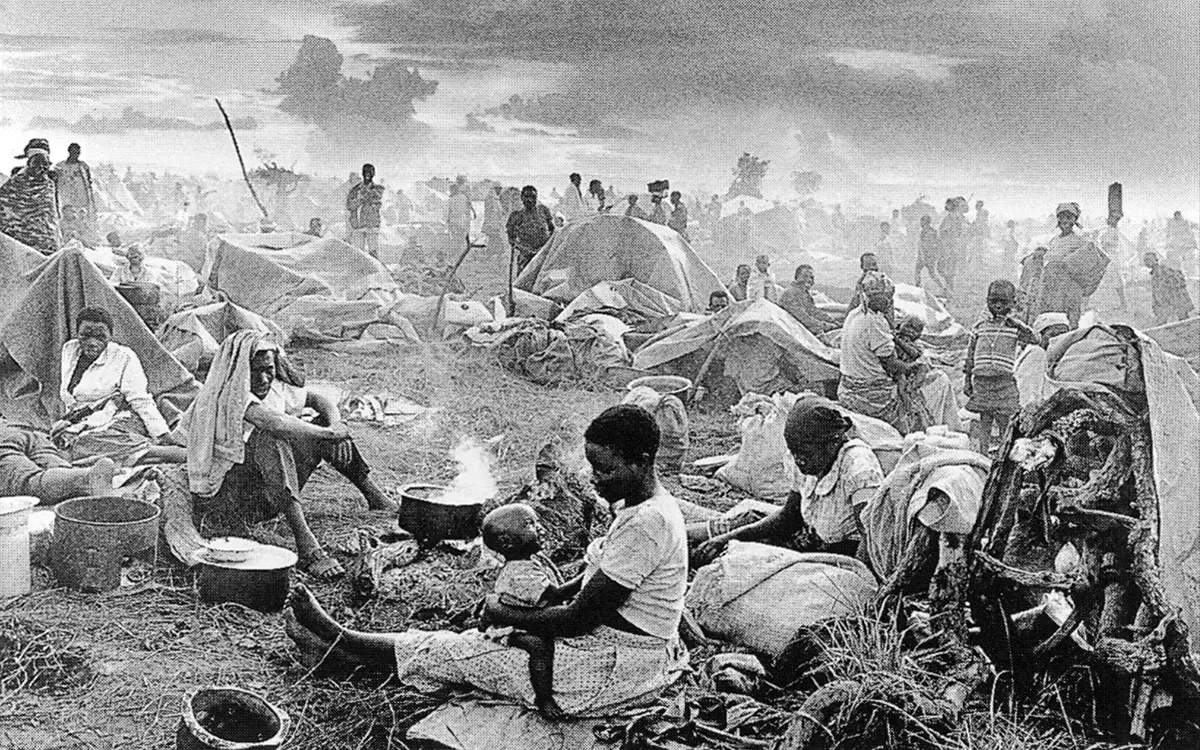
Both for the viewer and for the photographer, two levels of reading are not necessarily confused, and they are superimposed. That of the severity of the testimony, of the brute reception of the reality of the facts, of the recognition of situations that are sometimes unbearable, of the awareness of existence. The level of knowledge, of learning, of truth, and of wisdom is that of an inexorable confrontation with facts, transcended by its dimension of timelessness. But in the face of this reality, there is a distance that the photographer (often reworked by Salgado) creates, like an aesthetic instrument of mediation As outlined by Christian Caujolle, sometimes the beauty of the photographs is disturbing, although Salgado may wish to reconcile aesthetics and information, aesthetic and political commitment. The perception or profound feeling that he contemplates is weakened through this impregnating intervention on form, and thought can give priority to emotion over reason. Therefore, a duality exists here that can sometimes appear shocking in the nature of these photographs, whose aesthetic beauty (second level) can smash the veracity and authenticity of the contents.
Even if it is sure that form can also produce meaning, what is outlined here is the problem of form and content, of this subtle, yet major border on which journalism photography is placed, and where it acquires its meaning which finds the limits of its significance. Naturally, the talent and technical quality of Sebastião Salgado’s photographs are at the service of a gaze that thinks, as Marguerite Yourcenar has written. And here lies its essence. But it does not impede a paradox from filtering into the commitment of a mediator who is genuinely possessed by a humanist feeling.
It seems inevitable to ask about the need for an inventory of human tragedies, aestheticizing them in order to propose them to the viewer’s gaze. Since this option is imposed, it ought to be explained. Sebastião Salgado is not a sociologist or anthropologist. He attempts to be a critical witness who goes out of his neutrality in order to propose his vision of exodus to us. Salgado’s gaze is in no way miserabilist, nor does he attempt to underscore the shocking image or highlight the unbearable. He proposes his criteria for reading the world. It is a very personal vision in which we observe a certain vision stripped of some very aesthetic or overly plastic situations: the photographed scene can take the aspect of a drawing or of an engraving framed by a sort of visual timelessness. Beautiful in spite of the drama, seductive in spite of the horror. Perhaps vain in its implicit demonstration?
It is obvious that such an option outlines problems, even if there are no reservations on the quality and beauty of the clichés. The symbolic option of black and white transcends the image, giving it the epic and timeless spirit that, contradictorily, influences its impact. There is an outdated message in the time since the drama is fixed life and, at the same time, distanced from reality. Salgado bears witness so that we may interrogate ourselves on the taking root of situations, their terrible permanence, and their unbearable repetition. This double apprehension of time turns the photographer into an eyewitness and an analyst a posteriori, superimposing two meanings on his photographs. As been-riches them, he also enriches our gaze.
Therefore, and in spite of the reservations formulated above, an exhibition like this one proves necessary. The almost mythical transfiguration of the image achieves this crash of the spirit and the soul that has many possibilities for installing itself in the deepest part of our being. The discourse of form and meaning that could have failed before such a theme winds up being frightening to our eyes and speaking to our conscience.
CHRISTINE FRÉROT