
Yishai Jusidman (Mexico City, 1963), who before the current exhibition was only known for his painting, gathers under the title of Mutatis Mutandis works that retread the paths of his two latest series, Sumo (1995-1998) and Bajo tratamiento (Under Treatment, 1998-1999), re-reading those series from media other than painting. According to the artist, "the title of the new series indicates the author’s intentions; the expression Mutatis Mutandis compels us to consider the differences between the terms purportedly compared by an analogy."
This time around, eight of the works from Bajo tratamiento are reproduced as digital images on polyester. These works depict the image of mental patients who hold an art book open on a page selected by them and a small card on the side, where the subject of the portrait’s initials along with the name and symptoms of his illness are recorded. The digital version is somewhat larger than the original oil or tempera on wood; the characters are seen within a sort of dark frame, and we get a better view of their rooms.
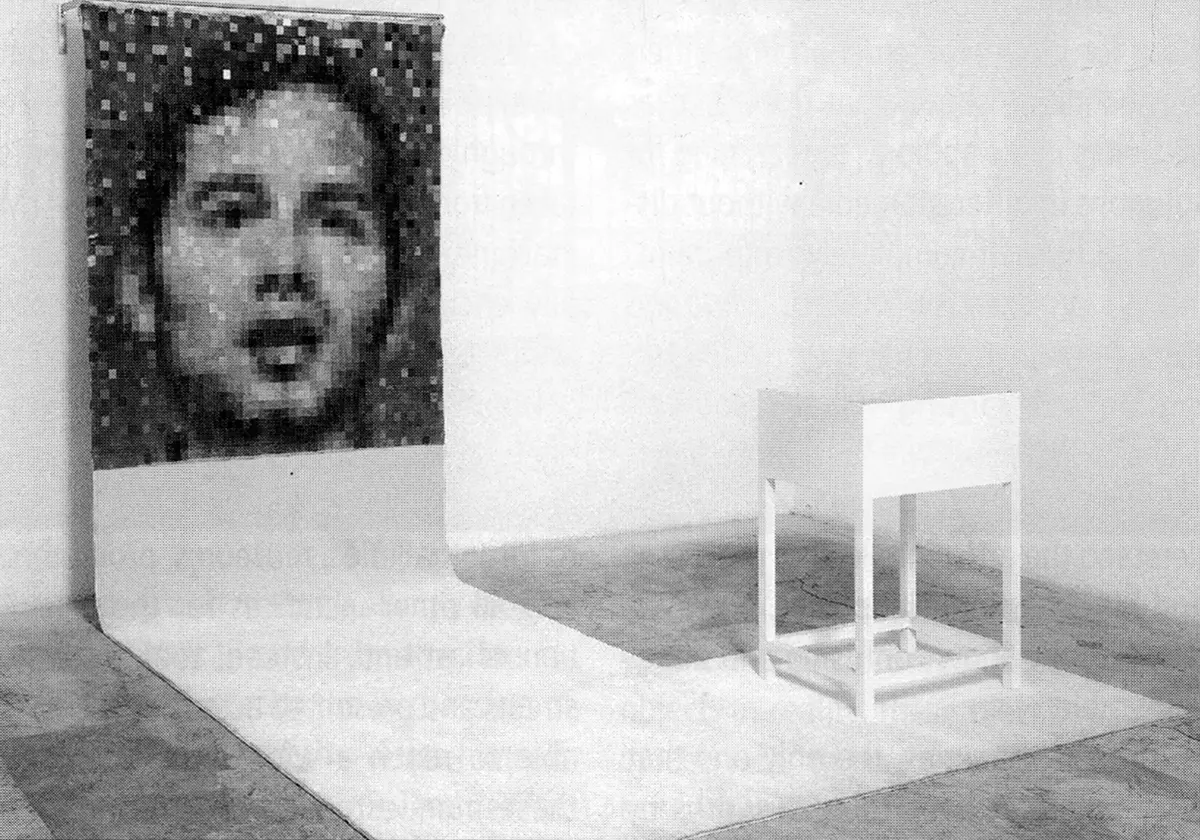
Yet another version of both Bajo tratamiento and Sumo is offered, especially the former, as installations of the patient’s faces in a digitally enlarged format, chromatically broken down into pixels. The images, woven as Gobelins touched up with acrylic paint, carry over to a rug that reaches the floor to form an ”L”, at the tip of which we find, inside a glass case, the book chosen by the subject for the portrait. For the Sumo-inspired pieces, acrylic on paint takes the place of the Gobelin, copying the work in question but eliminating the fighters, to leave only blocks of color that make evident the character’s force in action. In the glass case, we see a digital reproduction of the painting on which the installation is based.
The current show includes another series, formed by three large-format plotter printouts (220 x 150 cm) under the title of Narciso (Narcissus). These images are digital de-compositions of works by Velásquez, de Kooning, and Morandi, unfolded at the bottom to show, like Narcissus, their inverted and slightly stumped reflection.
The text “Brief Apology of relationships and Contrasts”, dated April 2000 and signed by Yishai Jusidman, accompanied the show. There the artist reflects on the place of painting within contemporary art, and wonders “From what point of view, apart from that of the dilettante and the hedonist, can a painting be expected to run its course within the artistic context?” In answering this question, Jusidman leaves painting behind and adopts new media for his work. He writes: "From the opposite extreme, in Mutatis Mutandis the extra pictorial is never physically excluded from the work of art: objective elements and photographic and digital processes included here serve to highlight, by contrast, the pictorial. Contrast is the internal relationship that sustains painting’s formal, descriptive, and operative potential; Mutatis Mutandis attempts to exploit contrast, from its original articulation (between the pictorial and the tactile) to its more complex elaboration (between phenomenon and discourse). "
Jusidman’s (de)construction of his own work for its (re)construction in a different technique shows that the artist, as he writes in his apology, is searching for solutions in different media without distancing himself completely from painting. As an exercise, Mutatis Mutandis deploys many different ways to reinterpret and reuse visual resources. Mutatis Mutandis will help those viewers familiar with the artist’s work to understand the artist intellectual processes and his evolution. Neophytes, however, may find the show confusing and indecipherable.
The Narciso series, the only one that does not refer back to prior works by Jusidman but to art history’s iconic images, posits the same conflicts. From the formal reconstruction, which attempts to inscribe by mere aesthetic reasons those past icons in an era that favors tech no-logical means of production and reproduction, he compels us to reflect on the present place of painting, and to turn our eyes towards in its direction.
FRANCISCA RIVERO-LAKE