
With the support of the Centro de Arte y Comunicación (CAYC), directed by Jorge Glusberg, the Grupo de los Trece (The Group of Thirteen) was created in Buenos Aires in 1971. Four years later, the group, reduced to its original six members —Glusberg, Víctor Grippo, Luis Benedit, Jacques Bedel, Clorindo Testa, and Alfredo Portillos— was renamed Grupo CAYC.
In a trajectory spawning a quarter of a century, the Grupo CAYC gave faith to the heterogeneity and interest of the conceptualist tendency within Argentina. The rewards came early on. Two years after it was created, the group received the Gran Premio Itamaraty at the XIV São Pablo Biennal (1977). Besides this group recognition, Alfredo Portillos (born 1928) has acquired many more individual prizes, among them the recently awarded Premio a la trayectoria, granted by the National Foundation for the Arts.
Portillos’ retrospective, presented at the Fundación Andreani covering fifty years of his production, was the occasion to glance at the thread and originality of his thought. It was a careful selection of the works, which were displayed in this institution’s generous space.
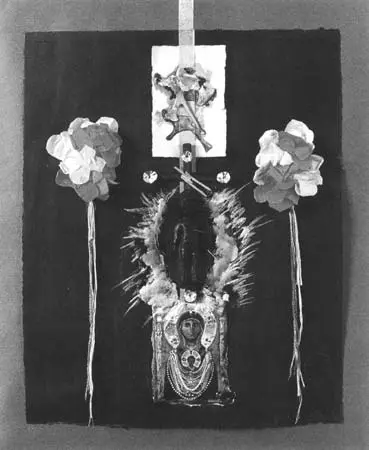
Revealing the biographic web feeding Portillo’s work, the show began with objects and photographs documenting his personal and family life. Next, in chronological order, were the paintings from the 40s and 50s representing wakes, funerals, and burials from cities in the countryside. Parts of these works were made in the province of Tucumán.
Even though he was born in Buenos Aires, Portillos was more interested in the country’s interior than his native cosmopolitan city. That’s why he decided to study at the University of Tucumán and then at La Rioja. There he worked as a teacher and founded the Escuela Superior de Diseño y Técnica Artesanal, of which he became director. His nomadic impulse took him to travel, on a donkey, the Inca Trail and to live in an aboriginal commune in the Amazons.
"Contrary to the mestizos and the sons of Spaniards, who never participated in indigenous rituals, I gave myself to the ceremonies of this people, explains the artist, I broke off with the European structure, I severed the umbilical cord and accepted the magical element of Pachamama, the Mother Earth. As an Euroamerican, I gave thanks to Pachamama for having received me in her bosom. And when I severed the umbilical cord with Europe, I began to feel Latin America free of grudges."
The Latin American mark is a central motivation in Portillos’ work, proved by series such as Vudú a los conquistadors latinoamericanos (Voodoo to Latin American Conquerors) or La segunda Conquista (The Second Conquest), and performances such as A la búsqueda de nuestra historia latinoamericana (In Search of Our Latin American History) or Homenaje a los santos y mártires latinoamericanos (Homage to Latin American Saints and Martyrs).
Aside from his Latin American in situ experiences, a decisive moment in his career was his entrance, in the early 70s, to the Grupo de los Trece. This led to a theoretical consolidation of his critical and anthropological conceptualism. The ritual ceremonies followed soon thereafter, many of which included the spectator’s physical participation. One of them was selected for the Grupo CAYC’s presentation at the XIV São Paulo Biennal. It consisted of an ecumenical space in which the major religions of the American continent were brought together: Catholicism, Judaism, Protestantism, and Candomblé. A priest, a rabbi, a pastor, and a mae de santo held services before the spectators.
With the exception of his passages through abstraction, in the mid-50s, through luminous art in the 60s, and the playful activation of visual and sound gadgets such as the see-saws of the 70s, the almost totality of Portillos’ works hinges around the theme of death as source of life. That’s why De La Muerte A La Vida (From Death to Life) was the title chosen for this retrospective. Everything he does demonstrates his obsession for that universal theme—from the early paintings of the 40s and 50s, which had a innocent and colorful gaze, up to this last installation, in which he participates in his own wake, representing his own death before a video camera.
We could safely conclude that the Latin American paradigm and the positive idea of death are the two pillars supporting Portillos’ artistic production. Placed at the edge of that which is “artistically correct,” he has no qualms about speaking, with a lively voice, of that which does not speak: his own effacement. From there, his discourse might result as inadequate as the materials chosen: bones, mummies, urns, altars—even a dead pig enclosed in a fish tank.
With the passing of time, his gaze has undoubtedly become less complacent, as if he wants to shake the spectator or pull him out from his habitual somnolence. That’s why he conceives extreme actions, such as those in which he represents his own death, or the one started in the mid 90s, in which he tattoos pieces of his own skin with designs made by other artists. The idea is that after his death, these fragments can be sold in benefit of UNICEF or the fight against AIDS.
That Portillos has a particular relationship with death is beyond doubt. He doesn’t fear it; he draws near it, exorcises it, tries to turn it into something familiar. And all this, for what reason? We can imagine that this neologist—as he defines himself—interested in the investigation of new consciousness and languages (materialized in photography, objects, performances, installation, appropriation, mail-art, or the artist’s book), is telling us—no, yelling at us—that up to the present, life, dominated by everyday acts of egotism, has not allowed men to communicate among themselves. Maybe a new and deep spiritualized conscience will do it: one that, in effect, unites us all, whether we like it or not.
ELENA OLIVERAS