
After three presentations in ARCO with Galería OMR (1995, 1998, and 2000), Alonso Mateo opens his first solo show in Madrid, perhaps the most natural context for his collection of courtly paintings inspired by HOLA! magazine, the bible of Spain’s rosy press.
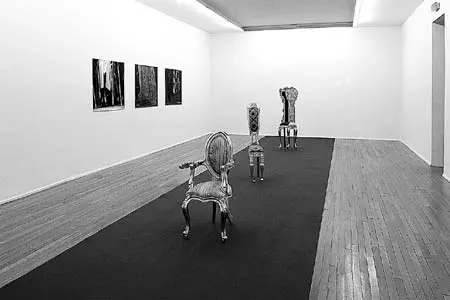
The show, which includes portraits of illustrious characters from European nobility, images of royal jewelry collections, and a brief installation of furniture, maintains the ambiguous intentionality found throughout Mateo’s works. Seen in this city, it even heightens the uneasiness they incite. The show’s assembly has a lot to do with it. A red carpet unrolls in the gallery’s main hall. On it march three malformed golden chairs surrounded by paintings and photographs. In the show’s catalog, Santiago Sierra interprets these pieces as a metaphor for the endogamy inherent in the noble classes of all times. Besides the fact that such interpretations coincide with the artist’s intentions, it’s true that they suggest a posture too tight to be comfortable, and this must be understood literally as well as metaphorically: they are objects retaining an assumed elegance and beauty, but they also demand a discomfort a bit too difficult to withstand. From there the chairs can give the clue to the reading proposed by the portraits depicting a nobility that has always been so uptight, so high-brow, and so compressed, that it runs the risk of becoming flat and transparent. Alonso Mateo’s court is incorporeal; it’s a court that exists only on the planimetry of the printed photograph.
The show’s main dish can be found in the gallery’s basement. It’s a space full of columns, gloomily illuminated, where the bigger (in reach and size) royal portraits have been hung at the level of the average spectator’s head, without frames and with an inclination of 45° or more. A scale model of what could become a twenty-first-century Escorial palace.
All that is found here is solemnity and protocol, including the careful descriptions of the pieces. It matters little that these portraits derive from the candid photos shot by HOLA! photographers. Their restitution to a more traditional pictorial language appears—but only just so—to return the sitters the dignity that mass-media photography has stolen from them. Paradoxically, the sitters, elongated to the point of deformity—albeit a deformity leaning more toward stylization than monstrosity—return to that timeless, spaceless place belonging to what shall remain eternal. Indeed, through their permanence in the medium, Mateo’s sitters have recovered their iconic value. It’s worthy of notice that he erases the contextual and ephemeral details found in the photographs, and paints his sitters floating in that nonplace belonging to icons or specters. The texts are taken directly from HOLA! Captions seem to return some reference to the sitters, and more than once Alonso Mateo has used them with an ironic twist, but they simultaneously appear simply as identification tags.
Amidst so much protocol, this time around Mateo gives us a refreshing breath: a series of medium-format digital impressions providing a glance at the solemnly painted sitters’ feet. A shoe softly tapping to the rhythm of the music, an uncertain step, a pair of small feet shooed with oriental delicacy hiding and crossing timidly —details through which Alonso Mateo recovers what is human in his works. Perhaps that’s the meaning of that golden, somewhat crooked leg, a bit imperfect, but by the same token a little more lovable.
ISSA MARÍA BENÍTEZ DUEÑAS