
Anthony Aziz and Sammy Cucher take the photographic image through a process of digital manipulation that alters the relation of homology between the model and its representation. Beyond the reflection of a fluid reality, these artists deal with the conflicts facing the contemporary subject; in particular, those related to the configuration of an idea of itself and its fellow-subjects’ selves. Thus, the photographic register’s efficacy does not depend on its mechanical fidelity, but on its power to articulate a reflection anchored on the creative experience itself.
In their Series 96:00 exhibition, held at the Alejandro Otero Museum between August 20 and November 12, Aziz+Cucher focuses their attention on the discourse of the body as a relational model. Curated by Ruth Auerbach, the show comprises the Interiores, Plasmorphica (Interiors, Plamorphica), and Quimeras (Chimeras) series, which propose different ways to approach the image of the body. Three distinct but complementary vectors converge there: identity, space, and the object. The vessel for this convergence is the skin, deprived of its anatomical support, and devoid of any singularizing mark or any trace of ego-centered intentionality. It is a formulation that reflects upon the fading of the self and its transfiguration into an epidermal magma. Such metamorphosis brings the individual back into anonymity, into a purely exterioristic, bodily existence.
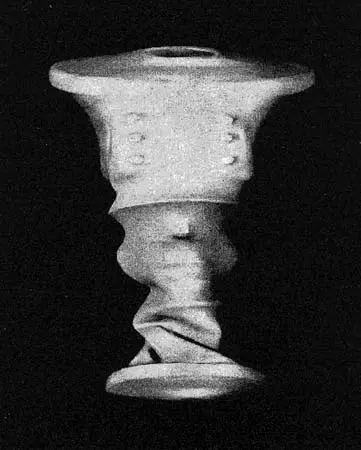
The relationship between identity and the body develops from the historical fracture suffered by the naturalistic mimesis. There was a time when physiognomy sufficed to make “the movements of the soul” recognizable. The body was emotion’s “natural” vehicle. Gestures were the external manifestation of subjectivity. In Aziz+Cucher’s photography, however, all that is gone. The body has lost its borders, its face, and its gender, and it is exempt from the extreme impulses that used to inhabit it. There are no distinguishing or identifying elements to tell one individual apart from another, either. There is only the skin, cold and distant, to show the contemporary subject’s ontological emptiness. In this fashion, the soft barrenness of the naked flesh points towards an identity without referent.
Body and space, as established by phenomenological thinking, form a pragmatic system that responds to the principle of continuity. The skin, sentient and configuring matter, represents that limit or contact zone between subjectivity and the external word. Aziz+Cucher takes advantage of this quality as a structural device for the demarcation of intimate spaces. The Interiores series opens a space where the skin becomes a wall, “embodying” the harshness of the private world, and also its shadows and its resplendence. There is something alien but also something recognizable in those passageways and rooms built with human clay.
The Plasmorphica and Quimera series, on their part, foretells the advent of a post-human stage, where the body suffers a definitive transformation. There, objects take the place of the individual and dress with the individual’s skin. There’s nobody behind that soft appearance; there are only strangely sensual artifacts. It is an inverted narcissism, the advent of which implies the death of the subject and the rise of the machine as its substitute image.
Beyond their existential and symbolic implications, the pieces gathered for this
show come to us enveloped in an atmosphere of deceiving serenity. Chance and emotion have been excluded; sobriety and the economy of resources prevail.
Aziz+Cucher has taken the protagonism of the skin to a hyper-real level, avoiding superfluous detail or flashy solutions. In that sense, it can be said that the expressive force of Series 96:00 resides in its
visual sophistication and great conceptual purity.
FÉLIX SUAZO