
More than a century ago, the Peugeot family brought fame to Montbéliard, a small city in eastern France, when they built their automobile factories there. Today, the city sits at the crossroads between great art centers such as Basel, Strasbourg, and Frankfurt. Unfortunately, the rich dynasty of entrepreneurs wasn’t interested in art, confirming the poor relationship between French collecting and private capital—at least before the recent boom of prestigious or annexed foundations such as Cartier or Pinault, or the lesser-known but no less active institutions such as the Coprim Foundation (real estate) or EDF (French Electrical).
In 1997, the Regional Center for Contemporary Art, known as El 19, opened the doors to the current creation of what it was an old garage at the end of the XIX century. Under the direction of Philippe Cyroulnik, who is known for his interest in art from the Plata River, the Center holds several yearly exhibitions in collaboration with other public and private institutions (five at the Center, three or four abroad). The exhibition Buenos Aires In & Out has benefited from the outside collaboration between the Galería Ruth Benzacar and the Fundación Antorcha, both in Buenos Aires. From title to concept, the idea pretends to be clear: showcase a group of Argentine artists chosen both in Paris and Buenos Aires, and integrate them into a clearly specified cultural center. The exhibition exploits space in the function of “families,” placing the big canvases at comfortable distances between one another and setting the installations in enclosed spaces. Each artist presents three or four pieces, which gives a good, diverse sense of young Argentine creators, and achieves a balance between representation, abstraction, neo-pop, and kinetic art.
Nevertheless, the selection made in Paris could have been broader. The inclusion of artists such as Marcela Gómez, Ruth Gurvich, or Leandro Berra could have enriched the French selection. Two “Parisian” artists were invited: Octavio Blasi, who showed pieces known from the early ‘90s (which are part of his satirical series on the art market), although today he’s embarked on a new constructive, minimalist spirit which is in complete opposition with his first critical-figurative style. He recently showed this new series in the Ivry Center for Contemporary Art, and it would have been interesting to see it here. Martín Reyna was also invited. His work is about the dilution and sliding of matter, about the faintness of form and color, between transparency and opacity (three large-format pieces from 1998 and 2000), expressing the atmosphere of the gestual matierismo that he’s been searching for some years now.
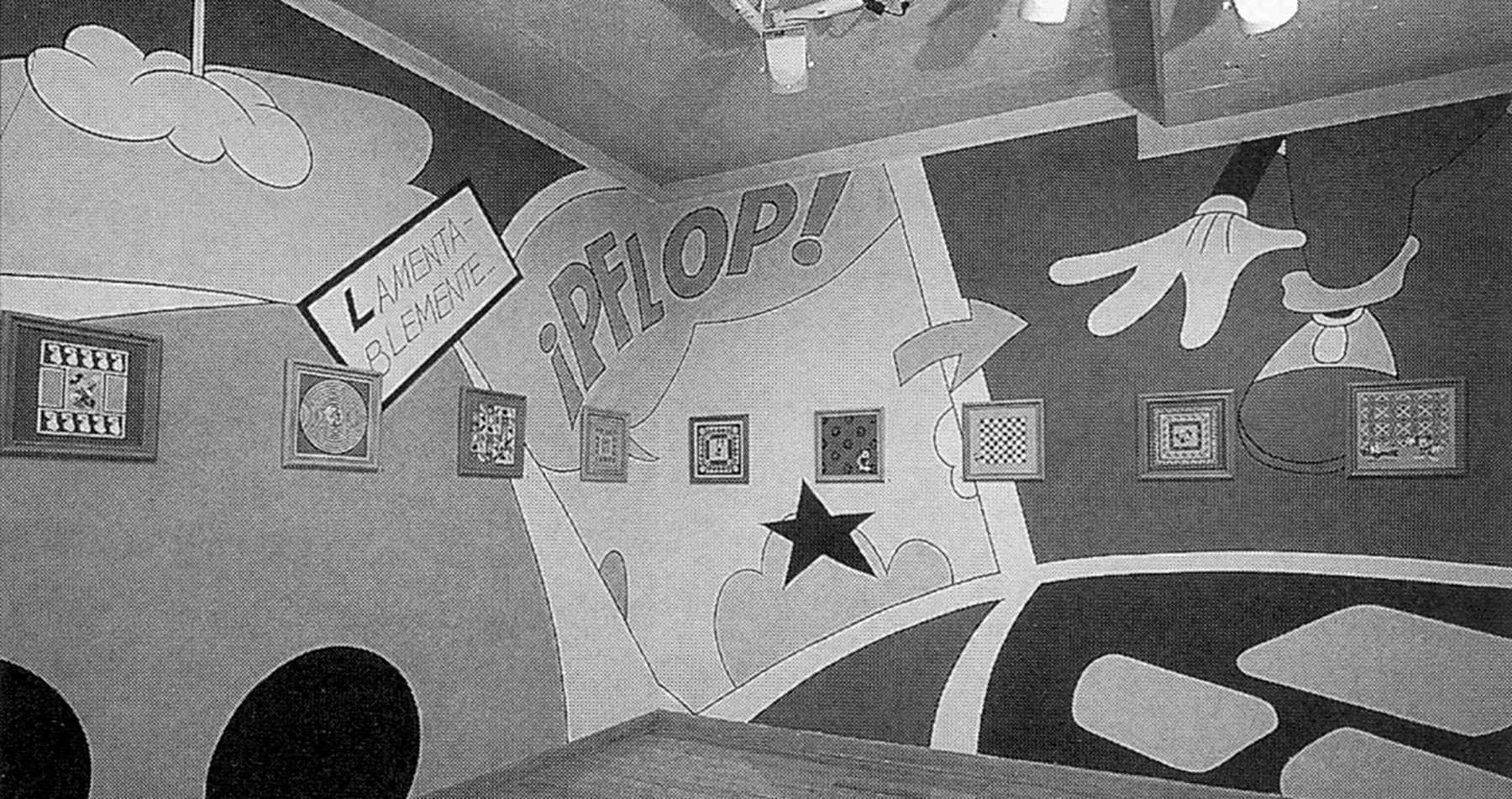
Argentina was represented by five artists: Rosana Fuertes, Pablo Siquier, Carolina Antoniadis, Fabián Burgos, and Daniel Ontiveros, who formed a personalized and diverse group. Rosana Fuertes had an entire hall to present an installation in which, with irony and humor, she makes reference to Argentina’s contemporary political history and its politicians.
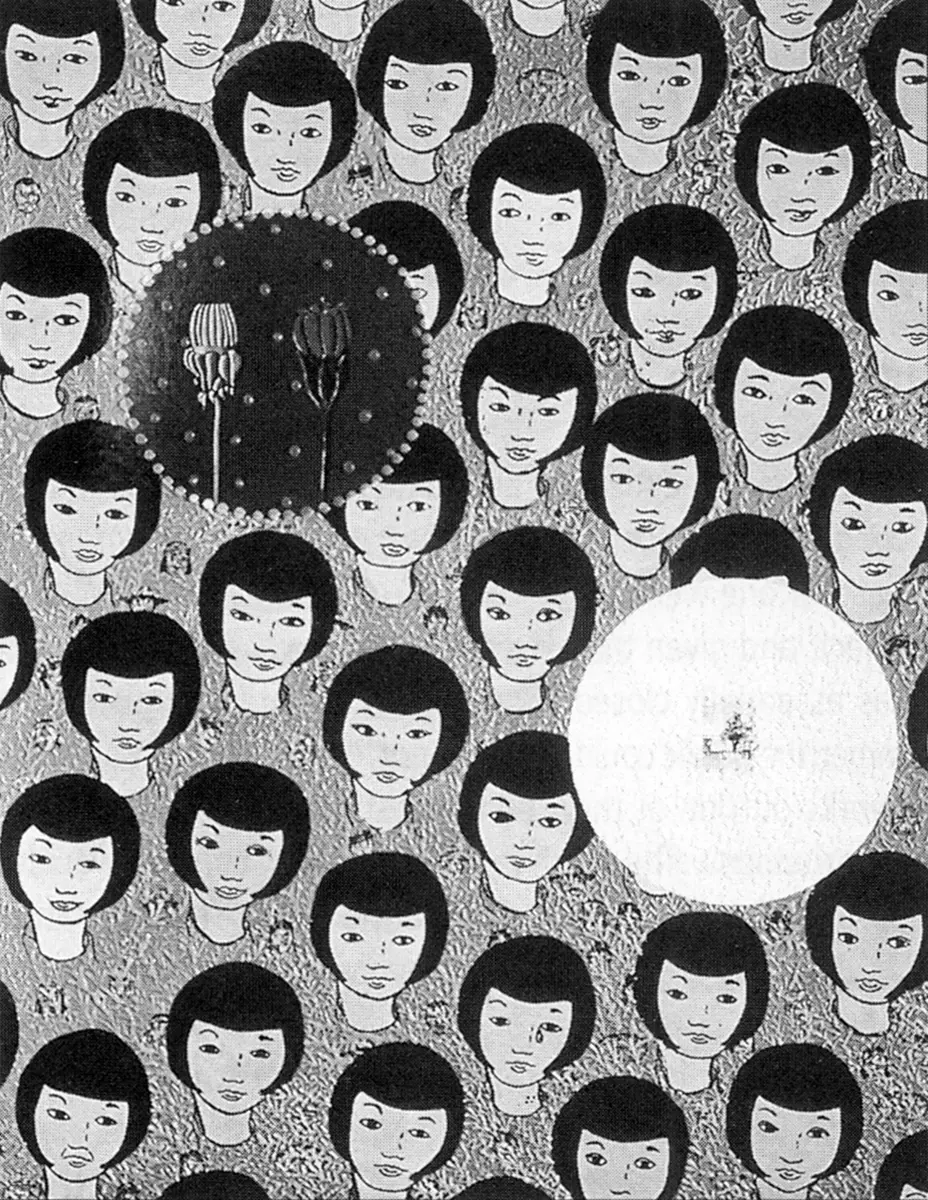
With this in mind, she used Miguelito —a character from Mafalda, the famous comic strip—and Mickey Mouse to question convincingly her country’s politics. It is a work that uses the comic book as a referential concept, combining images and text, with quotes by Argentine writers and politicians but it also belongs to painting, by means of a fresco painted directly over an entire wall. Carolina Antoniadis presented four large-format pieces overlapping times and icons, resorting to the incrustation of images over a narrative background. Making formal references to medieval tapestries or computer circuitry, the elements intervene in her weavings like punctuation marks, to interrogate the imbrications of human work, time, and techniques, with a certain “Baroque preciousness” akin to the work of the Mexican artist Alicia Paz. With the presence of Fabián Burgos and Pablo Siquier, canvas space turned into a game of shadows and lights, but it’s also a pretext for refractions in the rational dominion of science and their constructive logic. Burgos manifests a subtle delicacy in his organized “pointillism” and his geometric “arabesques,” while Siquier organizes spaces in a fragmentary and labyrinthine fashion.
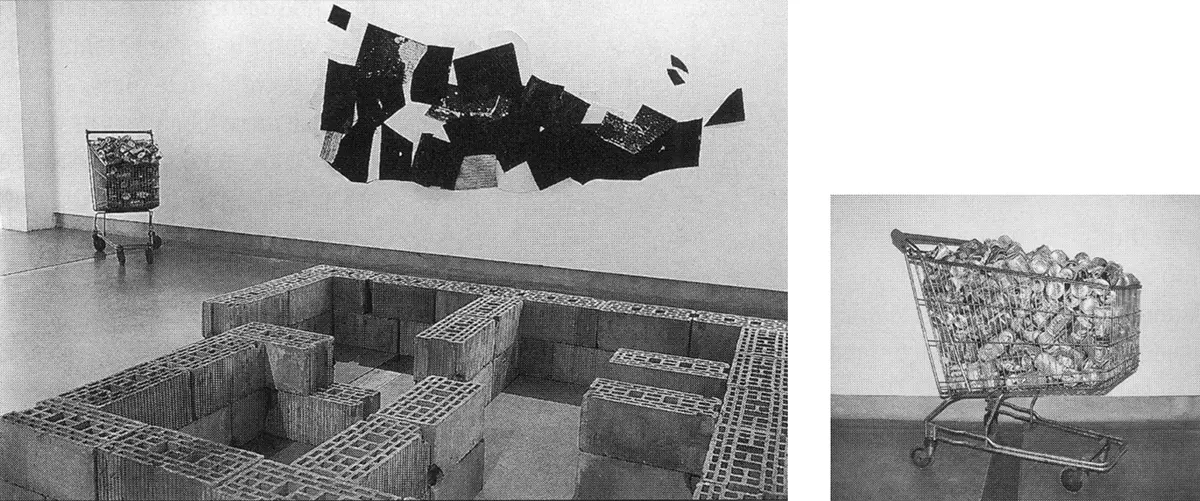
Daniel Ontiveros’ installation Taumaturgia (Thaumaturgy) (2000) is composed of seven “pieces” that speak about the dictatorship, North American domination, and poverty in Argentina. But the group’s most clearly politicized piece could have gained in efficiency and impact if the artist had been a little more concise. In other words, he could’ve achieved a more concentrated and less dispersed display by reducing to the essential redundant elements in his discourse.
When all is said and done, the love for painting still is the most important proof of citizenship for most of these artists, for whom the questioning of society, through quite different media, is still at the core of their conceptual and artistic preoccupations. Their critical sense and ironic spirit—unpredictable and derisive of any artistic, cultural, or social cliché—enrich figures, icons, and images in order to construct personal, open, and mobile aesthetics.
CHRISTINE FRÉROT