
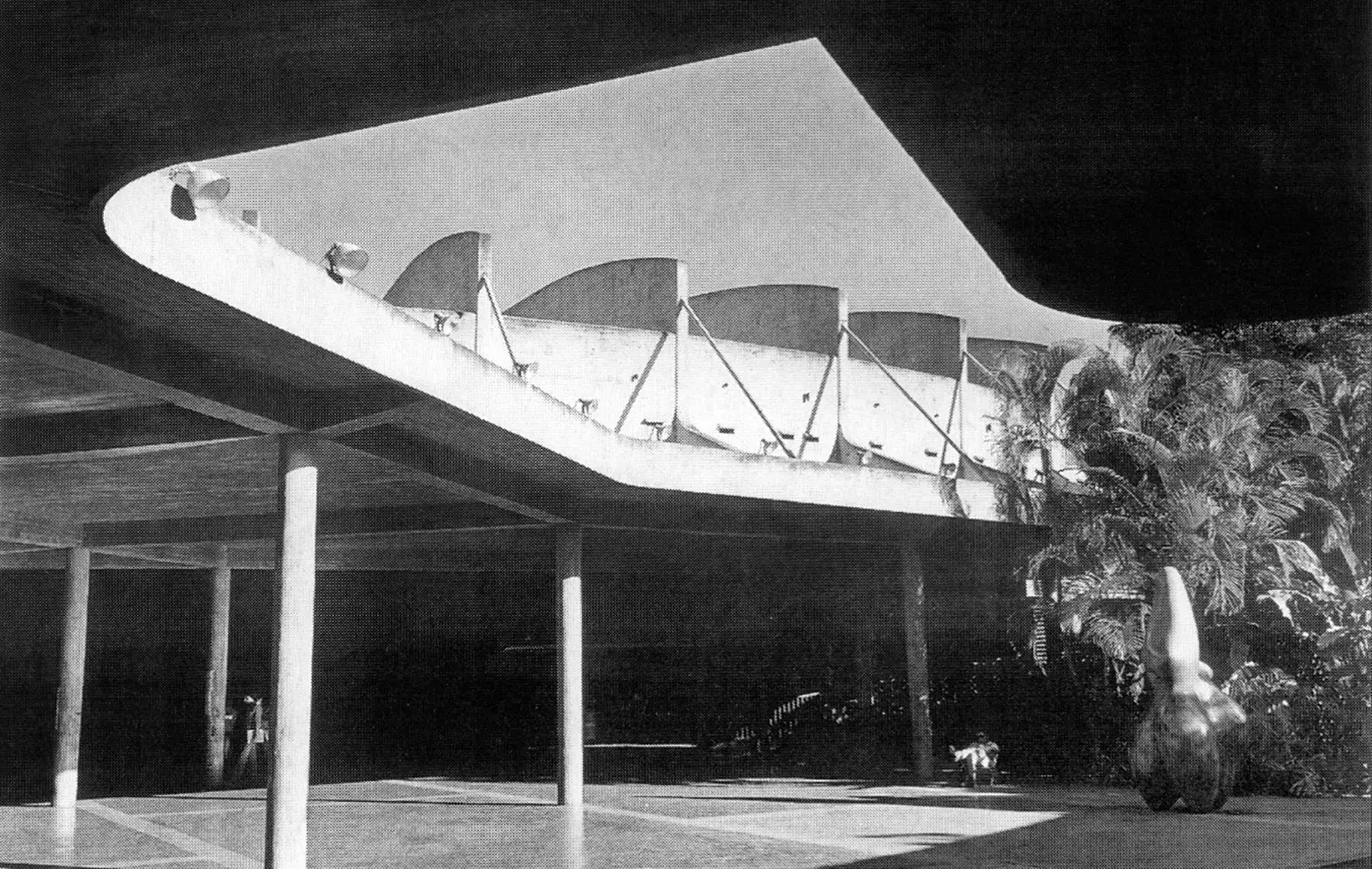
The ‘40s and ‘50s in Venezuela were marked by the definition and beginning of urban and city concepts by a generation of very valuable architects, noteworthy among whom is Carlos Raúl Villanueva (1900-1975), whose work reaches colossal dimensions in the notion of “a space that is fluid, used, enjoyed by men.”
The city of Caracas is marked by the architecture of Villanueva from the museums (1934), the Gran Colombia school (1939), the El Silencio buildings (1941), the multifamily blocks (1954), and the university (built in the ‘50s) as a distinguished group of what the master conceived of as active city planning in the service of man (“the essential invention of space as a privileged place of composition.”) Villanueva’s work has deserved repeated recognition by the students of art and architecture in Venezuela. Of his work, the Ciudad Universitaria of Caracas is the one that commands the most praise. One of the first to concern himself with Villanueva’s university campus was Guillermo Meneses, who wrote an essay in 1957 for the series of works of art found in its squares, gardens, and corridors. “The Caracas of today has in its Ciudad Universitaria the most obvious will to affirm its time: the future that we are beginning to consume. The Ciudad Universitaria is now.” In its circuit, there are original works by Calder, Léger, Lobo, Arp, Pevsner, Laurens, and Vasarely, all original and large-scale pieces (sculptures and mosaic murals).
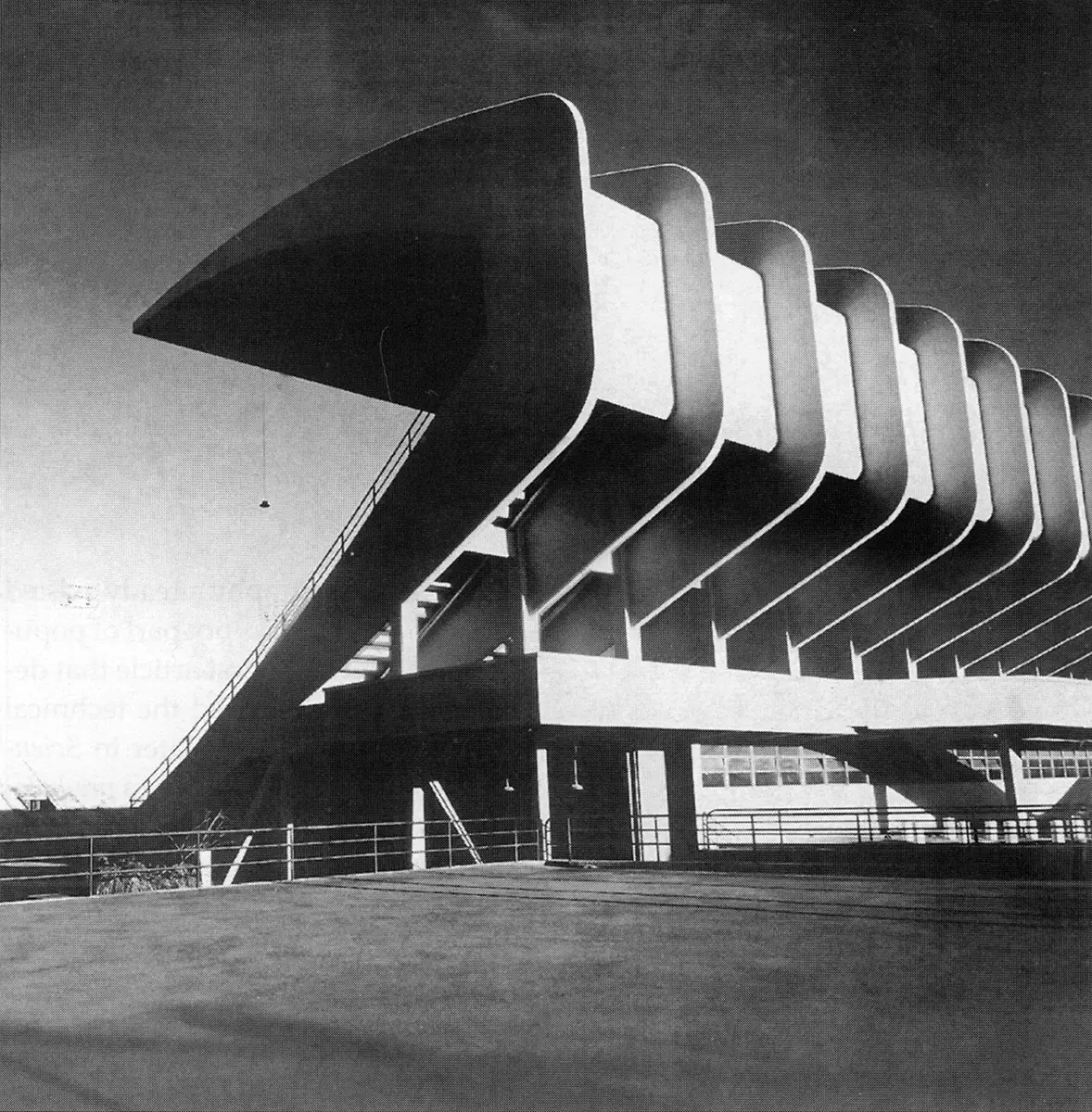
Years later, in 1978, the critic Roberto Guevara published an essay on the current plastic art in Venezuela, “Arte para una nueva escala” (Art for a new scale), in which he valued Villanueva’s visionary and humanist character, and “the fundamental project in the History of Plastic Arts in the country, the new seat of the Universidad Central of Venezuela.”
Thus, as the country has such milestones of modernity as the diverse aspects of Villanueva’s work, it is normal that the museums concern themselves with the study and diffusion of this work. The most recent undertaking, curated by William Niño, was presented at the Galeria de Arte Nacional of Caracas.
Documents of the period, plans, and photographs helped to illustrate the various chapters of Villanueva’s architecture. Some environments, both of his houses and of the aesthetic of the period, were even re-created.
Villanueva’s generation had to face the complex demands of Venezuelan social life, once the long phase of the Gomecista dictatorship ended. It was as if after 1936 they had to invent society. Regarding the work of an architect, it was the moment to resolve the urgency of public housing and housing for the new sectors of the population, at the same time as entire zones of the city were being redeveloped. Villanueva provided El Silencio, a series of blocks from three to six floors, conceived as neighborly, hygienic, and comfortable units. In the center of the buildings, there was a large square where the sculptor Francisco Narváez proposed a double fountain with allegorical figures of Venezuelan folklore, in perfect harmony with the facade, and in the culmination of an artistic chapter, both his and Villanueva’s, on the notions of criollismo.
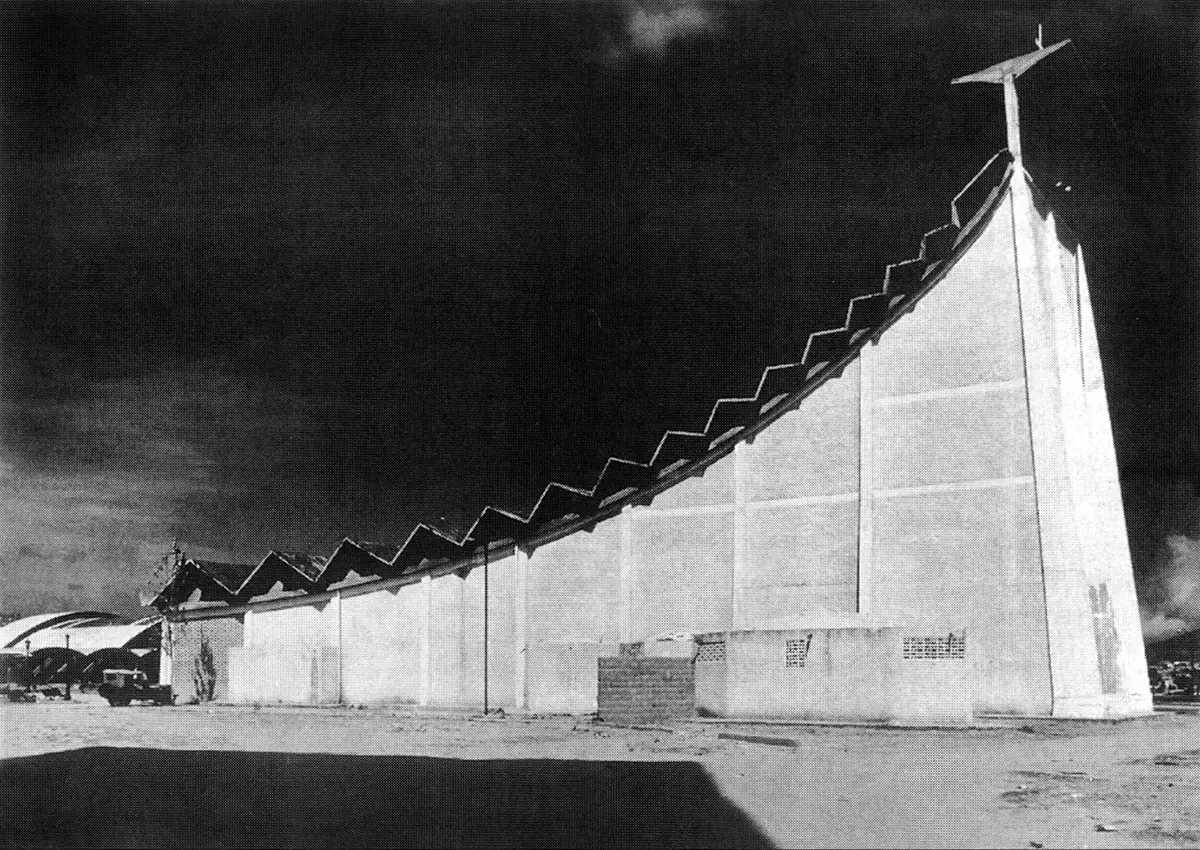
In a neoplasticist thesis that understood very well its inheritance of the Bauhaus legacy—let us recall that the artist studied in Paris, and there he became friends with creators like Calder, Arp, Léger, and Pevsner—Villanueva had an enormous opportunity to develop an urban concept for higher education on 200 hectares. He thus delimited and designed spaces, colleges, schools, studios, libraries, cafeterias, sports areas, hospital areas, the administrative center—the offices of the President, where the Aula Magna was also located, whose ceiling was designed by Calder, and the Central Library, in the lobby of which Léger arranged a stained-glass window that measured six meters high by twelve meters long—and the enormous botanical garden. All of these places would be decorated by young Venezuelan artists who broke into the local context with constructivist art theses, such as Alejandro Otero, Jesús Soto, Víctor Valera, Pascual Navarro, Carlos González Bogen, and Mateo Manaure, among others.
Finishing the project has brought more than the consecration of a creator, for it is the certainty of a period in which the State had specific plans that favored social and cultural development, and even more, the cultural inheritance that defines us.
There is an experimental sense in Villanueva’s work, since it is open to the materials, to the concrete needs of the user, and to the gardens of the tropics. Villanueva’s architecture combines his modern awareness with legacies of the national urban past, and it also occasionally has solutions that are festive, and I would even dare to call them humorous and surprising in the face of their own making. Ultimately, it is an architecture that has not grown old, that maintains its power, its dignity, and its dialogue with the elements, with its surroundings, and with the inhabitants of today and tomorrow.
The Galería de Arte Nacional has published this excellent book by Carlos Raúl Villanueva, a South American modern. With the collaboration of the Consejo Nacional de la Cultura (National Cultural Council) and CANTV and including images by Paolo Gasparini, this book focuses on architecture’s important role in the History of Art. It responds to the public’s needs in the field of architectural studies from a museological perspective. Villanueva’s work represents an essential phase, modernity, in the Venezuelan visual arts of the 20th Century. This book is a collection of analyses of the historical context, descriptions of technical processes, full color as well as black and white photographs, and blueprints and drawings of building projects, which together comprise a beautiful tome and an invaluable reference for those interested in the subject.
JUAN CARLOS PALENZUELA
Art historian, critic, and correspondent for ArtNexus.