
Diego Gravinese’s paintings are dense with stylish information and conflicting intentions; he is an unreliable narrator of a different sort. Are we meant to know his secrets or merely admire his virtuosity? The work mirrors the ambivalence it inspires. Simultaneously languid and intense, his lounging figures are caught in mid-sigh, but they compete anxiously for our attention with postmodern effluvia maps, diagrams, and the odd geometric shape.
The paintings clamor for attention. In his exhibition at De Chiara/Stewart gallery, Gravinese emphasizes bipolar juxtaposition of images which, together with his realist painting style, immediately, uncomfortably (and perhaps unfairly), reminds one of David Salle. Gravinese works as hard at achieving a spectacular effect when thinking up names for his pieces as when he is actually painting, but titles like Sad (The inherent truth in every cliché) leave you more bemused than informed.
Gravinese uses his own snapshots to establish a personal context for the paintings, then balances, or undermines, the chosen image with a seemingly more generic one. The viewer’s first instinct is to accept the dichotomy itself as the subject of the paintings. Identity mediated and defined by mass media, after all, is familiar terrain for many young masters of pastiche. However, this would constitute a misreading of Gravinese, for his true intent seems entirely and intensely personal, almost solipsistic in fact. The visual content of the paintings is drawn directly from the artist’s life: his struggles with women, with drugs and with his mother (not necessarily in that order.)
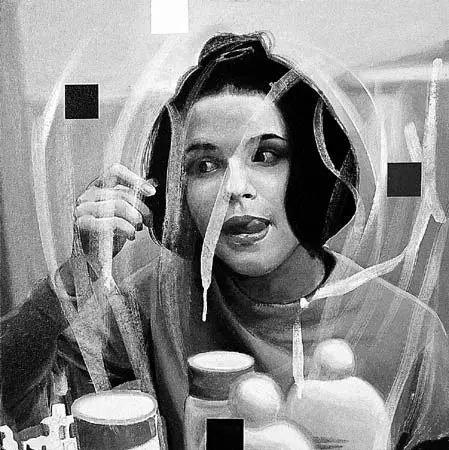
Unfortunately, the pleasure of unpacking Gravinese’s narratives from the paintings is compromised by their very ambition. These look like important paintings, or rather, they look like they wish to be understood as important paintings. As such they address themselves directly to their audience: they look out rather than in. This is a shame because these are really paintings about stewing in one’s own juices—but Gravinese is only beginning to squeeze. The inner meanings that drive the artist are doubly lost to us; lost in the immediate sense, since we cannot negotiate the work to see them, and lost again when we decipher them, for the passion that drives them seems lost in a rebus like riddles.
The good news is that Gravinese, an intelligent and industrious painter as well as an adept and ambitious one, is moving diligently in the right direction. He is jettisoning with startling efficiency the bravura tricks of paint and the dazzling but ultimately empty fusions of pop and personal imagery that characterized his (very popular) first shows. He is toning down the young master act, and is moving towards a more serious consideration of the subject that truly consumes him: Himself, his desires, fears, and hopes. This is not a bad subject, all things considered. It’s almost everybody’s subject, after all, and anyway, it appears Gravinese leads a pretty interesting life.
The overlay of cultural critique gave Gravinese a convenient and appealingly salable platform, but it was a dangerous and distracting temptation, and the artist recognized this. He is now working against the facile appeal of his earlier style by literally if tentatively muddying the waters. He is splattering his paintings with elaborately careless swatches of paint and white splashes—a not-so-subtle reference to cocaine—and is peppering his willfully banal imagery with small arbitrary abstractions intended to bridge the real and the internal worlds. The problem settles as much on the style as on the content of the images. In all of the paintings, an elegant distance separates his subjects from us, and in this, the artist cannot help himself, for his touch is inherently cool. But there is something else here. An artist of integrity is beginning to recognize and challenge himself, beginning to address his true nature. It will be no simple trick for Gravinese to see this evolution through. If he continues to fight the fight he seems to be starting, he is in for a hard time.
A sad paradox faces this artist whose glib brush has quickly earned him no small measure of commercial and critical success. If he is sincere about pursuing the path he has sketched out for himself, he must begin to discard the rhetoric that surrounds his current explorations.
Gravinese’s paintings now flatter their sophisticated admirers with their exquisitely presented insider take on the world. The small, inarticulate cries that are beginning to push through the verbiage may not be so attractive to an ironic and impatient audience. It is to Gravinese’s credit that he still seems dissatisfied.
It will be interesting to see how far he cares to push. As he undoubtedly knows, the stakes are high. He may find himself and lose the world.
MATT FRIEDMAN