The third season of the Five Continents and One City painting salon is underway in Mexico City. This time around, the curators turned to Africa (Olu Oguibe), North America (Gerardo Mosquera), Asia and Oceania (Fumio Nanjo), Europe (Chris Dercon), and Mexico (Victor Zamudio Taylor) for its participants.
The presence of artists who actually live and work within the geographical areas they represent is greater in this year’s salon. Last year there were many participants from big cities, especially New York, selected because of their racial origins, which should have been the main determinant according to the event’s guidelines. But these artists were so cosmopolitan that it marked some of their works, impeding an open interpretation of the mainstream influences on contemporary art.
Some of the representatives this year have not lived in their native countries for some time, but the majority, despite long periods of representation by European and North American galleries, maintain some attachment to their countries of origin.
Africa was represented by Mary Evans and Odili Donald Odita from Nigeria, and Julie Mehretu from Ethiopia. The work of the multifarious Odita stood out in this group. His visually pleasing work reminds us at first glance of the youthful Parisian works of the Venezuelan artist, Carlos Cruz Diez, when he started doing serious chromatic research based on long, crossing, and intertwining lines that formed areas of color. Over the years this type of work formed a school, the fruits of which began to appear towards the end of the 1950’s. In retrospect, artists like Odili have gone beyond mere chromatic investigations to wind up conceptually in a place that places their work into a field of criticism that can sometimes undo apparently stable human relations.
Pieces with titles like Tropicalia, Open, and PAN AM, just to mention a few, appear docile in their coloristic precision. But after looking at them for just a short while, they catch us in their complicated webs of evoked and absent images that reach us through the use of prototypical colors that the subjects with which the artist names his pieces evoke for him.
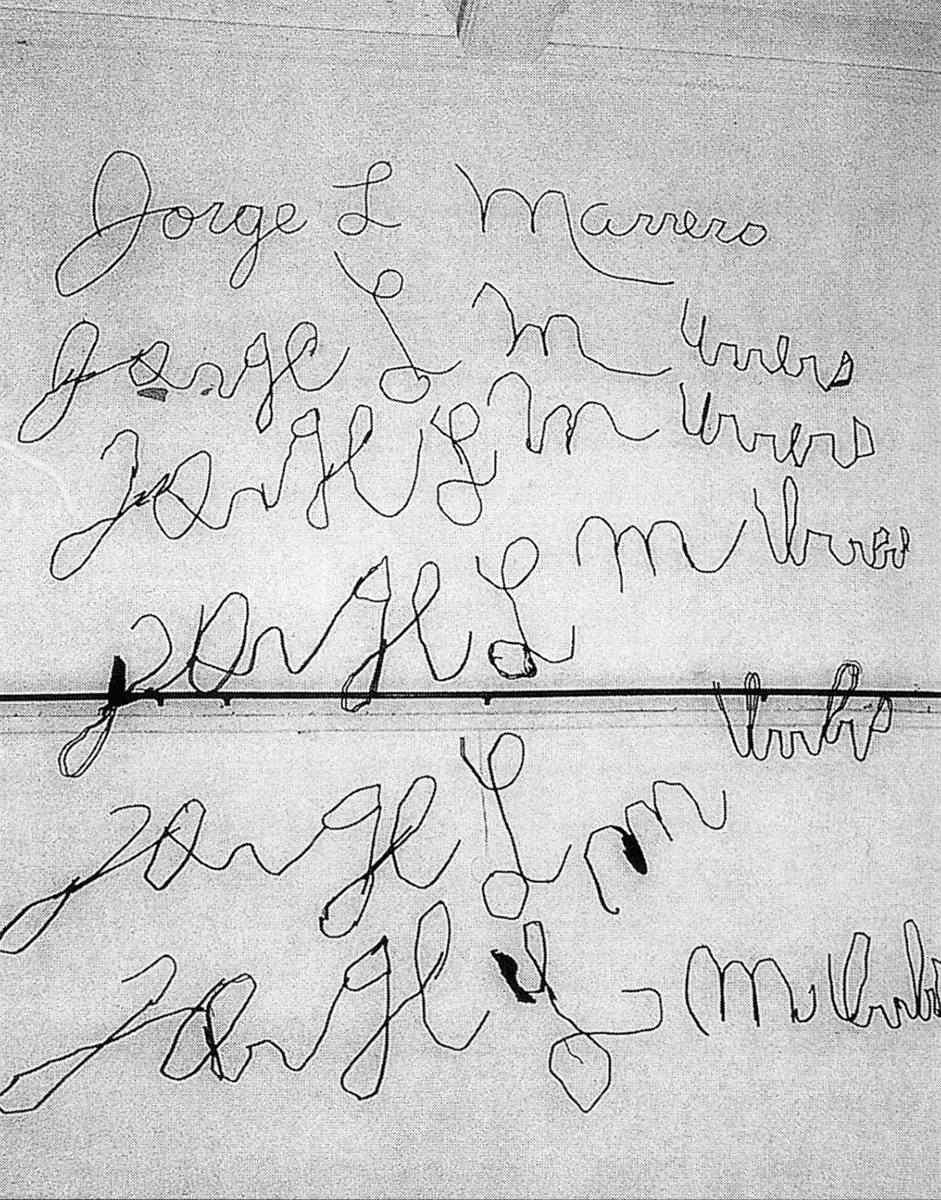
In the American section, two Cubans and a Colombian are in charge of representing the continent. Gerardo Mosquera selected Luis Cruz Azaceta and Jorge Luis Marrero from the West Indian island, and Delcy Morelos from Colombia. Morelos showed impressive pieces from her series, Color Que Soy (Color I Am), that construct large pieces of skin, complete with its coloring, its blood, and its memory in an overpowering chromatic display. She tells the racial history of the American continent from the point of view of the subjects, intelligently contravening that other kind of painting that for so many years reviled and disguised those whose skin tone betrayed their racial origins and their socioeconomic positions in an environment hostile to those not racially the same as the dominant and powerful.
Cruz Azaceta reveals a new phase of his creative output to the Mexican public. Without leaving painting as such aside, he incorporates photographic pieces and various objects that, when placed on the picture plane, lend his work a different compositional language from what is characteristic of his work. Jorge Luis Marrero’s wires, which stood out in this particular group, are direct transportations of drawings, materialized to an almost monumental scale and placed high on the walls of the Museo de la Ciudad. His name is repeated up to six times and gradually loses its shape in Gestalt I; a suspended figure appears in Diving in the Administrative Report from 1975; and a man with a giant colander in his hands is depicted in Effort does not Legitimize. These works, among other pieces, make this segment one of the strongest in the show.
The representatives from Asia and Oceania were Jacqueline Fraser from New Zealand/Oceania, Agus Suwage from Indonesia, Chatchai Puipia from Thailand, and Makoto Aida, Akira Yamaguchi, and Maro Sumi from Japan. Makoto Aida’s piece in particular gathered a crowd. A Picture of an Air Raid on New York City shows World War II-era Japanese planes flying in the formation of a Möbius strip. The planes have been executed in iridescent paper and are flying over New York City in flames. Amid the chaos, signature buildings of the Big Apple can be discerned, like the PanAm Building, the Chrysler Building, The Empire State Building, and the unmistakable spires of St. Patrick’s Cathedral. All of this has been mounted onto a screen in six sections, making this contemporary battle scene look suitable for decorating an elegant Japanese mansion the way a hunting scene, landscape, or pastoral scene might have done in the past.
Another powerful work is Agus Suwage’s Pressure & Pleasure, which consists of a military tent, austere and drab on the outside, in colors we tend to associate with soldiers. Inside, Suwage has reproduced dozens of images from soft porn movie posters and scenes from other publications accessible to men in uniform and so common and handy among military professionals the world over. In the middle of the tent, there is a simple, military-issue cot, which the viewer is invited to lie down on, better to observe the web of stories on the inside of this tent that looks more like a dream-catcher for the fantasies of its inhabitants, including the artist, who incidentally, includes himself in several of the piece’s scenes.
Charlotte Scheleiffert from The Netherlands, Stéphane Mandelbaum (†) from Belgium, and Gary Hume from the United Kingdom were chosen to represent Europe. The curator for this segment, Chris Dercon, is also the co-author, along with his fellow curator for Africa, Olu Oguibe, of ”The Burden of Painting”, one of the catalog’s finer texts. Beyond simply justifying a project or describing the careers of the selected artists, this text is a brilliant and lucid work of art in words that parallel those of the artists they selected.
Dercon’s selection includes one of the most unsettling artists of this exhibition. According to the police report, Stéphane Mandelbaum (1961-1986) of Belgium died at the age of 25, brutally mutilated by a member of a gang of thieves specializing in art robberies while they were divvying up the haul from the sale of a Modigliani on the black market. Mandelbaum placed images of Nasser, Luis Buñuel, prostitutes, and their clients before the Mexican public. Dercon wonders how these images will go over in Mexico, a more habitual setting for some of them (especially Buñuel). Without going into depth, suffice it to say that this representation of important figures mixed with the denizens of dives is nothing more than the symbolic recovery of a society constructed and deconstructed on a daily basis, nourished sometimes by the faces of cultural heroes, and sometimes by anonymity. If it is indeed important that Mandelbaum’s work be seen in Mexico, perhaps its interpretation here will only have meaning when the cycle the artist intended is completed. Perhaps with this show Mandelbaum’s work will achieve its vital purpose.
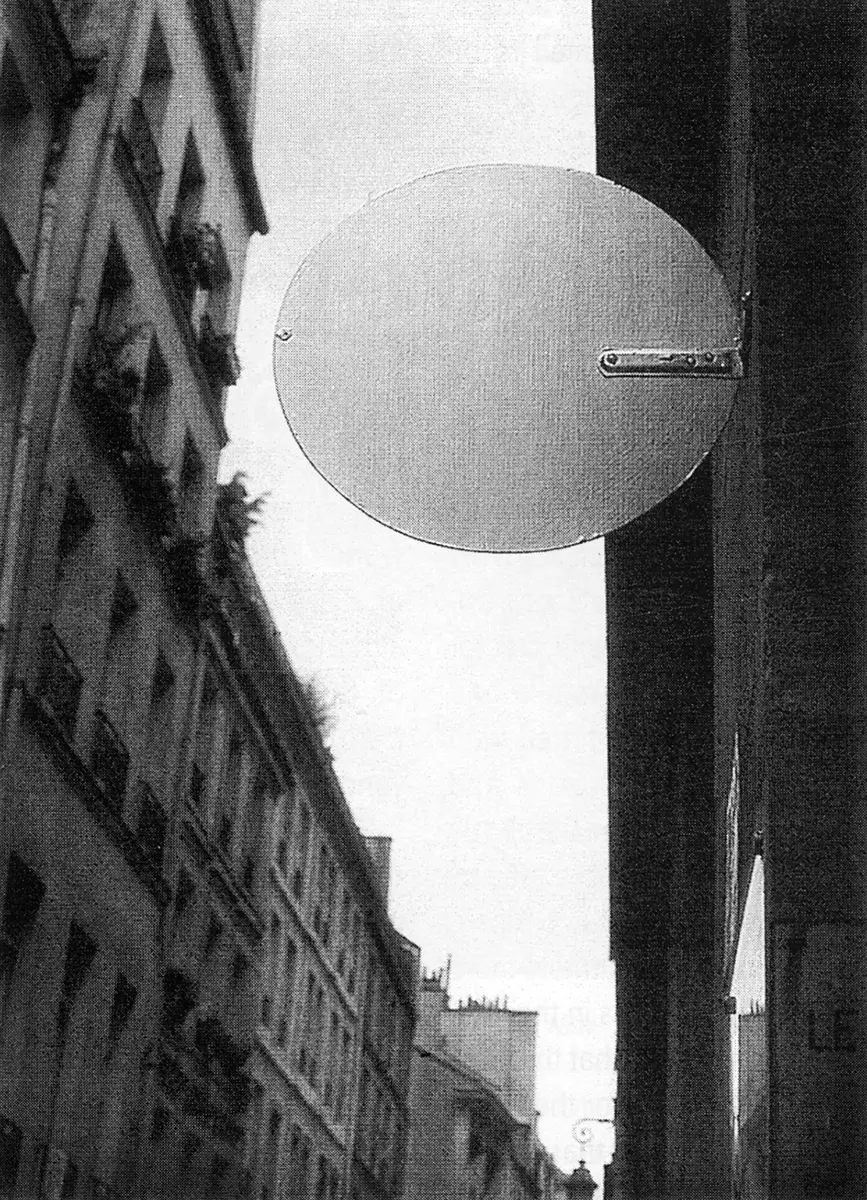
With regard to Mexico, we are left with as many questions as answers. As the area with the most participants (Víctor Zamudio Taylor selected fifteen), the work of some of the artists in this group, Marcos Ramírez Erre, for instance, gained quite a bit of exposure. His Toy and Horse is reproduced in the catalog with the photograph of Tijuana during INSITE 1998, and the model for the piece is exhibited at the Museo de la Ciudad. We see a new facet of Betsabé Romero’s work, derived from the very INSITE 98 where she went back to working with car parts—a fortunate decision—and within the same vein as the work shown by the Iturralde sisters in Los Angeles.
Perhaps due to the large number of participants in the Mexican section, the curators decided to separate pieces by artists whose work might have worked better together. Betsabé Romero, Marco Ramírez, and Thomas Glassford suffered the most from the division of their works among several galleries of the museum. The signage was not always precise and correct. The work of Sofía Táboas, for example, was not clearly identified and easily taken for one of the vanished Mathias Goeritz’s wall pieces. Philippe Hernández’s signs on glass and aluminum foil seemed to be part of the redundant signs museums tend to have. Perhaps this was his intention but the citizens of crowded Mexico City, where the museum is located, deserve to know what they are looking at, just as curators have an obligation to inform them that this or that work is part of the exhibition they have come to see.
The same thing happens with the work of Abraham Cruzvillegas, author of brilliant texts and creator of the much-copied men’s and women’s underwear printed with photographs of politicians and other people and subsequently hung on the familiar racks used by street vendors in the city’s center. The knock-offs are infinitely more creative and audacious in their design and composition than the work of the artist included in the show. The only difference is that Master Cruzvillegas conceptualized his piece, while the vendors on the sidewalk around the museum acted only on inherited intuition and under pressure to make a sale or go without that day.

Claudia Fernández’s doors and facades depict an important element of residential architecture in Mexico City. Chosen for their aluminum or metal designs or the coat of paint meant to distinguish Mexican middle-class dwellings, the photographs have been arranged so that they form a mosaic of almost exclusively geometric shapes, highlighting an aesthetic whose very prevalence in the city’s neighborhoods renders it invisible to the daily gaze.
Estela Hussong, one of the more traditional artists in the Mexican group, showed some careful pieces in tempera and India ink, representing plants and rocks. Something stronger and perhaps better made was missing in Jimmie Durham’s work. Forbidden Things consists of a metal detector like those in airports, above which hang images of three objects, according to Durham, that are “prohibited beyond this point.”
Perhaps the third and final stage of Five Continents and One City is a prelude to the Biennial that Mexico does not have. The show’s director, Marta Palau, assumed the risk of a large-scale event and worked hard to pull it off. With top-notch curators and artists available to collaborate in an event of this breadth (the selection would need to be fine-tuned, the mandates of the Gurus ignored, and more attention paid to the works of artists who create naturally and in spite of Gurus), we are in the early stages of an event that will surely draw worldwide attention. We have the space, the artists, the curators, and the will to do it. Let’s wait and see what course this monumental effort takes.
SANTIAGO ESPINOSA DE LOS MONTEROS