
Despite her considerable international reputation—her participation in the IX Kassel Documenta and the 1997 Venice Biennal stand out—Jac Leirner (born in São Paulo in 1961) is little known in Spain. Aside from the occasional sculpture brought to ARCO by the Galería Camargo Vilaça, her work has been seen only in two important group shows: Trasatlántico (Transatlantic) at the Centro Atlántico de Arte Moderno, Las Palmas de Gran Canaria, and Zona E (E Zone) at the Espacio de Arte Contermporáneo de Castellón. In this first solo show at Madrid’s Helga de Alvear, one of Spain’s galleries most open to foreign artists, we see a limited group of works from her last series, called Adhesivos (Adhesives). Formally speaking, they are pieces far removed from the previous series. Nevertheless, Leirner maintains her strategy of compulsively collecting similar objects that are later utilized as material for sculptures. In this case, we have hundreds of decals from museums, art centers, fairs, airports, and even shipping crates, which the artist has arranged on the inside of pairs of windshields or bus windows, forming mostly zigzagging lines. In two of the sculptures, she also plays with the decal’s back sheet, from which she has pulled out the adhesive, and the die-cut section serves as a “frame” for other, smaller decals.
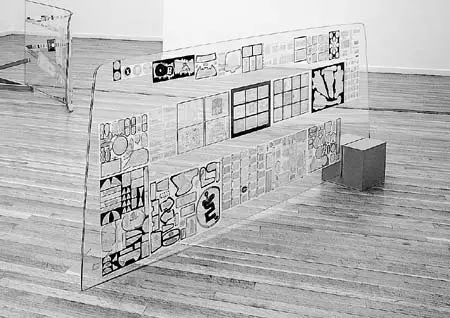
Once more Leirner returns to concepts and themes recurrent in her work: trips, the object-testimonial of personal experiences, art made from reality, the accumulation of “circulating” materials, the condensing and fixing in space of a prolonged period of time (throughout which she collected, from very distant places, the works’ components), the ordering of those elements according to simple, minimalists outlines. But, as stated before, something has changed in terms of form. In series such as Os Cem (The One Hundred), Pulmón (Lung), or Corpus Delicti, the sculptures were configured mainly with collected objects (respectively, bank bills, cigarette packs, and trinkets stolen from planes) that needed only the unifying elements. With the exception of one piece, in which the decals are placed directly on the low wall of the stairs leading to the exhibit hall, here, the adhesives have lost their sculptural dimension and seem relegated to a merely decorative function.
Although the succession of adhesives is still evocative, their arrangement seems to lack work or elaboration, including in terms of conceptualization. Something similar happened in the pieces from the
series Nice to Meet You or also in Name, the set of museum bags. The best of Jac Leirner is not here. It’s in the works of having a more objectual, volumetric presence where her talent becomes patent. The
formulation of a project and the subsequent (or posterior) accumulation of materials is not enough. Nor is it the ideological or sociological message. In other instances Leirner has shown a well-developed
sense of sculptural creativity, a great intuition for materializing ideas, for transforming those bits of reality into something different without altering them, a new physical entity communicating with the spectator through that very presence that modifies our vision of the individual object. It is in this territory
where the artist has more to say and discover.
The contents she handles don’t go too much beyond the obvious, no matter how much we might enjoy the references to artistic infrastructures, or even after we recognize the spatial-temporal confluence her accumulations unleash (and which, in truth, are inherent to any collection). With the exception of the
petty thefts committed on planes, which imply a transgression, the experiences she wants to share with us are not what we’d call passionate: that she travels a lot, that she exhibits a great deal, that the cruzeiro
has devaluated, or that she quit smoking. It’s true that if we look for the underlying cultural or social criticism we’ll find it, but only if we’re interested in finding it. Visual surprise is an artistic weapon Jac Leirner has wielded with mastery, and surely she’ll use it again. We just hope that the success that has kept her company for such a long time does not annihilate her self-criticism.
ELENA VOZMEDIANO