
The Bellas Artes Museum inaugurated recently Batallas (Battles), an individual show by Juan Araújo. This exhibition, in the spaces of the Drawing and Print Cabinet, gathers several paintings in a small format created under the strict guidelines required by this type of work. Based on the principle that people are fascinated by painting, Araújo doesn’t trouble himself with whether his public is in possession of the necessary codes to appreciate the work. His paintings reach everybody, and the artist is satisfied with that. The reason for this is that Juan Araújo sees the creative process as involving not only what happens in his workshop, but the spectator’s perception as well.
This show encompasses a series of oil on-wood paintings, including the artist’s earlier work and his most recent investigations. Along with his well-known imaginary landscapes, Araújo offers now his explorations of the works of the French painter Henri Fantin-Latour. All these pieces have developed from photographic reproductions (both black and white and color), taken from calendars, books, and catalogs. As the artist tells us, these images are the matrix from where a reinterpretation of the theme emerges; this is why the dimensions of the reproduction are maintained while the application of color is aleatory, and responds to personal searches.
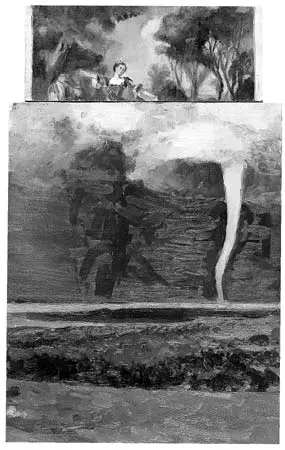
Araújo’s interest in seriality plays a dual role. On the one hand, the artists see these works as ready-made since they repeat a single image; on the other hand, that repetition allows him to preserve in each piece something that is necessarily lost in the process of painting. "Painting is always a loss of other paintings," and that’s how he understands it. This is why he insists on the series. with the intention of bringing to light the steps of the process that would otherwise remain unnoticed. The object of his paintings is not to minutely reproduce the model; in fact, in using a reproduction he acknowledges the difference between painting and reality. In this sense, Araújo’s work is nothing more than a re-creation of the craft’s established conventions.
The Batallas show is understood as a bi-dimensional installation where the free process of reproduction mingles with the imaginary landscape, and envelops the spectator in a rich repertoire of motifs. From Fantin-Latour’s beautiful flowers to the images of tornadoes taken from National Geographic, all of them manifest this necessity to reveal what is good in the model and to repeat it. But also, the acts of clearing up the areas of interest, discovering new possibilities in the stroke, and letting one’s self follow the instinct represent a new and fertile universe at the moment of assemblage. Passionate about his work, the artist does not obliterate the ironic element it contains. It is not a matter of painting in the classical manner; it is a diatribe against icons and traditions. In this sense, the artist makes a mental painting of the protagonist —that painting that allows for the imaginary use of author-imposed colors and atmospheres. That’s why, we insist, reproduction is still there: not to investigate the questions of painting au plein air, but to investigate those properties that reproduction does not have — above all, freedom. Maybe that’s why Juan Araújo speaks of battles; maybe such battles are those that he generously fought against the static, frozen images that suppress the original’s richness of texture, light, shadows, and color. Juan Araújo is a contemporary artist and member of the emerging young generation. A graduate of the Armando Reverón Art Institute, he has been a part of important collective shows, as well as many confrontational events. He received an award at the II Landscape Salon and his work is to be found in important private an public collections in the country.
ANITA TAPIAS