
The gallery of the Centro Cultural de Mexico —one of the most beautiful foreign cultural centers in Paris— just reopened its enlarged space with Magali Lara’s One Woman Show. In collaboration with Mexico’s active Galería Nina Menocal, the Centro Cultural de México, besides having printed an important catalog, presented a coherent and balanced group, composed of three big tapestries (Gobelin) woven in Mexico, two sets of ceramics, ten drawings, and seven engravings, all grouped under the generic title of Allá. (Over There) In the spirit of the shown works, we recognize a scenery that’s sort of aerial, transparent, and light, even if there’s a certain violence that joins the sweetness in order to feed the substance of these erotic, carnal games.
We still haven’t assumed a feminine version of the word “pintor.” (painter) The word artista (artist) is easily abandoned in a non-gender comfort zone. Questions abound, nevertheless: Is there a specifically feminine art? Can the artist’s gender be identified through his or her work? Are there (or not) gender-specific pictorial discourses? Can they be easily recognized? The questions have no end. What really matters here is that the act of painting creates a space of meaning where forms cross and crash with each other —fed by emotions and intentions, carriers of symbols, metaphors, and more or less unconscious messages. Naturally, these components are never neutral. The image is filtered through the prism of sensitivity, intelligence, ideology, and social, cultural, or sexual identity. But at the same time, a piece of art will not be understood or defined if we desperately look only for its feminine or masculine condition. What we need to do is question the relationship between idea and form. Art expresses its true nature in this encounter, which is not fortuitous. The issue of gender, artists’ gender, and their propensity to tackle it through their sexuality is a false issue. But it’s also true that men and women act out their sexuality (or gender) according to different registers. Consequently, why can’t the same happen with the act of creation — in the choice of representation, the intensity placed or not placed at the moment of evoking, describing, or showing? Shall it be constrained or overflow, shyness or all-out exhibition, dream or reality, etc.? Features and behavior are what evidently characterize more one individual than the other, but they undoubtedly differentiate man from woman.
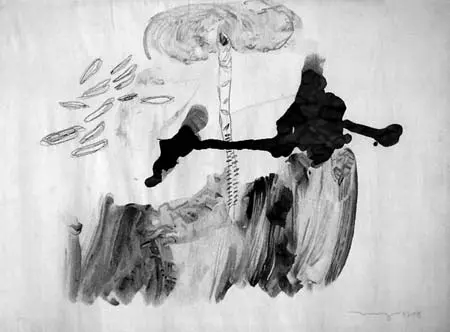
The title chosen by Magali Lara is uncertain and atemporal. It evokes distance, the other, difference. But it’s also an allusion to life and death, to the identity in desire, pleasure, pain, and loss. She tackles the shores of personal and universal emotion as if they belonged to a woman artist —sensitive, sensuous, generous— who invents, rewrites, and invokes them into a body of work summoning our senses. This syntax of the tact, this amorous archeology she elaborates in her burlap of flesh, blood, and passion, comes from a symbolic feminine she recovers naturally. With her, one is at the heart of the “wound,” of “vertigo,” of “ardor,” of the “warm cavern,” of the “stain,” the “folds,” “penetration,” the “eyes,” the “opening.” She’s in the friction, in the confrontation and palpability of the Eros. The act stalks the flesh, the sexes, and the “absent” hearts touching, stroking, and hurting each other in restrained proximity and violence. In these huge tapestries, there’s an atmosphere of intimacy that their monumental dimensions (from 220 cm. to 350cm.) can’t alter. On them, the reds, browns, blacks, and grays only gallop and fuse together. If later we compare them to the drawings and engravings shown on the upper level, we observe that the projection toward space and overflow —from the intimate to the suggestive, from the smooth surface of the paper to the rough surface of the wool weaving— doesn’t modify at all the contrast between delicacy and strength, between containment and explosion. This work dealing with artistic, technical, and sexual differences creates a nexus that is not only visual and esthetic but also a relationship between a body and a body of senses and emotions. Thus we can imagine a flow of sap (blood or sperm) running through her work as a whole. Symbols, a history; the red and the black. Opposition between drawing and color fixation, between work and gesture, between liberty and confinement. The artist suggests and says in brief phrases written by hand —they sometimes mark the engravings she later intervenes— or in other graphisms drawn on the white and crude white of the huge canvases.
Words that say and give testimony. In her inscriptions on two different ceramic platters, words turn into artistic and conceptual metaphors. They’re also a message directed to man, who questions for the best: “Do it,” “But don’t tell me.” But the wound is still there, hidden under the blood-red stains, as a memory of the worst, and to ensure that Magali Lara’s hate-love dialectical discourse belongs only to her, between cries and whispers.
CHRISTINE FRÉROT