
The paintings in Manuel Ocampo’s recent show at the Jack Shainman Gallery are so visually and verbally dense that they initially seem almost impenetrable. These large-scale works assault the viewer with an array of figures rendered in different illustrative styles and executed in thick painterly strokes of lurid colors. Ocampo adds another layer of signage to this palimpsest of images by imposing provocative phrases of text onto each work.
Those Long Dormant Pimples of Inattention Meandering Through the Cranium Arcade of Pitiless Logic Swastikating Between Love and Hate is the title given to this show and it encapsulates the general sensibility of the works contained within. Both ponderous and absurd, jargonistically intimidating and ridden with slang-based humor, these works almost defy the viewer to walk away dismissively or feel hopelessly out of touch. Ocampo has written that as a developing artist, he would immerse himself in the art critical writings of the 80s and 90s, growing to realize that these writings were increasingly isolating themselves with an increasingly specialized and rarefied mode of discourse. He claims to appreciate this discourse as an art form all its own, but judging from the generally mocking tone of this show, we are left to wonder just how much he truly appreciates what he has read. A Responsibility in the Name of Ideas (all titles double as the text we read in the paintings), for example, undermines the didactic urgency of its titular mandate by featuring a kitschy, impossibly cute, and innocent-looking puppy. The Stream of Transcendent Object-Making Consciously Working Towards the Goal, on the other hand, loaded its canvas with such excess verbiage that there is no longer any room for imagery.
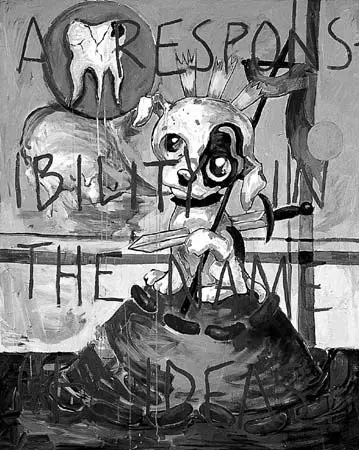
For all their humor, however, these works resonate on another level. In fact, if all they sought to do was ridicule pompous critics, they would inevitably start to wear thin given such an easy target. These paintings, like the works in the concurrent and equally pretentiously titled exhibition by Damien Hirst, want to be taken just as seriously as they want to amuse. Thus Ocampo tips the scale at times with loaded symbols intended to provoke. The Unseen Power of the Monochrome, for example, plays off the Greenbergian dictate of the color field for its background. But the semi-nude Afro-Latina presented as just a sex object plays off of this strictly formal—i.e., objectifying —way of looking. The figure looking at her is a man with two heads—those of Marx and Lenin, suggesting the ideological fragmentations that divide the left and invoking by extension the neo-formalism and critical discourse of the October editorial circle, issues of Western objectification of non-Westerners, and even the ersatz socialism of Greenberg himself.
In addition to these paintings there are a group of drawings, humbly tacked to the wall and referencing different forms of comic book art in a manner similar to Raymond Pettibon’s. Ocampo himself invites this comparison to Pettibone but the rendering of text-as-image also suggests Ed Ruscha, and given both these frames of comparison, Ocampo’s works come off as a little weak.
With this series of paintings, Ocampo cleverly appropriates many of the strategies of painting in the last 15 years as a means of critiquing the criticism that attempted to address these works. What borders on the problematic, however, is the artist’s own reliance upon the very devices that postmodern criticism emerged from. These paintings continue a tradition for the artist of relying upon the extensive use of the sign and the discontinuous picture plane, invoking different systems to inform their meanings and heavily slanted towards the personal and the politics of identity. It is one thing to toy with the text-image relationship, but in some ways, these works stop short of acknowledging the limited choices afforded writer who has no other option than to use text to discuss text-based art. There is also a somewhat disingenuous neglect of the artist/critic relationship, and how ultimately dependent artists are upon critics to help render intelligible their art.
Nevertheless, this series shows a welcome shift from his past few exhibitions and certainly achieves what for many is the most difficult task of all—to provoke and entertain at the same time.
JOHN ANGELINE