
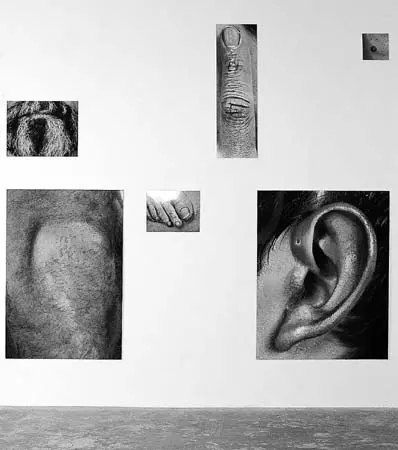
Mónica Castillo (Mexico City, 1961) works with a series of retouched and photographed paintings that go beyond the mere body fragment; she studies and visualizes it as a part far more important than the whole. In the group of workers making up Hombres pintados (Painted Men), Castillo paints over an eye, an ear, a foot, the mouth, the torso, a knee, a nipple, and a finger of his model, so she can have them photographed by someone else, and then mount and exhibit them as representation of the selection of a specific body part of the photographed subject. The artist forces us to question ourselves: How far we can go before having to delimit the represented subject? How important is model manipulation when he/she simultaneously becomes sign and signified?
Two pieces don’t quite fit in with the rest of the show: the photo of a man’s torso printed in magenta, cyan, and yellow on vinyl, remitting us at first to an Op esthetic. The printed points and circles seem to overcome themselves and begin to move on the diptych as in a clear dance of retinal stimulation. The other piece —in my opinion, the show’s best—is a self-portrait on a nylon web splashed with vinyl paint. The end product is a plastified blanket falling freely under its own weight; the splashes of paint seem haphazard when in reality they form a perfect self-portrait of the artist.
To represent her face in works going back as far as the early 90s, Mónica has experimented with various materials and techniques. On occasions, she has used only paint, but she has also aided herself with fingernails to build her face, she’s used baked bread, and embroidery, and has manipulated digital photos —samples of which we can find in this exhibition. Here we must highlight an important point in Castillo’s work: if it’s true that the 90s saw an abundance of self-portraits, for the most part, they were narcissistic fragments of intimacy or autobiographical references, which is something we don’t read in Mónica’s work. On the contrary, she shows herself plainly and directly before the spectator, who’s surprised at the honesty with which the artist allows herself to be seen. Mónica opens herself and is vulnerable to the gaze of an observer who has before him or her a portrait of a face with open pores, unkempt skin, wrinkles, pimples, or hair —marks that are erased from those images shown in public. Mass media and propaganda make everything in their power to hide defects and blemishes; it seems as if Mónica’s poking fun at their methods while at the same time questioning them.
In the same show, Mónica works on two videos. On one of them, a three-minute one, a fixed camera films the artist painting his model’s testicles and penis with a fine brush. We assume that the artist’s tickling will make her model have a hard-on. But she applies the red paint to the very end, and the recording finishes. In the other video, the artist “brushes” the model’s eye and makes him wink, reddens his eye, and makes him shed a tear —all under a minute.
Various aspects come into play when we see the work that Mónica presents in this show. The first problem we find has little to do with the signification process of the represented objects, nor it has do to with representation itself. Between image and portrait, reality is the first issue to become blurred. Reality generates many subjective questions when it finds itself so faithfully portrayed in a false image. We live in a society in which our perceptions are frequently geared toward representations, and toward a reality
multiplying itself more through new representations.
LUZ MARÍA SEPÚLVEDA