
At last Pepón Osorio (Santurce, Puerto Rico, 1955), returns to Puerto Rico, his homeland, to astonish and provoke us with a project unprecedented on this small island. Under the title of Pepón Osorio, de puerta en puerta (Pepón From Door to Door), the new Museo de Arte de Puerto Rico, the Museo de Arte Contemporáneo, the Museo de San Juan, and the Escuela de Artes Plásticas de Puerto Rico gathers together the following works: En la barbería no se llora (No Crying in the Barber Shop), one of his most important installations, which has been exhibited throughout the world; Insignia de honor (Insignia of Honor), which tells the conversation between an AIDS-affected, incarcerated father and his adolescent son; Escena Del Crimen: ¿El Crimen De Quién? [el escenario de un crimen (¿pasional?)] (Crime Scene: Whose Crime Anyway?), [the scenario of a crime (of passion?)] that takes place in a Puerto Rican/Latin American household in New York; and Visita al hogar (Home Visit), a semipublic, itinerant art project taking as a point of departure the Catholic ritual called “visita del Santo” (the Saint’s visit) to selected homes.
Born in Santurce in 1955 and a New York resident since the 1970s, this magician of hyperbole, the aesthetic baroque, and postmodern kitsch returns to his island bestowed with honors that range from numerous international successes to the receipt of a 1999 MacArthur Grant. He has come to share with his people his unique esthetic and ethical vision of Puerto Ricans who live “up there,” in the United States. His art— always powerful, always poetic—immediately invites us to become voyeurs in order to realize soon enough that we are seeing ourselves as “the other” —the Americans, or denizens of the US—see us in the countries we call “civilized.”
Even though at the beginning he rejected the “world” of Puerto Ricans living in New York, Osorio soon became one of the most important chroniclers of the Puerto Rican diaspora (which, in general, is also that of the Caribbean and Latin America). His hallucinatory syncretism —where his unique way of gazing at the Lost Fatherland, his fascinating games with Eros, and his enigmatic dance with Death turn into an incredible carnival — makes us start seeing ourselves the same way as “the other” sees us, those who poke fun at our esthetic and ethics, those who discriminate us in real life and in Hollywood (from Ricky Ricardo and West Side Story to the ungainly political correctness of the last few years).
Again, this genius of the postmodern baroque, who has openly told us that “he loves the contradictions” he sees in “the New York Puerto Rican households as syncretic temples,” makes us see “the passage from the land to the plastic,” and invites us to see through his art that although we think we’re part of the “American dream,” we are, in reality, part of another dream—one that many times turns into a long and terrible nightmare, essentially because we are and continue being different.
And just how does Osorio achieve this? More than an installation artist, Pepón, as everybody calls him, is a builder of “altars”—altars honoring the small and great deities who rule our lives; altars honoring the memories, big and small, that make us up. These are spaces where the Latin American baroque and the American kitsch (Midwest’s Warhol, not Manhattan’s cosmopolitan Warhol) mix deliriously, creating “paradises” that couldn’t have existed in our countries despite the fact that they originated there. Osorio turns his surrealist baroque (or baroque surrealism) into powerful metaphors for survival, and each of his “scenarios” can be seen either as a Greek tragedy or as a snapshot of what has happened to us in the 508 years following Christopher Columbus’ arrival.
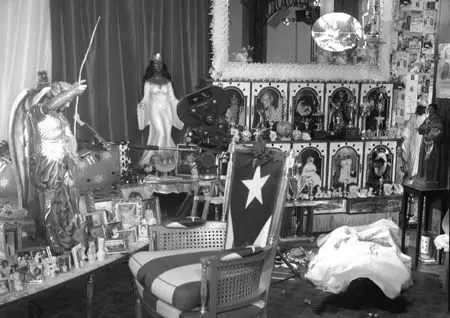
In Escena del crimen: ¿El crimen de quién?, En la barbería no se llora and Insignia de honor—three installations mounted and presented impeccably —we see how Osorio establishes a brilliant dialogue between Catholicism, Santería, athletes, and the Puerto Rican (and Latin American) rich and famous. A repetitive series of plastic and cheap porcelain objects, trophies, photographs, candles, plastic flowers, mirrors, and superficial patriotism, all form a dialogue that at first scares us but then quickly turns into a brutal mirror reflecting many of our faces and masks.
Behind a Police-Line-Do-Not-Cross yellow plastic tape, Osorio lets a cadaver covered by a blood-soaked sheet and St. Lazarus share the role of protagonist (Escena del crimen) in a chamber that seems to have been taken right out of the last scene in Visconti’s Death in Venice. On the other hand, this poet of the threedimensional turns a barber shop into an impacting visual labyrinth where the Puerto Rican macho, in an impressive show of homoerotism, has the real possibility of seeing and embracing homosexuality with no inhibitions whatsoever (En la barbería no se llora).
Finally, this chronicler of the survival and happiness of our people in New York, makes us understand the pathos in a conversation between an AIDS-afflicted father who’s incarcerated and his adolescent son who, in spite of everything, still has the same dreams as the adolescents who live in the middle-class suburbs in the U.S. (Insignia de honor).
For those Puerto Ricans who weren’t familiar with the work of one of their greatest artists, Pepón Osorio, de puerta en puerta, has been a true esthetic and ethical celebration. Through his installations (mirrors?), this indefatigable weaver of our realities makes us see ourselves
with our political and cultural confusion, our sorrows and dreams, our tears and laughter while thinking that, unlike Dante’s Inferno, where “desire exists with no hope,” we can still yearn and believe
in the future.
MANUEL ÁLVAREZ LEZAMA