
After the surprising closing of the Galería Larrama, the most radical of contemporary art in Santo Domingo has moved to the Centro Cultural España. There, Quisqueya Henríquez presented Panorama, her second solo show in the Dominican Republic. That Quisqueya Henríquez —who is Dominican and Cuban, was educated in Havana and is married to a Dominican lawyer—not only lives but also exhibits in Santo Domingo, truly makes a fundamental contribution to the local artistic life. At this moment she is our only truly conceptual artist.
After a much-commented solo show at the experimental Sala 7 of the Museo Tamayo in Mexico, Henríquez has continued investigating the problems regarding the urban environment. We have learned that when she prepares for an exhibition, the route she decides to follow is the one with the least possibility of accident. This tact applies to the creator and the spectator. The process results in an art of transmission and exchange, an interactive work, which is essential in this stage in Henríquez ‘s work.
In Panorama, the creator, who conceives art as a symbiosis of continuity and rupture in time, remits us to those enormous cylindrical paintings invented during the second half of the nineteenth century that created the word “panorama” where the spectator, sitting in the middle of them, could see the motives as a whole: surrounded by them. It was as if he or she dominated them with his or her gaze from above. Impressed by this type of painting, the pre-romantic writer Chautebriand said: “My memory is a panorama: there come to paint themselves, on the same canvas, the most diverse places and skies.”
One hundred years later, photography used that same all-encompassing format, which had quite an impact for the time…but which was not without its technical difficulties. Today, Henríquez, winking at the nineteenth-century panoramas, recaptures the concept of visual and informational totality through photography and installation, and applies it to the city of Santo Domingo. The artist, who is quite good at drawing and working with three dimensions, is also a photographer familiar with the latest technology.
The show was organized on two floors. On the lower level, we find the main installation, Panorama. Upstairs, we find Locus Nómada (Nomadic Locus), 1988-2000. These photographs, which have been selectively hidden or duplicated, are concrete proof of Henríquez’s ability to direct, control, or exalt the photographic expression through a formal solution.
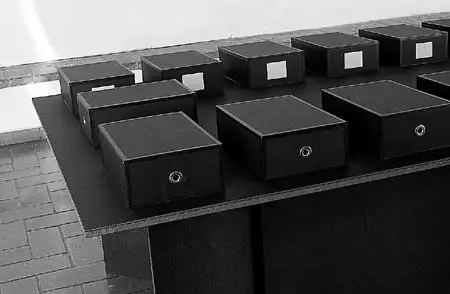
Panorama is composed of two tables. On top of them are 30 boxes symmetrically placed at the same distance from one another, a slight rectangle cut into each one. Everything is cold, black, calculated. The whole hall, darkened and enclosed, suggests a metaphor of a box…an abysmal show, boxes inside a box? It’s a first reading.
Nevertheless, light opposes shadow. The hall’s background is occupied by an enormous screen, white, substantial, iridescent, quite beautiful indeed. And there is a photograph hidden inside each box that we can see through a viewfinder. We grab each box successively and take it before our eyes, against the screen of light. And silently, we begin to reconstruct a moving “panorama” of Santo Domingo or any other similar city.
Very few people, fragments of gangrenous or partially constructed buildings…we already have the sensation of ruin. The artist has selected five themes: abandoned architecture, different spaces seen through holes, the intervention of the subject in the urban landscape, architecture and history, and constructions in progress. Even though there’s a noticeable lack of human beings, the images continue to involve man in this degradation—past, future, and present. Through photography, the body of work is a sort of recycling of the decadent city. Uncertain city, depression, and hurt, affect more our sensibilities when the artist evidences urban maladies. Isn’t she asking us to react and quit being accomplices to this degradation, which begins with our own indifference?
The process of contemplation is long. But spectators don’t grow tired; on the contrary, the more they see, the more they’re interested. They decipher the message, analyze it, and analyze it themselves. Then, Henríquez gives us complete freedom to interrupt the “cycle,” to change its order and take a second look, which we deem necessary in order to capture the messages, the invisible through the visible. The interaction comes naturally, and it varies according to the participant. It’s always joyful to see that this relatively difficult show in the midst of the complacent Dominican artistic world was one of the most crowded of this season.
MARIANNE DE TOLENTINO