
(NBP x I-You): New Bases for the Personality Versus I Trace the Union of You — that was the name of Ricardo Basbaum’s recent exhibition at the Museu de Arte Moderna in Rio de Janeiro. In it, he proposes a game of interchangeable, permeable, and flexible relationships between the subjects involved in the functioning of the piece (I and you, you and I), from its inception to this date —that is, if an indirect description of those partial impressions can reach a distant reader such as me, for whom they were time-resistant.
The environment (the ball field or a checkerboard) is composed of four cabins in the middle of a hall. The cabins are made out of wire mesh, each one ready to receive a body lying down over a light mattress covered with clear-colored sheets. A different color for each cabin, and a certain amount of pillows. In each cabin, there’s an opening that allows anyone to see, in different measures, inside the wire mesh. These body niches, almost-bed, almost-cage, are occupied by the participants who lie down in full concentration, listening to a recording of the artist explaining the way the game works. At the same time, the participants can decipher the diagrams hanging from the walls next to the cabins —two planes of thought in which we see a graphic mapping of the same ideas uttered by the speakers.
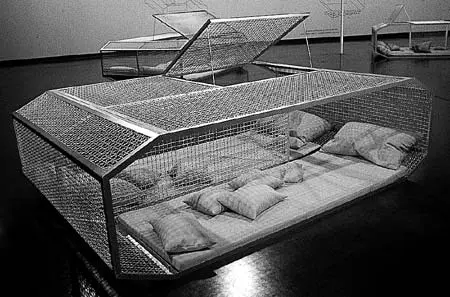
We’ll all fall captive. Some for believing in prison bars, some others for not having sheets; others, for not being able to run away, and still others for not being able to draw closer. Or the two possibilities of ourselves —you and I— confuse us. It could be because we’re interested in the text, or because the voice reading them seduces us, or it’s because we are worried about the train of thought or the lines being read. It could be a mixture of all. In fact, we are held captive, we’re inside the structure, a part of the diagrams and the syntax, as participants in a game that wouldn’t exist if there weren’t a he/she, a you, and an I. In this game, our objective is the observance of rules; the players and the pieces are always you and I. I, the one stopping the discourse or the other player, although my place can be switched.
And if at the beginning we nestle or jail ourselves in the semi-bed, semi-trap cabins and listen to you read your observations regarding how the game works and to see the diagrams codifying the word; and right now the game has shifted a little. And this is what’s happening: I speak and you listen, I write and you read; or, with my hands I let you say. Like in this very moment, when I decide to let you say, “I speak, you listen. They both speak [I’d say, ‘we speak’] at the same time: you, who wants to be I hurling itself at you;” I [and you couldn’t have known it] give you a confrontation that you’ll react to only when it’s too late. Such a fair confrontation, full of traps, just like the one you have proposed in (NBP x I-You).
The game you, being an observer and a participant as well, propose is parallel to the one I’ve spoken to you about, in which each he/she who plays it (and sets the rules) is also a part of us. We are (both you and all) arbiters, announcers, players, participants, pawns, bet runners, observers, observers, spectators, first balcony, points, and score. And the game is to accumulate as many different positions as possible. Maybe you’re right when you say that the artist should remain silent and involve the audience with his silence. But maybe you’d be even more on target by establishing mobile rules, ambivalent possibilities when the public’s not only public and this same rule applies to the artist. When the game’s about thinking and thinking again, and about repeating a structure, its mechanisms work by proposing the strict observance of those rules once and again and again.
In that perceptive encounter, you say you “involve sublimation, persuasion, and repetition as techniques to reach an instantaneous transformation, a memory implant.” Here it seems impossible not to have a conscience of the positions occupied. You speak too much of myself, of what I am, while at the same time, I listen so as not to recognize you within your territory. You give me too many prison bars, and too many pillows so as not to think of the human body as a piece in the checkerboard. The train of thought is too structured, the diagrams are too organized, and the words and sentences are too perfect for me to get used to them.
At no moment did I forget you told me who I was, nor did I forget the positions I had in your texts and the traps that had been set. From the moment you told me that the game was the place from which it was seen, I realized that I thought about lying down to listen to you, without knowing that it was really you who was telling me to lie down and make the truth of your words and allow you to repeat them. This seems to be the precise moment to let you remember “the impact of these two important places: he/she who talks and the other.” As if once in a while’s only fair to be the other person.
CARLA ZACCAGNINI