
Santiago Armada (Chago) died in Havana in 1995 at 58 years of age, just when two young independent gallery owners had taken him out of his self-imposed ostracism in order to present two exhibitions of his work that aroused interest in Havana. Nine years had passed since his last show, a period when the artist had begun to isolate himself. He barely left his house and he did not receive visitors; he was full of resentment because some cultural institutions had censored his work at a time when sex and the scatological —his main attractions— were not accepted by all.
Both on account of his controversial work and his caustic character, as well as his intellectualized form of approaching humor, Chago has become, in a certain way, a mythical character among Cuban plastic art. He said: "I reject conceptions of humor as a simple, farcical, commercial, cruel, pamphleteering, and stupid consolation. I seek transcendent facts and motivations. I do not undervalue laughter or smiling, but I practice it sensibly, intelligently, and differently. My fundamental aim is to make people think."
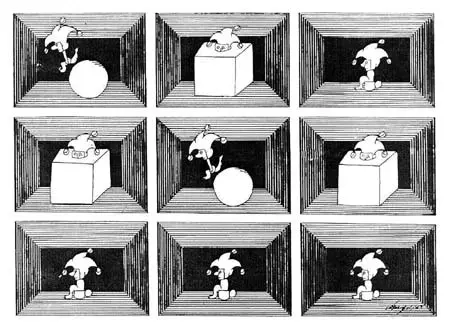
Among his polemic work, the comic strip of Sa-lo-món, created in the early ‘60s, was the most paradigmatic. With it, a show was organized at the Center of Development of the Visual Arts as part of the 2nd International Biennial of the humorous weekly Dedeté (DDT). The curator, Caridad Blanco, attempted to reconstruct the path of the mutant figure whom she considers a self-portrait of the author from the point of view of his essence, beyond his changing form. According to her, Sa-lo-món expresses the agony and the enclosure to which Chago condemned himself. From its beginnings in 1961 in a supplement of the newspaper Revolución, the strip was not understood and probably disappeared two years later for that reason. Sa-lo-món broke out of the conventions established by the genre, which were then worked in Cuba in imitation of the American style, although with different themes. Chago continued to work in this genre until 1975 on unpublished thin cardboard. He then began to work in another direction.
Perhaps by dealing with the eternal concerns of mankind, which were valid for a broad area, Chago’s philosophical digressions have the same communicative possibility today as when they were created. Time does not erase Chago’s sarcastic, ironic, and subtle humor, full of formal and conceptual experiments. He brandished doubt as a watchword and, from there, he attempted to inquire into everything, completely unprejudiced.
One of the mottoes of the first revolutionary period in Cuba read thus: “Estudio, trabajo, fusil” (Study, work, rifle). One had to study, work, and train in case the Americans invaded. Chago’s wise Sa-lo-món, who grew old and was then restored to youth, who grew fat and then lost weight, lost legs, arms, and hair from one strip to the next, also transformed his fool’s cap, finishing it off with a rifle and a feather; but instead of drawing a work tool for him, Chago drew a penis on him. Thus equipped, the irreverent and enigmatic little spirit, born according to his author through readings of Marx, questioned politics, society, interpersonal relationships . . . all of life.
Chago said that Sa-lo-món was thesis, antithesis, and synthesis. "A particular man, an individual, and, at the same time, all men, the collective." He added:
"With him, I have attempted to create such a vast, complex, and contradictory character as man himself. He can be intellectual, coldly analyzing his circumstances. But he is also emotive and his sentimental and irrational fits lead him to unforeseen situations."
The artist did his work in series: El humor otro (The other humor); El humor ninguno (No humor); El humor gnosis (Gnosis humor); La chanson du condon; Lo amorfo y descorazonador (The amorphous and disheartening); Domina el diálogo (The dialogue dominates). In them, the stories penetrate one another. Although I share the curatorial principle that the totality of the work is permeated with the spirit of Salo-mon, it seems inadequate to me to have placed other protagonists in this show, such as condoms, mouths, or simple talking spheres, and to formally assume them as Salomonic.
It seems that even the most serious, brainy, or transcendent for Chago was susceptible to being questioned from very earthly and hilarious planes. It is thus possible, from that perspective, that in his pieces everything relative to the human being should always be assumed very naturally, not seem foreign, and least of all inconceivable, to us. Consequently, he used to place his characters (nude figures "in order to achieve unselfishness that the limitations of time and space impose") in common situations of daily life and, even among a lyrical fit, they fart, burp, and ejaculate. However, it is not a matter of praising vulgarity for vulgarity’s sake, as might be imagined, but rather they act in a sort of “deconstruction” of any aristocratic pose. Among farts and burps, sentences of profound content are uttered (valid even today); the sublime, in sympathetic conjunction with the pedestrian, and the character remains, just like that, in comical form, because it is disconcerting.
Chago’s work, over the course of the years, remains intact. It can dialogue with us because, except in the technological field, the world is still very similar to what it was forty years ago (in spite of the noted transformations in the colors of the maps and the questions on utopia). Specifically in Cuba, just like Sa-lo-món, many of us ask ourselves a lot of questions all the time and we do not always have answers. But we also follow the tendency of Chago’s characters to focus on essences. That allows us to praise him and, consequently, to live, even among the confusion at first sight.
ERENA HERNÁNDEZ