
Victoria Gitman is a young Argentine painter who stands out for the way in which she finishes her paintings. The show, entitled Trabajos recientes (Recent Works), was held at the Galería Elite Fine Art during the month of September 2000. The exhibition clearly shows the artist’s mastery of the technique and the gusto with which she represents it. Her canvases —large-format and realistic— make us feel her playfulness with a set of operatives that are valid in her rhetoric and artistic poetics.
As a persuasive device, the rhetoric is enriched by two axes. On one hand, the subject of representation —the self-portrait—, introduces an introspective dimension to the work. On the other hand, the represented images are loaded with noticeable tenebrism, an effect achieved by means of dark backgrounds contrasting with the dramatic relationship between light and shadow.
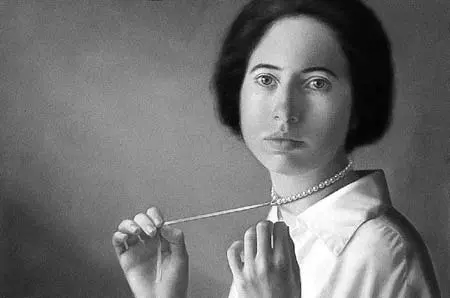
The representation’s theatrical condition affirms its persuasive impact. The self-portrait creates a rupture with the classical model, which inspires the artist and generates a new identity based on the identification of the subject of representation (the painter) with the object of representation (the painting). In other words, an identity is generated between the artist and the painting. The theatrical dimension is felt when the creator and work coincide. The model has the double condition of being passive and active. Victoria does not only represent, but she is the object of representation. Her work unfolds in a game of substitutions or an exchange of roles that dramatically transforms the meaning of the signified and the signifier. The isolation of the main image and its relationship with a transcendental space grant it a theatrical breadth that heightens the intensity of the artistic dialogue, which becomes even more dramatic in those canvases where the same female character is multiplied. The poetics is linked to the thematic recreation. Taking advantage of the relationship between the works as spaces for esthetic reading and their title, the artist quotes the great masters of painting: Degas, David, Sargent, Bronzino, Waterhouse, Georges de la Tour, Caravaggio, Ghirlandaio, and Vermeer. In a sort of game of critique, the painter moves from the document to the monument somewhat à la E. Panowsky. In other words, what is being represented is anchored in the History of Art, and at the same time, it pays a critical homage. In this fashion, the process of character substitution banalizes de historical dimension of the painting (its condition as a document), while at the same time, it consolidates itself as a contemporary piece of art (its condition as a monument). As a result, there’s a balance and a game between the representation’s weight and lightness. The fact that the representation sustains itself only in the self-portrait of a woman turns this work into the stuff or source for a study on substitutions. The historical material could be cross-referenced with the image being represented —Victoria Gitman’s self-portrait— and thus be compared to, among other things, the recreation of the models of classical beauty.
When glancing at the thesis proposed by the artist, one senses a historical, critical, artistic, esthetic, and feminist preoccupation, which serves as a springboard to produce art and engage in a dialogue with the public. In this fashion, Victoria Gitman proposes a critical dialogue with Art History and its phallocentric axis, tilting it in favor of the feminine.
MADELEINE IZQUIERDO DE CAMPOS
* Editor’s note: One of the most important traits in Victoria Gitman’s work is the quality with which she handles realistic representation —with techniques from the Renaissance and delicate meticulousness. The richness of color, particularly the way she depicts the porcelain-like hues of skin, and the painstaking labor on cloths and folds, are proof of an incomparable technical mastery, product of months of work and dedication.)