
Since 1988, the Bogota Biennial has been held by agreement between the Museo de Arte Moderno and the Bogota City Hall. For the first time, participants in the VII Biennial were selected from entries responding to a call for proposals for projects bearing a direct relationship to the present historical moment. 147 artists responded to the convocation; 19 projects were selected from this group by the jurors Gloria Zea, Álvaro Medina (the director and curator of the MAM, respectively), Jaime Cerón, Carmen María Jaramillo, Luis Fernando Valencia, and Eduardo Serrano. These projects which dealt with various different issues such as the city, nature, violence, loneliness, and isolation, were exhibited at the Museo de Arte Moderno de Bogotá in October. Seen as a whole, the works that comprise the VII Biennial, lead us to think that contemporary art has become a kind of sensible or physical appointment, a commentary that sometimes uses the experiences of art and sometimes does not, in order to demonstrate the many aspects relating directly to the situation of a country in crisis or the many notions which have been formed within the framework of western thinking, which is also “under suspicion”.
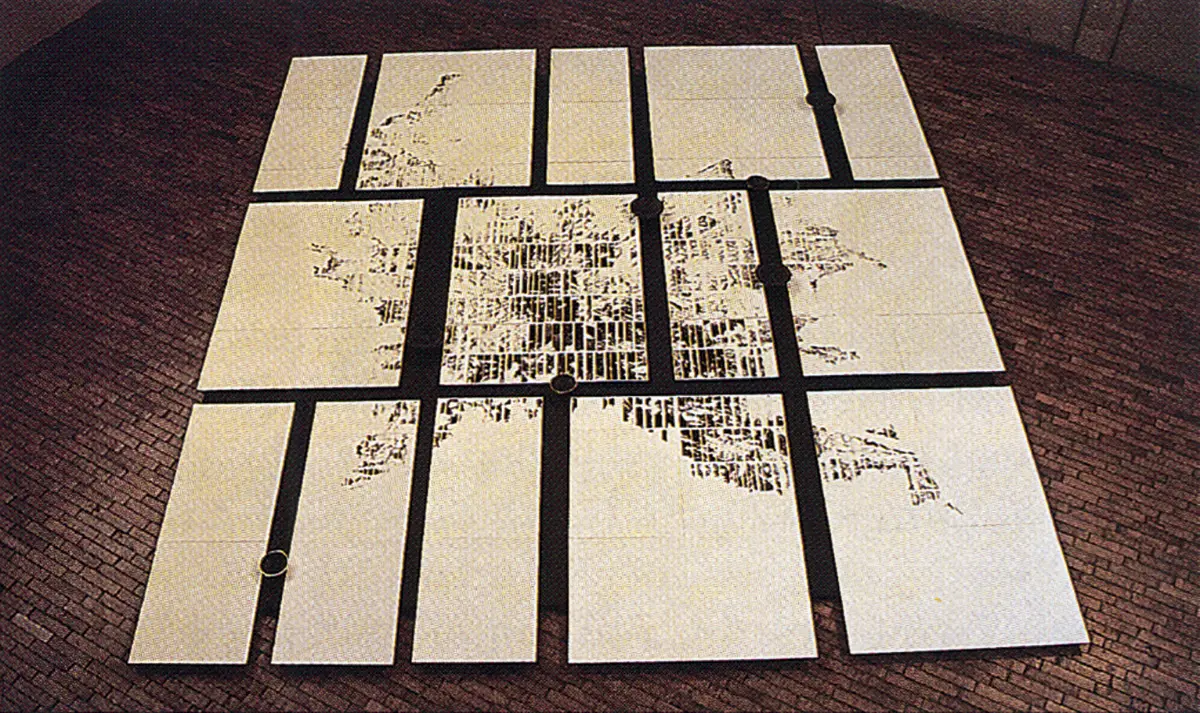
One of the most interesting pieces in this Biennial is that of Beatriz Eugenia Díaz, an artist who began to study music in 1969 at the age of four and then continued at the Andes University, where she simultaneously developed studies in music and visual arts. This experience set the course for her current work, which seeks to interrelate musical and sound structures that take place in time with plastic forms that exist in space. Her laureate thesis work No hay absoluto (There Is No Absolute), was her first one-woman show and made her known to the public.1 Her work, which has been seen in various national exhibitions, has been characterized by an impeccable, minimalist rigor in the use of materials and the precise placement of the components in space, qualities that are evident in the piece exhibited at the biennial entitled Minus One. This is a sound installation, which refers subtly and effectively to the violence in Colombian territory and consists of a section of floor and another of wall. A blackboard, placed on the section of the floor that is diagonal to the quadrangular gallery space, serves as support for a drawing the artist defines as a “melodic drawing” that consists of black ink and sounds on white sheets of paper. The map of Colombia has been printed on it through the technique of monotyping. The central part of the country is shown as a kind of explosion, a violent burst contained by the slightly dislocated boundaries of the territory which, despite their distortion, allow displaying the characteristics of a topography all Colombians identify with. The sheets of paper are arranged in groups with speakers placed among them. These speakers emit a nearly imperceptible sound comprised of three soundtracks in which the number ‘7’ (the number of letters in “Colombia”, leaving out the “o” which is repeated) plays a key role. The first soundtrack is based on the whispered phrase “one minus one more”. The second is a melody played by the artist on the piano and structured around the word, “Colombia” and subsequently manipulated on the computer. The third soundtrack is a rhythm based on the number 7, which as an odd number yields an arhythmic rather than a rhythmic structure. On a side wall, through which the spectator enters, a thin gray strip of paper that blends with the color of the museum walls has been placed at the spectator’s eye level. In this strip, a text reads "....and yesterday there were 146... and four more... and another day there were seven: four and three more... and one and one more and ‘NO MORE.’ And one plus one plus one made three." These words have been lifted from the statistics that the media emits daily on the numerous deaths that are duplicated every day in the different murders and terrorist strikes committed in the country. The strip continues reading "One plus one left. Those who leave; those who wait no longer, leave; those who cannot stand it anymore, leave; those who say: ‘NO MORE’, leave; and others leave too. Those who forgot, leave, and the ones that were forgotten already left... and there were more." This of course refers to the massive exodus that takes place in this country plagued by the fear produced by an indiscriminate violence that has no truce. Finally, in this long “sound” strip, though the words are just written, in the continuity of reading them the spectator finds a particular rhythm in the articulation of the sound of the words which end in a long stretch in which the following sentence is repeated: "... one minus one minus one minus one minus one minus one minus one..." These words finally suggest a progressive subtraction in which the viewer is ultimately excluded. In this way, the spectator is invited to penetrate, through images, sound, and words, in a reflection that –with the intelligent manipulation of a few subtle elements conceived around a mathematical game that builds a sonic as well as a plastic structure– refers to a reality which threatens to dissolve our life and with it, all that has been constructed so far.
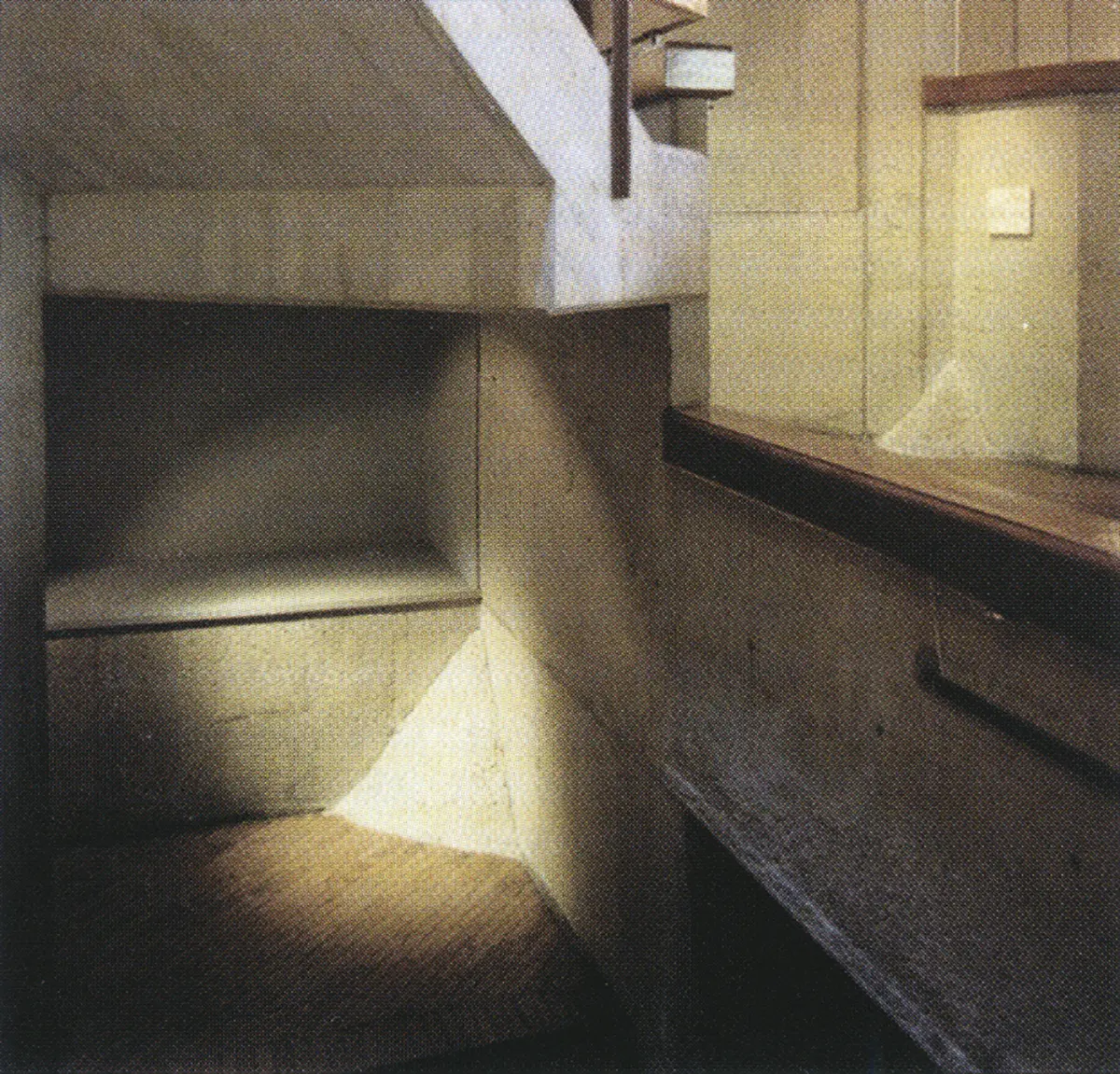
Rosario López received the Biennial’s first prize with Esquinas gordas (Fat Corners), a work elaborated during the past two years, composed by an installation located in different corners of the museum and by a photographic register of eleven color photographs. This project deals with the theme of the city and with the private and the public as observed by Rosario López in a phenomenon that takes place in the neighborhood of La Candelaria, the oldest in the city. Transients began to use certain corners of this neighborhood in the city as a place to urinate and defecate –private acts done in a public space. For obvious reasons, these acts were disagreeable to the homeowners and led landlords to close the corners by filling them with concrete, creating the “fat corners” which are essentially the negation of this space. This urban phenomenon was transferred to the museum in the form of the shapes described, first as a kind of sculptural piece installed in the museum so as to a sculptor's work that melds with the space, and second hand, as a photographic image –which in virtue of its plastic values– occasionally asks for aesthetic tones, as it sometimes recalls the way certain qualities of vernacular architecture are made to stand out in architectural illustrations. Some of the corners reveal themselves as textured forms, on other occasions as closed volumes, and one image shows a fat corner on which someone has placed a cross so that it leads volume to suggest both a tomb and a mountain. In each of the three cases, the corners are a testimony with a particular meaning of their own and are also pleasing to look at. In other instances, the corners are revealed as integrated with that urban phenomenon, graffiti, in that the transients’ words and phrases are scrawled across them and the walls that frame them.
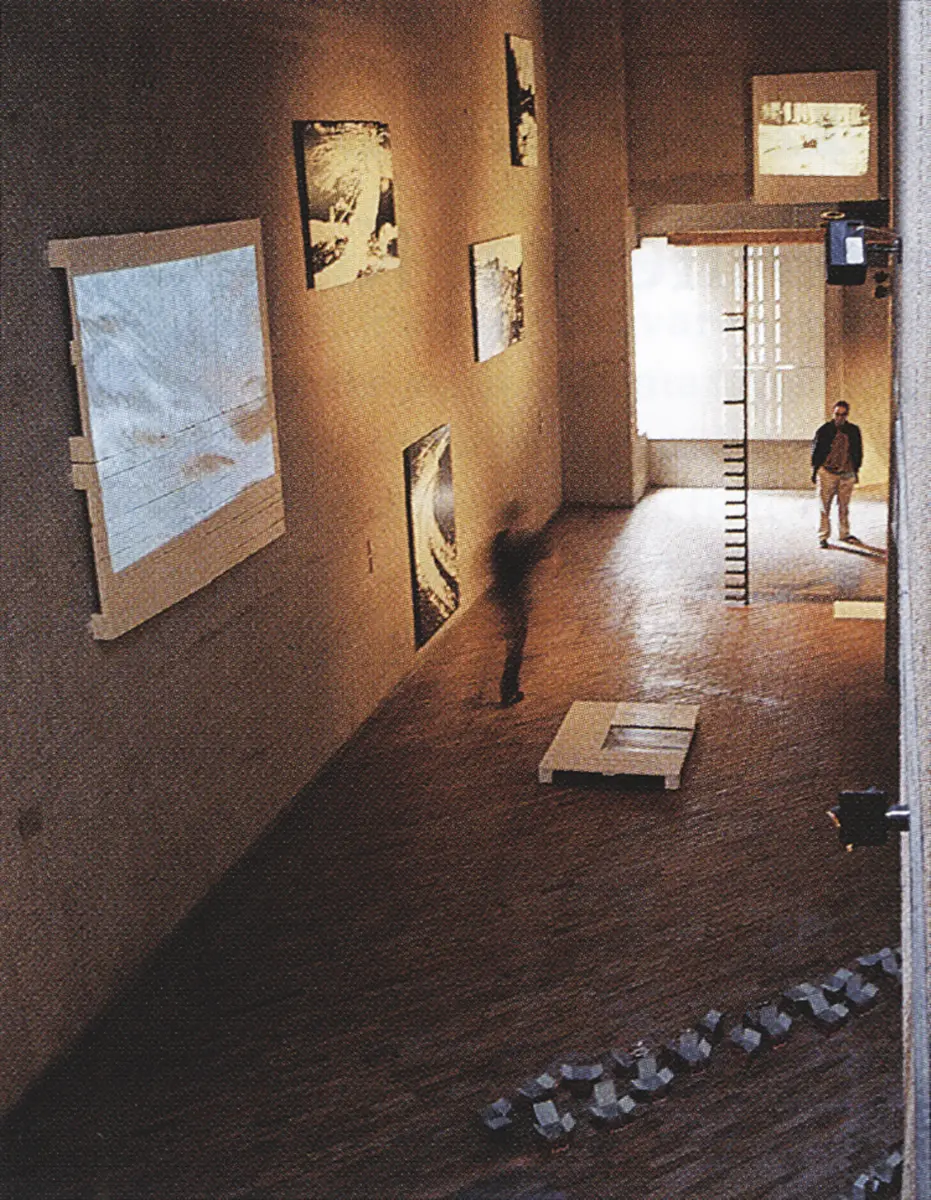
In Adriana Castro’s piece, which received an honorable mention, we encounter a work that at first glance borders on the “documentary.” The origin of this project had its beginning in 1998 with Castro’s thesis project in Visual Arts at the Universidad Nacional and has been developing over these years until reaching its final state with the project for the Biennial. It is based on the course of three rivers that pass through the city at various points. The installation is comprised of large-format, high-contrast photographs in which the course of the Juan Amarillo River is registered. The stasis of the river contrasts sharply with the continuous flow of water presented in video images of the Tunjuelito River which are projected onto whiteboards called estibas. Estibas are wooden structures collected from zones alongside these rivers and used as a support for certain household appliances. Carefully painted and waxed, these pieces, were arranged throughout different places of the exhibition space. These shapes are in debt with Danilo Dueñas’ (who also took part in this project) work Enchapes. The boards, which also cover the museum’s windows, are also complemented by another weathered, wooden structure that serves as a support for the slide projector that projects a series of images documenting the course of the Fucha River. All these various elements were carefully arranged in the space and they give their testimony of a certain invisible fact: Our city’s rivers, when they are channeled as the Juan Amarillo, around 30th Avenue, are virtually invisible under so much pavement.
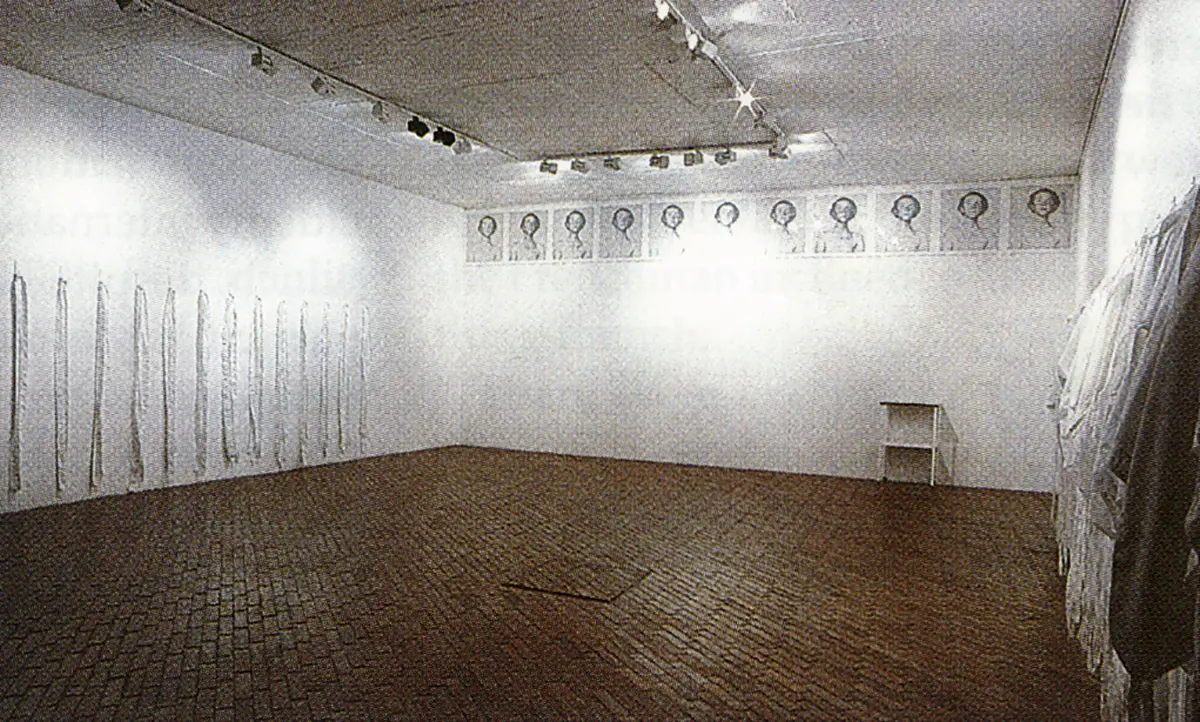
Another well-resolved and strong piece is the work entitled Sala de aislamiento (Solitary Confinement) by the Antiochian artist Libia Posada. She transformed the galleries on the museum’s first floor into a cold, white, sterile impeccable, and silent environment such as a hospital-like atmosphere in order to demonstrate how the Western World, with its desire for order, clarity, and classification, has dealt with mental disorders. Upon entering the space, the viewer comes upon some metal file cabinets, with the drawers clearly labeled “Paranoid States”, “Psychosis Brought on by Forced Isolation,” and “State of Confusion.” An interrogation lamp hangs from each corner of these drawers, bringing to mind the chambers where people were grilled for information by whatever means necessary. The white coats of those in power and in the right hang neatly and in a perfectly straight line along the walls. A perfect grid has been drawn in fine pencil lines on the back wall, suggesting at once the ideal ordering of space. Above are installed a series of photographs printed on plaster. They show the face of a young man whose head and body have been marked, probably in preparation for surgery. A metal table painted white and gray makes the space still more terrible and merciless so that the sentence placed at the entrance becomes a real experience: “....where to flee to? Where to hide? What outside can we escape to when space is nothing more than an awful outside, inside?”
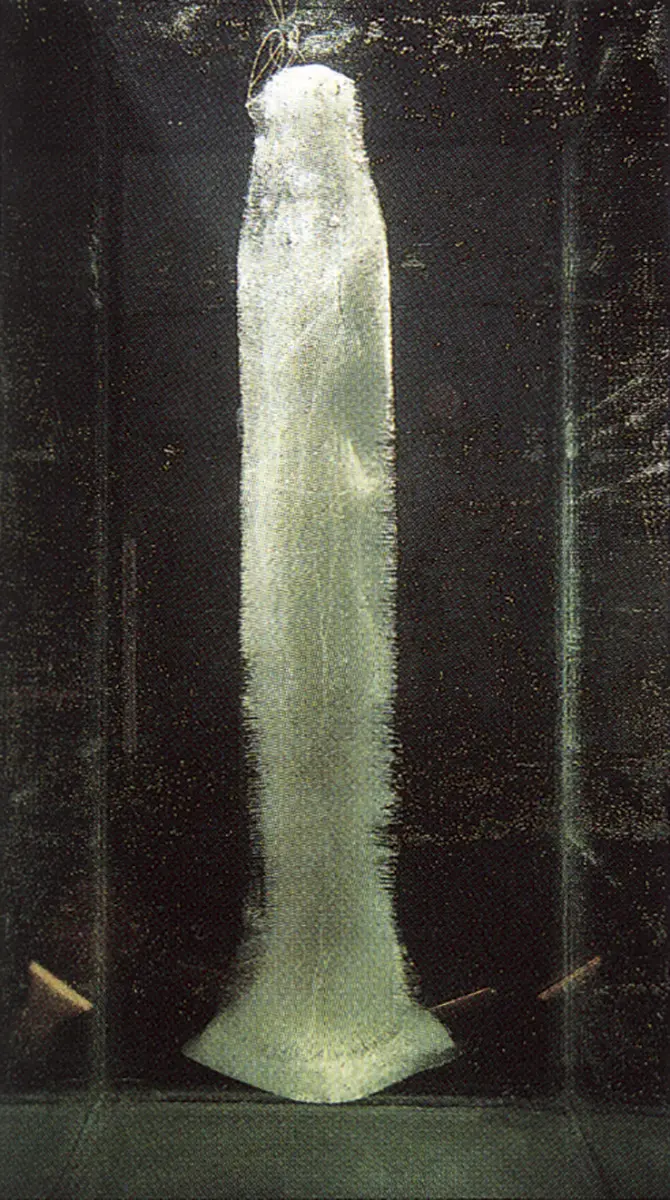
Contiguous to this room is In Memoriam by María Elvira Escallón, consisting of a metal and glass urn, the upper part of which is filled with water. A column of ice measuring 124 cm. x 40 cm. was placed inside the urn and allowed to melt over a 20-hour period. This piece can only be seen on certain days of the week. While I did not have the opportunity to view it, I did see the images recording the various stages of the melting of the ice figure, complete with plinth and capital, and the unusual shapes it assumed until disappeared completely. Only water remains as evidence of the encounter between water and ice. The experience, which grew out of images in a dream, takes its shape from the behavior of the materials, which gives the piece a relationship to time, movement, fluidity, and diffusion. This work has much in common with the work of poor art of the 70s that emphasized the behavior and the physical and chemical characteristics of the materials used. Sharing the museum’s first floor is José Gabriel Calderón’s Baño de lágrimas (Bath of Tears), a dark, complex, labyrinthine environment involving images and sound. The piece brings the viewer into a woman’s bedroom, face to face with her bed, a bookshelf, and an open closet in which her clothes hang, while in the distance a heartbreaking and continuous weeping is audible. As the viewer advances from the bedroom along a dark hallway to the bathroom, a moving image and soundtrack reveal a woman crying inconsolably to the sound of running water. This piece contains interesting elements, particularly the one in the bathroom that, despite having very different intentions, brings to mind the drawings of Óscar Muñoz. But a too literal handling of the space and of the “staging” prevent the images from being as effective or as unsettling as those of Muñoz.
Other participants, like Eduardo Sena, opted to use video. His piece Upst, uses animation and three television monitors to tell an urban story that culminates in a traffic accident involving three characters. Each event is shown on a different monitor and with the help of a diagram. Marcelo Alejandro Villada edits footage from the news and other programs and uses repetition to show how raw violence is presented in a veiled way.
The photographic polyptych shown by Edafos Group (consisting of Alfredo Virgüez and Carmen Filippidis), refers to the tracks that have persisted in Nazca since ancient times, and the ephemeral tracks left in the sand by a passing vehicle or marks left on skin by pressure or scratching. The images of skin are in color, while the others are black and white. The photos of skin are close-ups so large that at first glance they look like landscapes, and not until the viewer looks more closely are the pores that give the skin away as something alive and wounded revealed.
Adriana Duque’s piece, Paroxismo (Paroxysm) deals with the impossibility of dialogue and the negation of the other. It consists of a dining table surrounded by six cast iron, high-backed chairs turned with the backs facing the table. The dark color and weight of the materials combined with the sobriety of the design drive home the idea of a disintegrated meeting, of a dialogue taken up by people unwilling to listen. The mood is tense and intransigent, and the austere and somber look is frightening. The imposing presence of this piece contrasts sharply with the means used by Gustavo Turizo in ¿Y le tuviste miedo a la sangre? (And Did the Blood Scare you?), a succession of drawings in acrylic on canvas based on the image of the ideal young executive or successful businessman as represented in simple advertisements. The figure is shown in different positions but is always smiling brightly. These images are interspersed with drawings of a dog in various stages of its training. At the bottom of them are printed stock phrases like “What do you want to be when you grow up?”, “Who is the king of the castle?”, “Do you have a girlfriend yet?” and “Boys don’t play with dolls.” This game of word and image, which is preceded by a typical group class photo, appears to undermine the cultural values imposed in men’s traditional education, that is to say their “training” for success.
If we take the works in this Biennial as a commentary on a complex reality, we find examples of simplicity and literalness and others of great complexity. The group composed of Nómada, Rafael, Mora, Mario Parra, and Máximo Aponte, presented Proyecto Porsche (Porsche Project), a work that seems to refer to the condition discussed by Deleuze, “the disappearance of the world in symbols and the masking of this disappearance.” The artists use an advertisement that discusses the perfect condition of a Porsche in specialized, technical language (McPherson suspension, 17 valves, gentle stops, 1900 c.c.). Another symbol, a map, and an object that serves as a traffic signal confirm Deleuze’s discourse about a world of symbols that hides reality.
Rafael Ortiz’s Mesa de lectura (Reading Table) and Selva húmeda (Humid Jungle) are comprised of three parts: a bookcase, a shelf, and a kind of tiny garden. The garden contains natural elements from the mountains, moss, and other small plants that protect the ground and the environment and which require constant watering by the viewers, for which purpose several sprinklers have been supplied. The presence of nature in this piece invites the viewer to play with associations and reflect on the subject of violence, a reality that has established itself with utter naturalness in our country, or perhaps because of the violent “nature” of its inhabitants.
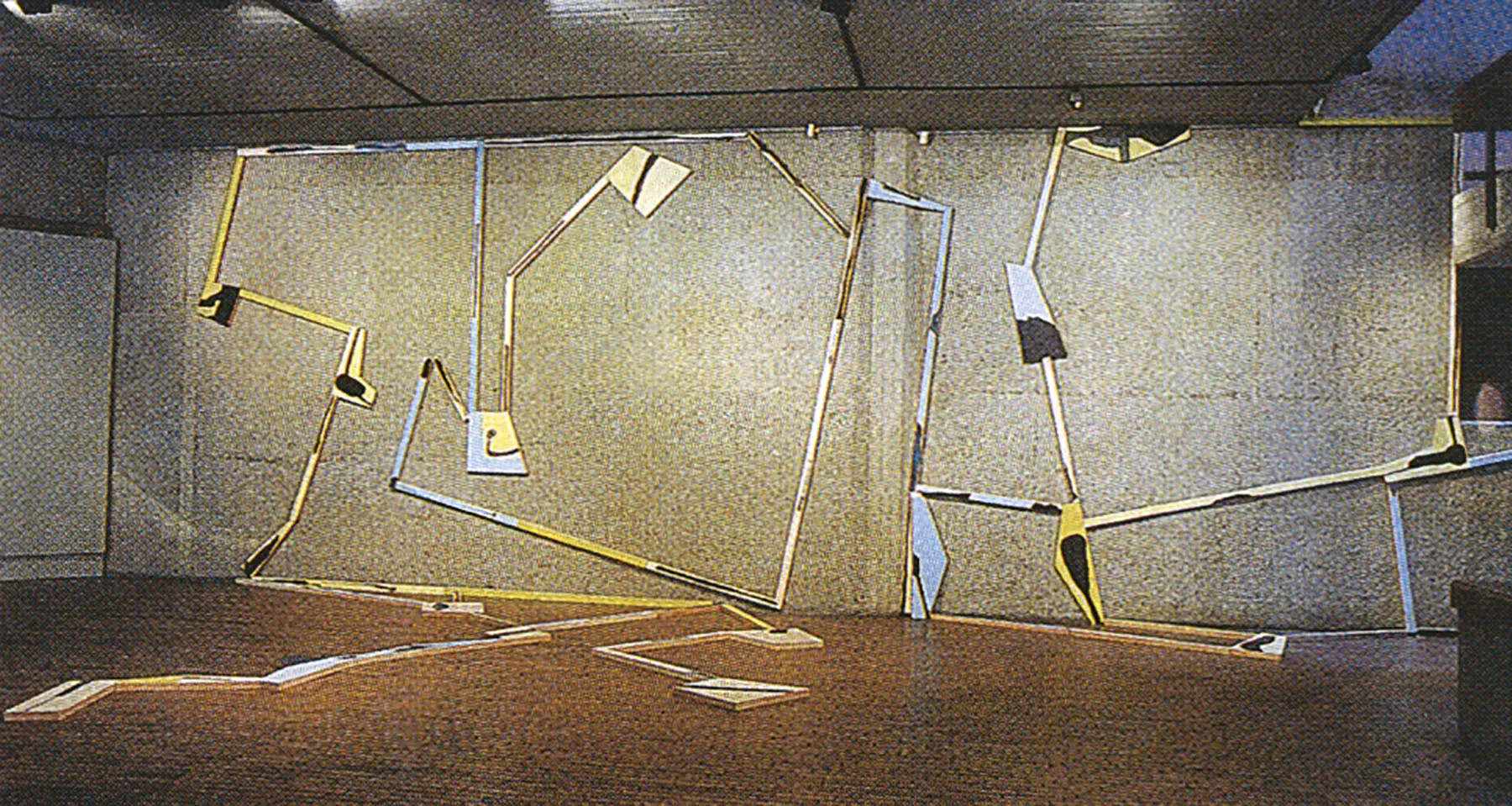
Other participants in the exhibition included María Fernanda Zuluaga, with La memoria en el espacio (Memory in Space), a pictorial construction in pastel tones that interacts with the space; Jaime Ávila, with El proyecto Radioactivo (The Radioactive Project), which uses photography to record the marginal living conditions of the inhabitants of certain neighborhoods of Bogotá; Santiago Vélez, with Contador (Meter), a rather hermetic piece; Liliana Estrada, with a drawing called Tinieblas (Darkness), which seems to be related to the labyrinthine work of Piranesi; and Germán Toloza, who showed an installation called Renacer en el vacío desde la cumbre (Rebirth in the Void from the Peak) which includes painting, sound and found as well as constructed objects.
NOTE
1. There is No absolute, Centro Colombo Americano del Norte, Bogota, 1992.
MARTA RODRÍGUEZ
Professor at the Arts Faculty, Universidad Nacional.