
The seductive series of collages that Alejandra Padilla presented at the Diana Lowenstein Fine Arts gallery pose questions about our ways of seeing and about the notion of originality. If, as Water Benjamin tells us, “The presence of the original is the prerequisite of the concept of authenticity, "1 what and how does a work of art based on reproductions of photographs mean, of whose negatives, in turn, innumerable copies can be made?
Without a drop of paint, just with illustration paper —cut, copied, dented, pasted— the artist paints images that seem to reproduce summer dreams, archivist obsessions, and unending kaleidoscopes. A collector of beautiful images, the artist, born in the northern province of Tucumán, Argentina, in 1961, composes her works from photocopies of copies. These are fragments of commercial shots that originally appeared in glossy magazines related to advertising, design, and fashion, all of them taken in the 1990s and all of them the works of famous photographers.
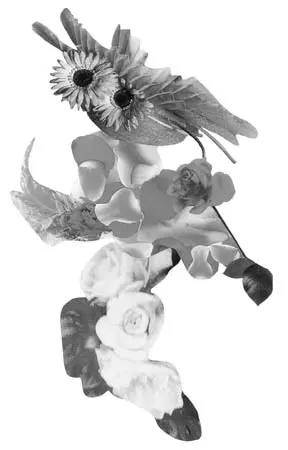
Padilla appropriated these edited images —dazzling faces and figures, captivating pieces of jewelry and fragrances, garments and furniture, elegant dresses and hats, sensual flowers and gems—and breathed a new life into them. Copying and repeating them over and over, she empties them of their identity and, usually, makes them unrecognizable. The artists call them vessels, angels, polyscopies, petals, and catalogs.
Her gallery of forms and colors is only a minimal portion of the large offer of visual representations fighting daily for our attention. She undermines the importance and prestige of the advertising code, transforming it into an object of art, closer in language to painting than to billboards. The photographic material (designed to advertise beauty, belonging, and power) is presented pasted to a cloth support, fixed with varnish. Padilla’s collages seem to reach somewhat beyond the complex visual game or pleasurable search; they express a tension between desire and possession, as well as between what’s fleeting and the very idea of perfection.
Padilla’s different series opens a wide array of formal possibilities. While the collection of “angels” refers back to Dadaist collage, such as Hanna Hoch’s, her polyscopies disassemble figuration to the point of turning it into abstraction. At this point in its almost perfect realization, the polyscopies (a neologism meaning multiple gazes) resemble pixels taken from some design software. But they are, on the contrary, the exaltation of manual craft and rational thought, and Padilla’s love for mathematics and for constructive labor filter through them.
The collages have an internal logic and a mystical side that only the artist seems to be interested in. Padilla takes light from the photographs (following some premodern cultural beliefs that photography steals the soul) and creates invisible angels, resplendent mandalas, and refulgent vessels that promise to take us to a deceiving happiness.
Beginning or end, Boceto para mayors dimensiones (Sketch for larger dimensions) appears as a catalog that condenses and multiplies the possibilities of doing and seeing. In one of her works, the artist gathers each and every one of the pieces that, thanks to the repetition of their motif, later become part of polyscopies, one way of approaching the optical illusion of movement. On their part, Color (Color) and Blanco y negro (Black and White) incorporate the ideas of play and of compilation. These pieces summarize a whole decade, the 1990s, and exhibit as in a quarry the resignified materials of Padilla’s work. In her Pétalos de color (Petals of color), Padilla seems to be exploring a new transit towards volume. Dented and pressed, the pieces of paper settled in unforeseen ways on the fabric support. The composition has been worked on the basis of accumulation and discard, along with the saturation of consumer goods and Padilla’s interest in 3-D. Without a narrative, this self-taught artist’s oeuvre deepens the enigma of the work she initiated in 1993.
NOTE
1. The Work of Art in the Age of Mechanical Reproduction, Art in Modern Culture, Phaidon, 1992, p.299.
VICTORIA VERLICHAK