
The work of Angel Ricardo Ríos (Holguín, Cuba, 1965) centers on the bi-dimensional and tri-dimensional creation of structure, either utopian or utilitarian, that can be called, in the most general sense, furniture. These works that bring together the functionality of furniture with that of sculpture, come to us in the form of drawing, painting, sculpture, and photography.
At the Nina Menocal Gallery, Ríos presented, for the first time, only utilitarian pieces. Among the most enigmatic were the two works opening the show, comprised of two pyramids, one yellow and the other purple, attached at one end to the floor through a metallic structure. On the wall, some photographs show the artist using these pyramids, which, when pressed at the base (perpendicular to the floor), push into the walls, creating an ergonomic space that turns the whole creation into a chair. Guided by similar photographs depicting the artist, we follow the established route through the gallery to find three fiberglass pieces in the form of pillows with wheels attached to the bottom; these are intended to be used as chairs also, either indoors or outdoors thanks to the material. In the next space, we find the photo of another pillow seen from above, illuminated by a line of light boxes; the object is repeated until it fills the whole length of the room, giving it a warm luminosity. The only titled piece in the show, Rossi, is also a pyramid, made in this case in wood, which when placed on the floor with its top part unfolded, turns into a chair. What seems to be drawers that also function as light boxes contain photographs of female underwear, and in turn can be used as side tables or coffee tables. Wooden structures with cylindrical constructions in cloth, one yellow and the other green, hanging from their sides, turn into simple closets with shelves and drawers when the rectangular body’s front panel is opened. More pillows, this time in resin and emanating light from the installation occupy the last space in the gallery.
In these pieces, Angel Ricardo Ríos plays with the concept and the limits of art. Throughout the 20th century this was one of the most recurrent explorations among artists; Ríos, however, gives the whole pursuit a new freshness and simplicity by using basic geometrical shapes such as pyramids, cylinders, rectangles, and cubes, and by creating forms and functions in response to basic needs such as sitting, lighting, and storing clothes.
Ríos also plays with the spectator’s initiative, these being interactive pieces that are revealed only when one dares to try them or experiment in search of their function. The artist tests the spectator, daring him or her to touch and manipulate the sculptures.
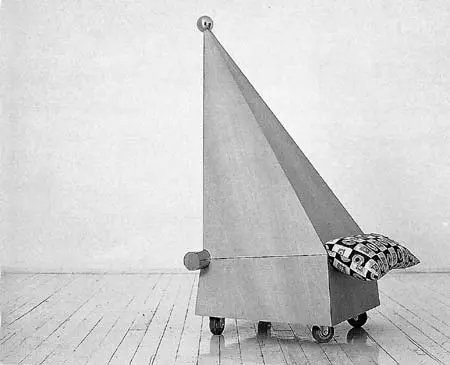
By titling the show Mi casa (My Home), Ríos makes an analogy or a parody of the contemporary way of life, creating a new world under his own rules through this furniture, which it’s as esthetic as it is functional and will be revealed only through interaction. Ríos appeals to a way of life where everyday experiences are redefined, proposing a closet customized to his own needs, with two drawers and four shelves made to his own scale, camouflaging chairs as pyramids, and hiding lamps inside pillows. Keeping his distance from purist and minimalist tendencies in the use of color, Ríos explores textures, tones, and a variety of materials and forms. These works also widen his range, including now both indoor and outdoor pieces.
Without entering into a debate about whether these pieces belong to the world of industrial design or to the world of sculpture, Ríos creates objects that are impeccably made and possess a unique aesthetic. The esthetic investigations sustained by the artist for over 10 years around the theme of furniture, have now reached a point of maturity. His forms once were impossible to build, then very difficult to use, but in Mi casa there is a perfect coordination of form and function.
FRANCISCA RIVERO-LAKE