
It has been ten long years since Antonio García Ponce (El Salvador, 1938) last exhibited his work. With many personal tribulations and professional disillusions, but with hard and consistent creative work, today he’s produced an oeuvre that confirms what Marta Traba said about it in 1977: "quite exceptional due to its well-defined expressive condition." The series of drawings and paintings exhibited here were done within the last three years. This Salvadorian artist began working in the 1950s when he distinguished himself by his clear and outstanding drawing skills, for which he received several awards. During the same decade, he started painting, which also gave him some awards. His native country hasn’t been the only one that has fed his artistic needs; he has traveled widely to study, visit museums, and distill the essence of his creative capacity.
Painter, draftsman, engraver, and teacher, Antonio García Ponce studied drawing and painting at the Spanish painter Valero Lecha’s workshop in San Salvador, lithography and engraving at the Pratt Institute in New York, mezzotint at the IMBA’s Taller Libre in Mexico City, and visual language at the School of Visual Arts in New York. His work is recognized as some of the most important in Central America and can be found in prestigious collections in Latin America and Spain. Many critics have seen it as an artistic complex of great visual and emotive strength. This new show of drawings and paintings confirmed the full-time dedication of an artist who is permanently haunted by his ghosts but who is conscientious of his responsibility to his work and the development of art in his country.
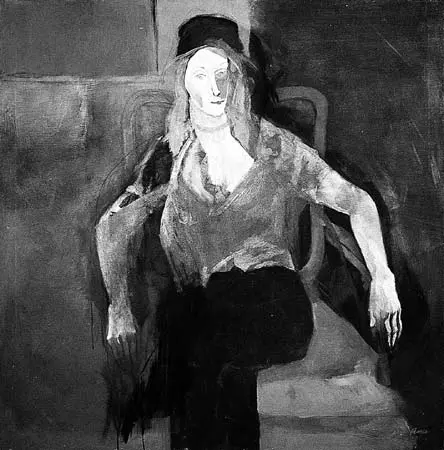
García Ponce is an expressionist, figurative artist who favors topics that deal with human anguish. His main interest has been the human figure, treated technically with deformations and subjectively with internal anguish. These characters, assaulted by their almost-apocalyptic visions of the world, are completely isolated, and they come from unconventional sources such as insane asylums, whorehouses, and the lower strata of society. In general terms, García Ponce’s work has been determined especially by its graphic quality and the drawn form’s tonal impact, which artistically is related to the strong color effect that the artist reserves for some sections within the painting’s structure. The work reveals the struggle between different forces, among those the artistic ones. We could say that it expresses a Manichean vision of the subject, which is debated among archetypal forces such as good and evil, turbulence and serenity, darkness and light, order and chaos, reason and instinct. The artist unconsciously uses this resource even to confirm the extraordinary expressive force of his drawing and painting. As parts of a whole, the characters move at the artist’s discretion, occupying the space according to a pictorial agreement he has designed. For example, in the oil painting Comediantes (Comedians), a feminine figure painted in white comes forth to the foreground while lying at the feet of other, standing, figures exuding an exuberance of colors and gestures. In Desnudo En Cuarto Tranquilo (Nude in a Quiet Room), we see a yellow feminine figure who, seated at the center of the canvas surface, stands out due to her posture and her strident color against the blue background.
It is difficult to constrain our artists within artistic codes placed inside tendencies or movements that belong to art history. If here we speak of expressionism, it’s not because we’re referring to historical expressionism, but because García Ponce’s work expresses the power of a particular way of painting that is
linked to a concrete reality —his reality. As a man who is sensitive to his time, this son of Central America hasn’t ignored the cruelty of a reality that is simultaneously full of misery, love, guilt, irony, and desire. The characters have a habitat: themselves. That is their reality. An artist loaded with anguish gives life, on
the canvas or the paper, to those characters who cannot avoid the gaze of who’s looking at them while trying to find a common point with the other. The strength of the color and the line play in perfect harmony with the theme. A drawing purposely undone, a paint stroke purposely broken, faces purposely erased—everything in García Ponce’s work is consciously calculated. The work is inscribed in the expression of all the formal elements that make it up. García Ponce should continue ahead, and not wait another ten years before showing his work again.
BÉLGICA RODRÍGUEZ