
One day in 1964, Salvador Dalí showed up at the Pratt Graphic Arts Center in Manhattan.1 The Center was one of the printmaking Meccas in the U.S. and Dalí needed help for one of his works. He wanted the effect of some flies jumping off the forehead of the Virgin Mary (already engraved on a copper plate) towards the viewer. I was asked to translate what seemed to be a hermetic metaphor enmeshed in a salad of Spanish, Catalan, and French pretending to imitate English. It was not a metaphor and it did not have anything to do with printmaking either. What Dalí was looking for was a manual equivalent of a hologram, a 3D image to be seen without the aid of special glasses. Holography already existed at the time2 but was not part of popular knowledge. The first article that described and popularized the technical details appeared a year later in Scientific American.3 The search for a pre-holographic solution led Dalí to visit a series of laboratories and consult with scientists and, in fact, he did eventually make a hologram. I don’t recall the image, but it wasn’t the Virgin with the Flies. What is interesting in the story is that Dalí, at the height of his most stereotypical and commercialized period, nevertheless had an intellectual openness and interdisciplinary approach to things that drove him to find unknown techniques with applications that did not fit traditional art. In his search, he preceded younger artists from the avant-garde, like Warhol and Bruce Nauman, who later employed the same media.4
About that time Bell Labs was looking for artists who might be interested in working with the first models of computers. Bell’s scientists teamed up with artists and in 1966 organized a series of spectacles under the title 9 Evenings: Theatre and Engineering with artists like Rauschenberg, Whitman, and Paxton who used technological gadgets to achieve new light and sound effects in their happenings. Under the direction of both Rauschenberg and Billy Klüver (a scientist from Bell) these evenings generated the creation of a foundation, E.A.T. (Experiments in Art and Technology), with the purpose of stimulating this research in a more organized fashion.5 This work culminated with a competition and the products were then exhibited in a big show of art and technology in the Museum of Modern Art and the Brooklyn Museum, in 1968. Surprisingly, most of the artists who were in this show are now forgotten, with the exception of a few like Juan Downey, Hans Haacke, and Tsai.
Around the same time (1967) another project, Art and Technology, was being started by Maurice Tuchman for the Los Angeles County Museum. A show was organized for the Osaka World’s Fair in 1970 and subsequently exhibited at the museum. In this case, more established artists were gathered and connected with big corporations that provided money and technicians. Unlike the team and interdisciplinary approach employed in E.A.T, the projects were conceived separately by the artists. Many of the more interesting ideas were among those that never were realized, like the proposal by George Brecht to relocate the British Isles next to the coast of France employing hydraulic pumps. Rauschenberg made his Mud-Muse, Oldenburg the “Ice Bag,” and Warhol a version of his flowers to be seen three-dimensionally thanks to a process called xography.6
Somehow all these efforts shared the purpose of exploring how technology might enrich the artistic repertoire. Strangely enough, one was looking only for a “new art” updated with the latest technological achievements. The possibility of a “new science” where art could enrich scientific perspectives was never an issue. When in 1953 James Watson, Francis Crick, and Rosalind Franklin finally found a solution for a model of the DNA molecule, nobody stopped to think about the fact that the achievement was a consequence of sculptural imagination, however banal (two wound-up snakes from which the double-helix was deduced). With the Nobel Prize in 1962, DNA became fashionable and everybody fell under the spell of its design (including Dalí, who had memorized “deoxyribonucleic acid” and used it on every possible occasion).
Artists, as much as scientists, continued to use a compartmentalized vision of knowledge. There was a multidisciplinary intention of a technological kind, but not an interdisciplinary vision that might generate a new field of creation. I remember two crossovers during the sixties, scientists who entered art as individuals. They were Gerald Oster and Bela Julesz (although there might have been more). Oster specialized in the particularities of moiré patterns, the virtual design generated by the out-of-phase overlappings of two similar configurations. Julesz hid images among what seemed to be random accumulations of dots. The information only became visible when the viewer looked at panels with stereoscope devices.7 Both were exhibited in the Howard Wise Gallery in New York, which specialized in kinetic and technological art. Julesz did not have artistic ambitions and his work was a direct consequence of his scientific research. Aesthetically very appealing, they were appropriated by Wise for an exhibition. His images served to prove that three-dimensional vision occurs in the brain. The brain acts like a third eye that processes and integrates the information brought by the physiological eyes, compensating for their mistakes.8 Oster worked not only with moiré but also with light-sensitive paint A flash of light would register shadows of objects on the wall. Magically surviving the absence of the objects for an instant, the shadows disappeared sometime after, the same as the after image on the retina after being blinded by a spotlight.
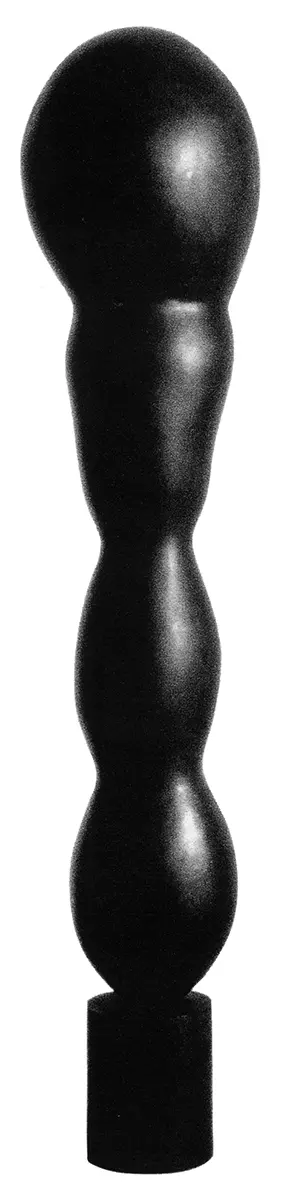
All these remembrances came about because Exit Art, one of the more prestigious and experimental alternative galleries in New York, presents Paradise Now. The exhibition is dedicated to the newest genetic innovations and their impact on art.9 I went with the hope of seeing truly interdisciplinary works that would erase the borderline between art and science. I wanted to see hybrids, a kind of genetic change in art (and in science) that would expand my horizons to the point of making me feel that art in its more or less traditional form, including what is done in the most rebellious avant-garde, doesn’t make sense anymore. Instead, I found that the majority of works were didactic, illustrative, and superficial. Many pieces seemed custom-made for the occasion rather than the product of a profound investigation of either genetics or the issue of disciplinary limitations. The exhibition is about art as we know it where the scientific excuse didn’t make any dent. Some of the works, however, deserve to be pointed out. Ronald Jones, in a counterpoint to Watson, Crick, and Franklyn, has a big sculpture (1989) that seemingly refers to Hans Arp. But the bronze is just a big-scale reproduction of a DNA fragment of chromosome #13 with mutants that generate cancerous tumors. It can be seen as a big monument in honor of the enemy. The piece questions, even considering the memory of the first experience of eating spinach, that prejudice that survives in us: what is good is desirable and what is bad is ugly.
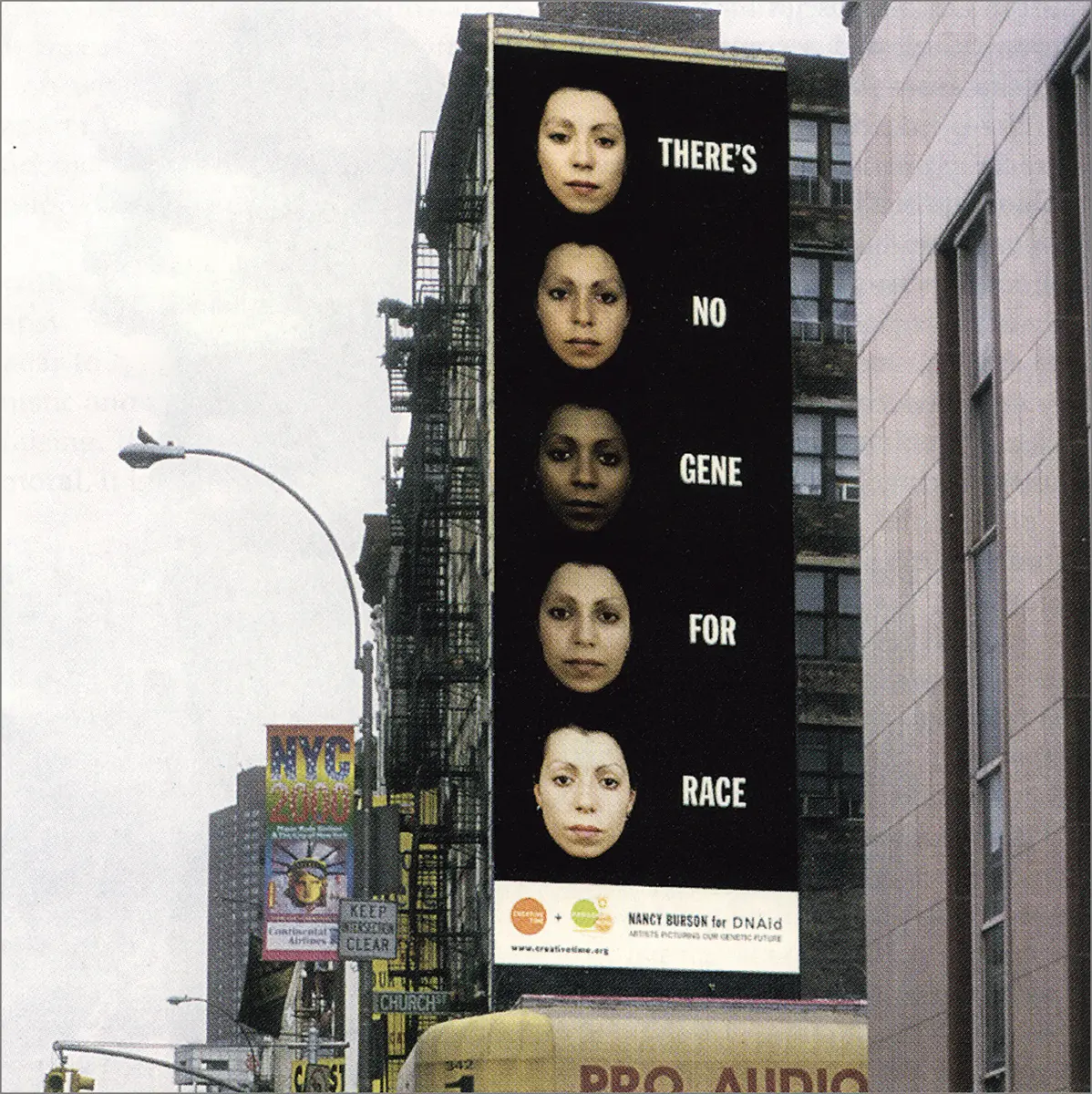
Nancy Burson is probably the only artist here who in real life managed to transcend art as a disciplinary enclave. Burson developed a computer program that fuses physiognomic characters. She is known for her creation of the racially average man (a balanced combination of all the racial characters into one single face), of the super-beautiful actress (an average of the most successful movie actresses that, paradoxically, does not produce a particularly attractive result). But, above all, she is famous for her program that simulates aging. This program allows visualizing the facial changes in a person’s future. Even if the result is not guaranteed, the program seems precise enough to be useful for police work. It allows to update faces of children missing for a long time, a reason for the FBI to have bought the rights to the program. For this exhibit in Exit Art, Burson prepared a machine that keeps the facial build of the user while it transposes it into different races. The piece in the gallery was accompanied by a billboard that spans five floors of a building. It shows five racial versions along with a text saying: “There is no gene for race,” a scientific truth since the genetic legacy of all races is practically identical. But this work in particular reminds the one Tibor Kalman made more concise and funnily in Benetton’s Colors. The Queen of England appeared as herself, but with black skin, something impossible not because of color, but because of royalty.
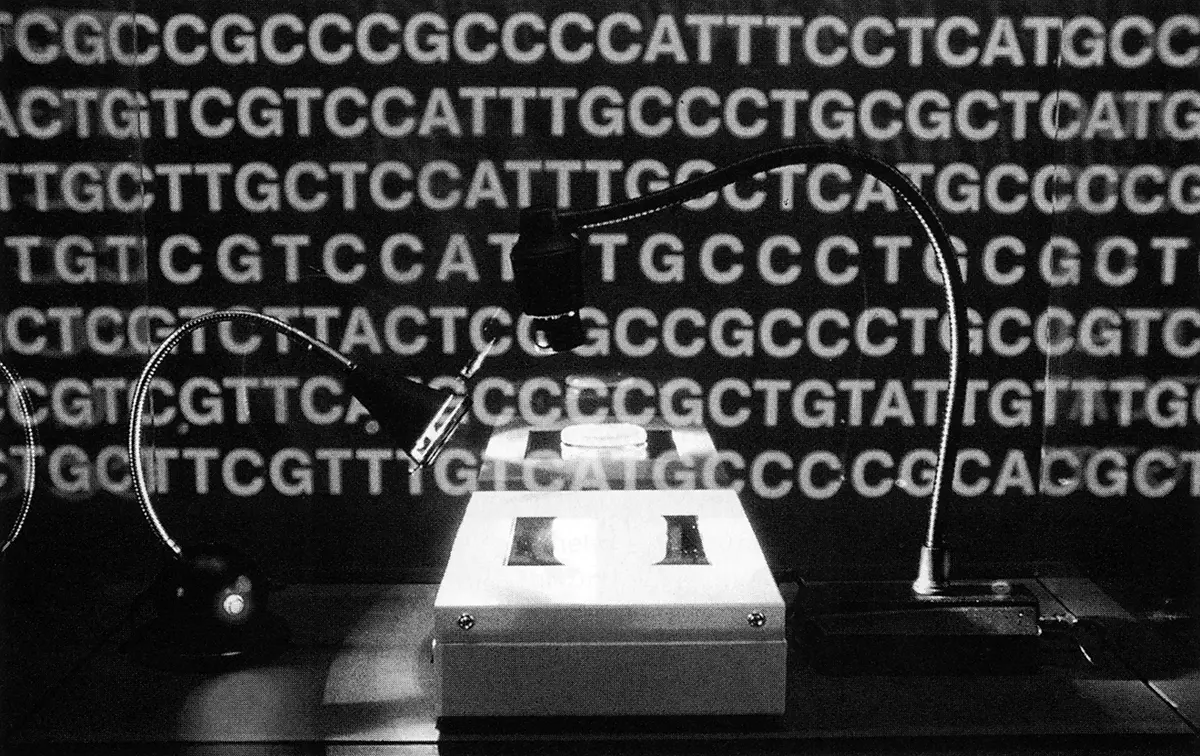
Eduardo Kac, a Brazilian artist residing in the U.S. who for many years made holographic visual poems, has a transgenic project. Kac took the biblical quote where man receives the power over everything that moves on Earth and put it into Morse code. On the basis of the dots and lines, he created an artificial gene representing the text and implanted it into the genetic structure of bacteria. The image of the bacteria living in a Petri dish is picked up by a camera and projected onto a screen. The public can light the bacteria with ultraviolet beams and thus introduce mutations that change the original text. Perversely, Kac makes us simultaneously omnipotent and ignorant. He allows us to become God (it is not anymore the biblical power but the change of the essence of living creatures ) while we are put in the position of irrevocably losing the meaning of things. The re-translation into Morse of the genetic code mutated by the intervention of the public initially produces misspellings but, eventually, these accumulate and meaning is completely lost.
Laura Stein combines the cruelty of the Chinese tradition of foot binding with the humor of the ceramics by Nadín Ospina. Vegetables and fruit grow pressed into molds bearing the design of cartoon characters. The smiling tomatoes are then immortalized as photographs. Aziz + C ucher’s work also fits in this same vein of an ironic “vision of the future.” More ominous than the work by Stein, it is a digital image of an empty and apparently normal architectonic space. Seen more carefully, it is human skin that grows to become the interior of a building. Hybridization here managed to have living matter grow into a dwelling for other living creatures. It is pregnancy integrated with slavery carried to its most sinister extreme, and the piece is the most apocalyptic image of the whole show. Fully convincing in its presentation as a visual document, it gives the feeling that the artists already visited that place that none of us wants to ever visit(10).
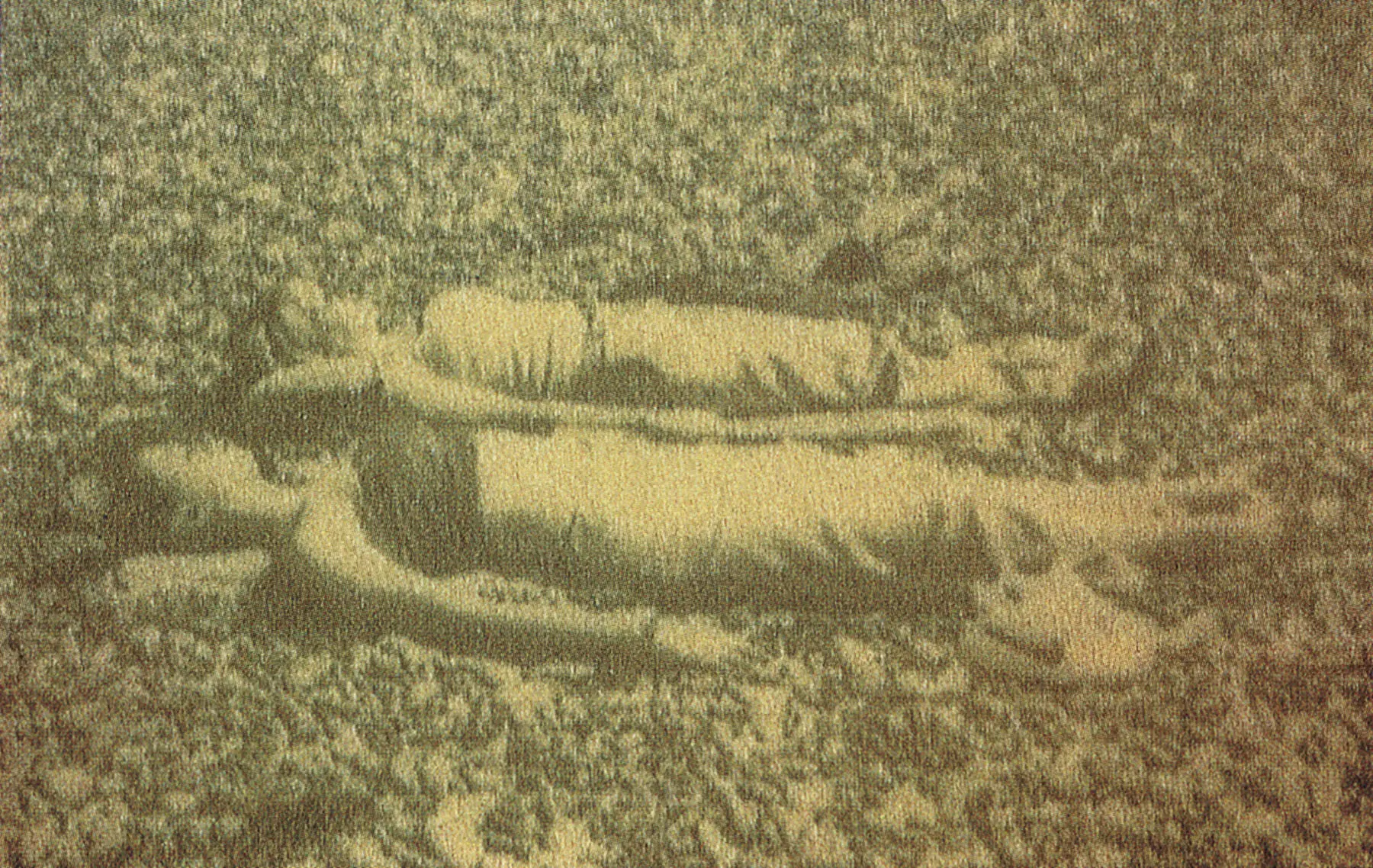
Heather Ackroyd and Dan Harvey explore the photosensitive qualities of chlorophyll. Scientists in Wales manipulated grass genetically and were able to control the degree and speed of discoloration, even preserving green after the grass dried. Working with IGER (Institute of Grass and Environmental Resources) and using this research, the artists managed to fix photographic images on the grass with stunning results.
Martin Heiferman and Carole Kismaric, curators of the exhibit, gave the show a subtitle: “Visualizing the genetic revolution” that became fateful. It is an ambitious show, with about forty artists, where in general terms there is no room for criticism. Assuming that the works shown cover correctly the area delimited by the curators, what seems to be a target for criticism is the state of the art itself. Confronted with a traumatic event as violent or more than the invention of the atomic bomb, artists continue to use the same parameters, as usual, to continue playing or to offer small criticism in the shape of illustration. The majority of the exhibitors limited themselves to the subtitle, they “visualize” the issue rather than contributing to it. The exhibition gives few, shy, signals. Ultimately, however, it tells us that we are not prepared for what awaits us in the future.
It is interesting that when, during the sixties, art was confronted with a political crisis, the response was to generate political conceptualism. This reaction provided a complete revision of form and content that (for a short time) measured up to the circumstances. It was an interdisciplinary confrontation where one couldn’t tell politics apart from art. Given the nature of both art and politics fusion was neither unpredictable nor difficult. Now that the crisis is deeper and more complex, with a danger of being irreversible, the answers offered by this exhibition appear to be tepid, sometimes opportunistic, and very seldom consciousness-raising. If Paradise Now bears any moral, it is that for now the subject of genetics is too big for us. If we want to deal with the topic we will have to radically revise our ideas about art. To limit ourselves to the change of form and content or to narrative adjustments is useless. Paradise Now, therefore, is of no use to alert the public or to change any perception of the problem. The only benefit provided by the apparent weakness shown by the art in relation to the context of the exhibition is that it points out the size of the challenge posed to future artists.
NOTES
1. P.G.C.A. was a satellite of Pratt Institute in Brooklyn.
2. A hologram is produced by two sets of light waves intersecting on a light-sensitive surface. The light is emitted by a laser beam and split so that one part goes directly to the surface, where it meets the rest reflected by the object to be documented. When the “negative” thus prepared is lighted with the appropriate lighting, the image is reconstructed and appears to be three-dimensional. The technique was invented by Dennis Gabor in 1947.
3. Emmett Leith and Juris Upatnieks, “Photography by Laser,” Scientific American, pp.24-35, June 1965. Dalí read the magazine regularly and it is since then, thanks to working with him, that I still subscribe to it.
4. Nauman made his own series of holograms shortly after. Warhol worked with xerography, another technique Dalí approached, four years later.
5. Klüver’s interest in art collaborations had started much earlier. It was he who had helped Jean Tinguely in the design of the self-destructing machine for the Museum of Modern Art in New York in 1960.
6. Xography is the technique used for postcards that switch images, give the illusion of movement, or provide a three-dimensional effect using a grated plastic coating. The stripes on the plastic are semicylindrical lenses that bring into focus the printed lines underneath that reproduce a photograph taken with a special camera for this purpose. The patent of the process was owned by Cowles, the publisher of Look and Venture magazines. Venture, a travel magazine, used the process for its covers. In 1965 they had the idea of having Dalí design one of them. The project was canceled at the last minute when one of the managers discovered that some of the props, particularly a piano and a telephone, both toys and painted over with bricks, were not hand-made by the artist.
7. One panel was prepared for the left eye and the other for the right one, with the same trick that produces three-dimensional vision, allowing the eyes to see only the corresponding panel by means of separation or polarized (or bi-colored) glasses.
8. Julesz would present two panels prepared for each eye but with a discrepancy in size or focus of over 10%. However, the viewer still would perceive a perfect stereoscopical image. Since at simple sight the panels seemed to have only a chaotic arrangement of dots, the perceptual result was proof that the processing of the information occurred after it passed the eyes, not in the eyes themselves.
9. The exhibition went from September 9th through October 28th, 2000. 10. By coincidence the Exit Art exhibition overlaps with a show of Argentinean artist Nicola Constantino in Deitch Projects. Constantino makes clothing that is seemingly made from human skin containing nipples and anuses (in reality it is a silicon plastic cast into molds of human body areas).
LUIS CAMNITZER
Uruguayan artist, professor at the Department of Visual Arts, State University of New York, College at Old Westbury.
t Old Westbury.