
In 1970, Portuguese-born Rio de Janeiro-based artist Artur Barrio wrote a manifesto in which he firmly stated his political position as an artist: “against art categories, against salons, against prizes, against juries, against art criticism.”
O fio de Ariadne (o tempo, como jogo...de tempo no próprio tempo.....) [Ariadne´s thread (time, like a game...of time within time itself...)], his new installation for this retrospective exhibition organized by Daniela Bousso, shows that his views remain firmly rooted in his body and mind—the body as an essential supplier to the mind, a metaphor of its own creation and existence. Barrio started to gain wider international recognition after his participation at the XXIV Bienal de São Paulo, in 1998, and this is one of the two retrospectives dedicated to the artist held this year (the other has been organized by Museu Serralves, Oporto). “Today my work passes from the exterior space to the interior space.” This sentence is one of the first things we read as we enter the gallery’s foyer. By interior space, Barrio refers to the art institution as well as to the installation conceived for a gallery space. Until the early ‘80s, most of his performances took place beyond the museum’s walls, and today survive through documents (books, sketches, illustrations, photos, notes, writings) of situações (‘situations’ or environment-situations, as the artist calls them) and other performances and installations.
Barrio’s toilet paper ‘environment-situation’ entitled P....H.... (toilet paper), first carried out outside the Museu de Arte Moderna, Rio de Janeiro, in 1969, is here illustrated with photographs carelessly mounted on cardboard opposite the entrance to the exhibition. This documentation reveals the importance of physical experimentation and the artist’s desire to establish a balance between the forces of nature (wind and water) and the material being manipulated by him (60 roles of toilet paper spread along Guanabara Bay). The next series of documents illustrate the T.E. (Trouxas Ensangüentadas or ‘Blooded Bundles’). T.E. consists of compacted cloth and detritus bundles scattered throughout the city, containing blood-looking red ink stains and slashed morbid openings reminiscent of wounded body parts. Perhaps to reinforce the work’s importance (Barrio considers this one of his major pieces), it is the only one that was materially exhibited here. A T.E. hung from a string attached to the gallery’s ceiling amid photographs revealing its creative process and implantation in Rio de Janeiro and New York City, in 1969.
In addition to P....H.... and T.E. are documents illustrating another twenty-three performances/environment-situations/installations as well as unrealized projects. Fixed to the walls or racked on shelves along the corridor that eventually leads to O fio de Ariadne, are displayed books and photographs of works such as Descompressão. . . compressão (Decompression. . .compression) from 1973—the artist presses his face against the glass in growing compression until the moment of de-compression; Cadernos livros ( Sketch-books Books), 1978—Begun in 1966, these represent the ‘embryo’ of Barrio’s work and contain the quasi totality of the documentation regarding his entire oeuvre); and Livro de carne, 1979—a chunk of red meat is sliced in book format containing some four ‘pages.’
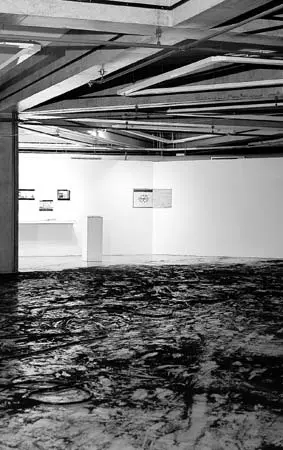
As we reach the new installation, a strong smell of coffee is in the air, and our eyes adapt to the faint glimmer whose only source is six light bulbs spread throughout a ‘Y’-shaped space of about 140 square meters. This space is determined by precarious wooden black and white panels that simultaneously delimit the installation area and physically interact with it. They are also scribbled with times and dates indicating the timeframe of the work’s construction, along with social, political, and art historical comments and quotations that provoke the spectator to think about the dominant forces that control the art world. The darkness of the coffee-covered floor and the dim lighting paradoxically add warmth and formal unity to the endless paraphernalia of live and rotting ephemera. They also imbue the space with a mystical aura more characteristic of a primeval temple. The tensions created by the way one object/material is fixed to another are both violent and sculpturally formal: bread loaves are strangled against the walls by tight elastic bands, roughly cut wooden rods nailed to the walls stick outwards with threatening and sexual connotations. Rotting fish inside tanks filled with rock salt makes us reflect on the qualities inherent in the concepts of decay and preservation. A mound of powder malachite glitters with the help of a light bulb on its top.
Should we find a symbolic meaning in each element present? Such an approach would possibly contradict the artist’s intentions since each presence is supposed to be nothing more than what it is. “The dualistic function of subject and object can no longer withstand itself... man finds himself before his own self.” This is where Barrio’s writings on the walls act more as cue cards than as indispensable elements to the (formal) composition. They often sound like hailed statements—new truths that at times are anything but new. Are they really necessary? Assertions such as “Art is something linked to time, like a game of time creation in time itself” move to more aggressive denunciations such as “Culture is at everybody’s reach...depending on how much you have in your pocket.” Yet, they remind us that such issues are as pertinent today as they were in the ‘60s and ‘70s or with Dadaism and neo-dada. Barrio’s artistic trajectory began at a time of political repression in the ‘60s, together with other artists in Rio de Janeiro such as Hélio Oiticica, Lygia Pape, Antonio Manuel, and Lygia Clark, who became involved with social and political issues.
The question embedded in this work is that perhaps the art world has become tired of reviewing: has artistic discourse changed since the avant-garde? Or will Barrio’s piss and blood bundles soon be worth a Duchampian fortune? Perhaps Barrio’s central concern is as ephemeral as his works, and as visceral. He “looks for a contact with reality in its totality,” in an attempt to unveil all that is marginal and cast aside.
VERÓNICA CORDEIRO