
Compared to the coherent visual monotony of most individual gallery shows, Arturo Herrera’s (Caracas, 1959) exhibition may seem, at first glance, disconcerting. The show includes a fragment from a mural, a group of small collages on paper, two black-and-white photographs of comics, a wall piece in perforated black fabric, one drawing on copying paper, two sculptors wall pieces, and one cardboard sculpture, the latter set on the floor as if abandoned in the middle of the room.
The connecting thread throughout the show could be Herrera’s work with the form of the comic, reiterated in several pieces, but, paradoxically, the show’s cohesive element is to be found less in the recurring images or anecdotes than in the very diversity of the media employed. Opposed to the idea of a series —as the development of a theme or concept through the horizontal and homogeneous space of painting, photography, or drawing— Herrera’s strategy has a transversal character: To create a group of works constituted by the successive translations implied in the move from one language to another. The work, the series, is built precisely on the transitions from comic to object, from photograph to fabric, from drawing to collage, or from comic to object and photography. This strategy, this definition of the media as passages, or better yet as destination points from another medium, relates in a particular way to the fragmentary and relational logic of collage, which is, in turn, the artist’s main technique.
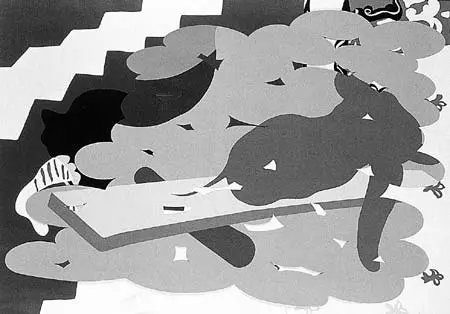
For as can be clearly appreciated in the works on paper presented in the show, Herrera works with an idea of the world as an assemblage of independent parts, a world of gaps whose image never presents itself as a totality of meaning, and whose logic is clearly dysfunctional. It is a regime of mounted fragments that seem to refer to some figure but, since figures are always broken and attracted by fragments of another figure as if guided by the desire for strange couplings, are transformed into operations that negate the work itself as a unitary meaning.
If in Herrera’s collage totality is always alluded to but never exposed, translation from one medium to another reinforces the idea of language as a partial, impure universe. The elongated piece on perforated fabric is, from a distance, a landscape with a horizon that seems to derive from a photograph; both black and white photographs show fragments of a drawing, and the plastic wall pieces seem to represent parts of other drawings as well.
Herrera’s show can be seen as soft and light. Not only because of the rather childlike images depicted in some of the works but also because of the colors employed and the serene continuity of technical experimentation. But it can also be seen as quite frightening: fright comes from the substitution of graft for pure form; from places where there could be a figure but we find an abstraction made of unidentifiable parts; from things being nothing more than mutants that depart, without the possibility of return, from their original totalities.
INÉS KATZENSTEIN