
El rostro de los Vivos (The Face of the Living), a show by the Mexican painter Arturo Rivera, avails us of an opportunity to draw near a body of work inscribed in the purest tradition of Western painting, in which academic virtuosity combines with the richness of a mythical and conceptual universe.
For Rivera, the execution of painting is the selection or appropriation of methods and techniques to form a continuum of this art as an enormous resource allowing him to elaborate his poetic discourse. His main formal resource is the use of the plane as a surface for the representation of space. The Renaissance perspective is minimized to certain notes in the canvas, giving preference to a first plane in which the figures, fused or softened against this short space with the background plane, denote their volume through the handling of the chiaroscuro and the perfectly drawn line. The techniques utilized by Rivera affirm this historical conviction inscribed in the great Western tradition, and in this respect, the media used: oil, casein, egg tempera, charcoal, or watercolor are the most common. But it is mainly as an homage to the Western canon that we appreciate in most of his works, evocations of artists such as Bosch, Goya, Velázquez or the Italian Renaissance painters, as well as some of the painters of the Mexican tradition like Julio Ruela and Jose Guadalupe Posada.
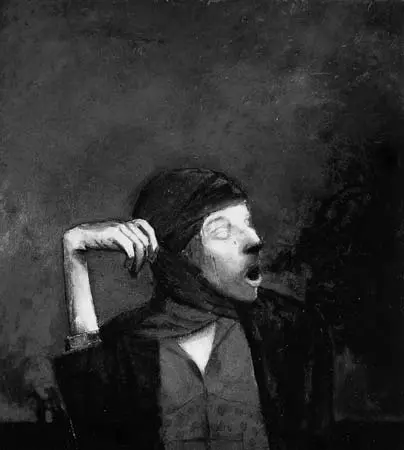
The paintings’ harmony is achieved through the predominance of light and the use of grisaille which confers a theatrical quality to the exhibited works’ atmosphere, which has been configured as one more element in the mise-en-scène of the eternal drama of life and death. The plane utilization reminds us of the illustrations of plant and animal dissections or Leonardo da Vinci’s studies of human anatomy and fantastic machines—the plane is a surface explaining the different elements that constitute the artist’s discourse and poetic vision.
With this elaborate representational technique, and the utilization of a healthy amount of symbolist resources, Rivera pays homage to artists and poets alike. The multiple branches of Symbolism have definitely influenced an important generation of Mexican artists in different periods and with different results. In the first group, Ángel Zárraga and Alfredo Ramos Martínez, and later, with Montenegro and the Mexican School of Painting, along with a clear affiliation to the Surrealists and de Chirico. In more recent painters, we see images very close to “a first-generation symbolism,” with artists including Rafael Coronel, Rafael Cauduro, and Benjamín Domínguez.
The artist’s literary and pictorial obsessions parade through his paintings in complex, dream-like visions with symbologies mixed in an enormous and varied range of possible readings. Crowns of thorns, dried roses, eyes, fruits, and above all, animals. In Rivera’s bestiary, the skinned, mutilated, deformed, or mythological animals give testimony or are the counterpoint of a human condition revealing an intimate unity, a common substrate between man as an animal and animal as a man. Besides the symbolic load that animals have in different traditions, be it Christian, Hermetic, or Gnostic, and even in non-western traditions, Rivera’s bestiary allows us to observe an apparent antagonism that ends up diluted, beyond which man appears to partake with animals, flowers, fruits, and objects. From the dissected anatomy sprouts roots or subtle vapors as the breath of life, objects float in an unsuspected harmony. An epiphany of the symbols occurs in Rivera’s universe, sometimes with a maximum degree of tension, an upsetting of the world of objects and the world of ideas, an approximation to the unfathomable world of the sacred. As in Rilke’s Duino Elegies, there is a moment in which man can rise above the prison of his limited earthly condition and meet with the Angel. This revelation, like one of the elegies, goes beyond the beauty we’re able to stand.
In a previous exhibition called Historias del Ojo (Stories of the Eye), Rivera, taking the eye as a metaphor, explored the different connotations surrounding the gaze. The eye is the vehicle through which the world is made, and once it’s made it reveals itself as the space for meanings. The eye also allows us to draw near to what is different, specifically another person’s face. For Emanuel Levinas, the philosopher of otherness, the tracks of any face allow us to recognize the Other in his or her infinite humanity, that person with which we share a condition but who also is unique and irreplaceable. We notice a similar intention in El Rostro de los Vivos (The Face of the Living), which is constructed from multiple ways of seeing. In one of the readings that the work allows, the face of the living belongs also to the dead, because it is from that inexorable finiteness—the foundation of anything human—that the discourse of life springs forth. Life and death interlace and correspond with each other. As Heidegger’s existential structure, Rivera maintains this duality of life and death which was represented, albeit with a different intention, by the vanitas of Baroque painting, and it was a subject dear to Symbolism—not only in terms of the visual but also the literary.
Velázquez’s Las meninas is one of the founding paintings of artistic modernity, an iconic painting, which, as it is said, marks the end of representation, of the subject and modernity, or at least of one of the many stages of this equivocal age in which generations of human beings have pretended to live in. Las meninas has been annotated, transfigured, or deconstructed (to use a pure postmodernist term) by many artists, who have seen in it the well-known symbolic and conceptual loads. Rivera sees it, not as something occasional within his painting, but as the center of a web of “classical” references running throughout his work. His paraphrasing of La meninas, however, is not up to par with the other paintings, and it’s somewhat poor if compared with Saturno (Saturn), an excellent painting, disquieting and at the same time provocative, that clearly presents the man-animal symbiosis. Or maybe with another painting that spreads its roots in the mythical, in the fusion between man and God; or perhaps with La última cena (The Last Supper), in which the master and his disciples congregate underneath a huge skinned rabbit that breaks the supposedly sacred space.
We have an undoubtedly imaginative artist, whose formal and stylistic excellence are beyond reproach. Above all, he is an artist who, thanks to the huge iconography he handles, is safely removed from one of worst maladies ailing many contemporary artists—the repetition and erosion of images, original or appropriated, that end up being formulas without content. In Rivera’s case, the iconographic resources seem as inexhaustible as myth and man’s capacity for symbolism.
ERNESTO SOSA