
The oil paintings in David Solís’ recent show had such harmony and pictorial maturity that they produced a profound visual pleasure for the viewer. This did not come as a complete surprise because we have seen this in earlier works, and in the development, over the last decade, of what is now palpable in his paintings. The works aren’t strident or disproportionate but disquieting —the pun is intended. They seduce us with their nuanced textures, unusual colors, and poetic compositions.
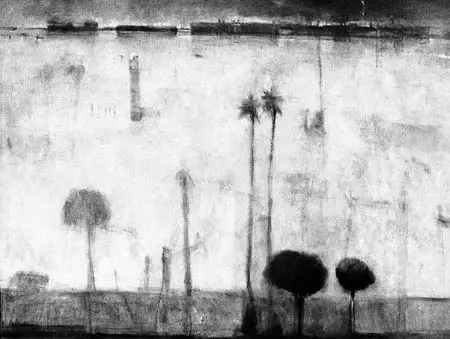
The surfaces of Solís’ paintings give the same impression as an old wall, in which the different tones seem to reflect pieces of lives or experiences, recombined as layers of history in order to produce a new image. His colors—blues, grays, ochres, yellows, and reds, colors that no reproduction can do justice to—are seductive and almost indescribable because they are the product of paint strata. In fact, each canvas contains several compositions the artist has made on top of the other—painting, veiling, erasing, and repainting throughout several years— in what he describes as an archaeological process, a search for the work that in the end remains visible on the surface.
Solís’ search has not been gratuitous. His years of exploration and practice in the techniques of drawing, engraving, and painting are reflected in the strokes and lucidity of his work today. His paintings maintain a constant technical quality that is a product of a solid artistic education of continuous investigation and personal search. He began his studies in Panama, his native country, but he matured as an artist in France, the country to which he traveled to continue studying but ended up staying for several decades. His way of expressing himself, as a person and as a painter, reflects the combination of his Latin American heritage and the European culture he has been exposed to, which he has incorporated with the passing of time.
His oil paintings reflect that amalgam. In them, we can perceive a sensation of humidity and diffused light that can be identified neither as obviously tropical nor clearly Mediterranean. He paints long palm trees mingling with roots and urban lamp posts in works like Laguna Azul (Blue Lagoon), elevated horizons reminiscent of the coastline, as in Tarde en el Malecón (Afternoon at the Breakwater), or harbors and vessels representing no place in particular but at the same time evoking his native city. He paints the gray cloudiness of coastal storms, and the dark green found in the shades of tropical rainforests. Also present are the horses of his childhood that also belong to art history. He also paints sensuous human shapes, or fragments of them, that seem to be taken from some religious nightmare or influenced by the memory of a great Spanish master.
In Solís’ work, nothing has a single meaning. In his most recent landscapes, we find fences that are more psychological than real, solitary anthropomorphic trees, crowns of black palm trees, and great plains that could be interpreted as lakes. There is constant visual flux within these works, where the skies could be the earth and vice versa. And curiously enough, the bodegones look like landscapes, and the outdoors like the indoors, because for Solís they’re interchangeable. The border of the precipice could be the border of the table or of an old dresser. Fruits function as three-dimensional shapes, colored or striped, with light or shadow, or they reflect windows we don’t see or are seemingly falling off the table, as in the case of Colección Selenita (Selenite Collection). There is a huge and delicious existential load in his desolate landscapes and in the still lifes where the fruits are more part of a lyric game, melancholic and visual, than the representation of the harvest.
By means of careful technical execution, the artist has mastered a spatial and thematic ambiguity that makes the viewer a participant in the image while at the same time remaining detached. There’s something familiar in these works, something known and involving, but they also represent great spaces devoid of humanity, with distant horizons to which we do not belong. Whether it’s a reputed still life or a pseudo-landscape, whether it’s seen correctly or viewed upside down, it’s all the same as the composition demonstrates a control over the pictorial field that’s not dependent on the theme but on the balance between abstract forms, texture, and light.
The mastery of mass and space is surely related to Solís’ years of training and work as an architect, and to the uninterrupted practice of drawing as personal expression and fundamental artistic challenge something forgotten by many contemporary painters. Solís has magic, but he also has craft. His compositions offer an abstract structure first perceived as square—a shape for which he shows predilection— and then in the way the square is subdivided into rectangles, circles, ovals, and lines. On the surface, defined by the textures and multiple layers of paint, Solís distributes the iconographic elements in a totally subjective way. For example, in some of the canvases he doesn’t hesitate to leave the central region “empty,” devoid of objects, people, or symbols. Thus it becomes an abstract study of color, an area loaded with suggestion. He plays with volume, space, and our perception of depth by using a variety of optic elaborations. He combines traditional perspective with a sort of Orientalist perspective, in which the lower part of the canvas corresponds to what is nearer, and the upper part to what is distant. Or he reminds us of Cézanne and that artist’s way of seeing and representing objects from diverse angles. Above all, Solís fills everything with an extraordinary aura and light that contribute to creating the unusual atmosphere of his works.
There’s something moving about his vision of the world, about this other reality that Solís interprets for us. As with poetry, his canvases invite us to a meditative space, passionate and sometimes nostalgic. They seduce the spectator to participate, to fill in the absent parts, to try to interpret what he sees, and to resolve the enigmas that the surfaces present. We have an intense artist, a thinker, but also a mischievous one for those who understand his subtle sense of humor.
Solís’ work is traditional in the sense that he draws, engraves, and paints using the usual materials and known techniques. But the images he creates are repetitions of nothing known; they are works that consciously integrate lessons from the past and defy an apathetic attitude towards art. Within the frenetic, changing, instantaneous, and digitized activity of today’s art, Solís offers a contemplative and intimate experience, a subtle and genuine rebelliousness that is also a commentary about the world in which we live.
MÓNICA E. KUPFER