
Haitian Vodou deities, called lwas, have taken up winter residence in Miami in two imaginative and complementary exhibitions and installations by Edouard Duval-Carrié. Recognized internationally as one of Haiti’s premier artists, the Miami Beach resident has used the opportunity to exhibit his work in the local museum and gallery venues to continue his witty and cynical comments on the Haitian reality, past and present. At the same time, he also creates an environment for his strange cast of now-recognizable characters to “grow up” and dwell for a short period of time before embarking on the next stage of their enduring journeys and “migrations.”
The Miami Art Museum installation features a Renaissance-style altarpiece dominated not by Western icons, but by Duval-Carrié’s inimitable interpretations of the lwas, syncretic spirits that rule the different realms of nature and human activities that take their definition from the Yoruba and Fon peoples in West Africa and the saints of Roman Catholicism. The goddess of love and luxury, Ezuli Freda plays a significant role throughout the installation and her three different aspects of womanhood are reflected in the surrounding offerings of flowers, perfumes, jewels, and pink overtones. She can be sweet or seductive and the artist’s Baroque aesthetic comments on the Haitian consumption of Western cultures, while criticizing Western stereotypes of Haitian society. His appropriation of Catholic religious and artistic traditions throughout the installation is actually an obvious reference to the indomitable spirit of African spirits to survive and transform out of necessity, to “migrate” back and forth in time and place.
The altarpiece is approached through a series of hanging and standing constructions, as faux as the altar itself. Boats symbolize floating islands and the vibrantly pigmented l was traveling within them are the uprooted migrants representative of exile everywhere, but particularly relevant to Miami. Duval-Carrié’s complex of mixed media objects includes a variety of ornamental details cast in plastic and painted to be rococo, and garish. Portrait heads, decorations, candelabras, vases, and a strange assortment of accessories are reminiscent of the luxury of the island’s French colonial society. He synthesizes disparate elements into a grand spectacle that is as humorous, kitsch, and decorative as it is a serious and sardonic interpretation of the multiple effects of migration on people and their gods, who desert the disaster of the land with them.
Migration has long been a theme in Duval-Carrié’s work and the subject of three previous installations (which will come together in Spring 2002 at the Davenport Art Museum). It also appears often in the titles of his paintings or can be read as a subtext, although there is little doubt that his most recent visit to Haiti strengthened his resolve to take his art beyond merely narrative or imaginative visualizations of its history, landscape, rituals, and politics and infuse it with new meaning in light of the country’s ongoing failures. The paintings, bronze staffs, and faux-malachite installation titled The Last Boat in Landscapes: Real and Imagined at the Bernice Steinbaum Gallery complement the MAM installation and encourage the viewer to become more familiar with the strangely pigmented and tattooed personalities who inhabit his exotic world.
The fuschia-colored visage of the lwa of the snakes rises above the chasm of the sea to protect all modes of transportation in Damballah, 2000. His bulging eyes reveal his gift of penetrating vision and illumination, plumes of fire rise from his head like those of Esher Legba who protects the crossroads and gates of passage. Toy planes detract from the seriousness of this apparition.
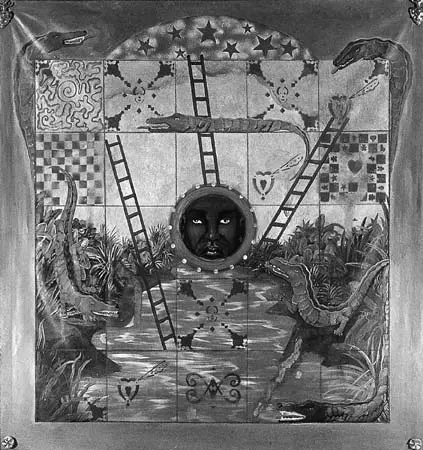
Toys, often cast into resin frames or attached to their surface, and humor are plentiful in Duval-Carrie’s work. In the wonderful painting Crocs and Ladders, from 1999, the artist’s inspiration is the child’s game, based on an ancient Indian tradition of fortune-telling moves associated with the zodiac. Duval-Carrié places a black man in the center of this crocodilian landscape, in a no-win situation that not even a seer could rescue. Not only does the artist find the game and the zodiac signs visually interesting, but he also uses them to explore spatial arrangements and painterly possibilities that go beyond the merely representational or traditionally acceptable.
Frames, additional objects, glazing, and stencils complicate the character of Duval-Carrié’s work as he constantly investigates the crafts of painting and sculpture as unique art forms. Gathering from a multiplicity of sources and completely at ease with the plundering of materials, themes, and symbolism to create his own personal vocabulary of forms and images for a visual commentary on the plight of his country, Edouard Duval-Carrié uses humor and pain as aesthetic solutions when all others seem to fail.
CAROL DAMIAN