
Emilia Azcárate ‘s work has been gaining notoriety in the national scene for some years now. Lately, the artist has held shows in prestigious spaces in Venezuela, Spain, and Colombia, and she received the I ABC Painting Award at the Arco 2000 fair in Madrid.
Azcárate, born in Caracas in 1964, showed 22 pieces at Caracas’ Alejandro Otero Museum. The show was curated by Adolfo Wilson and Ana Aquilina Azcárate. These 22 pieces make evident the continuity in the artist’s explorations around nature and the possibility of assembling languages on the basis of plastic and sensorial interventions on organic matter.
According to Adolfo Wilson, "Emilia Azcárate’s plastic work shares one of contemporary art’s most essential preoccupations: searching for the invention of a linguistic model, of writing, of a form of speech —considering that communication is one of art’s determining values — capable of interpreting both the manifestations of the artist’s internal impulses and the experience of the artist’s relations with the external world."
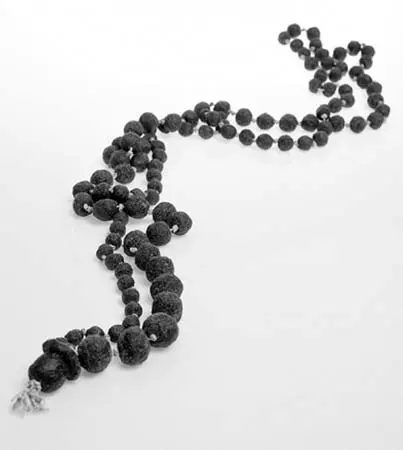
Azcárate’s poetics is certainly nourished by her constant fascination with Nature, evident in her utilization of organic matter such as beeswax, lard, or oak ashes, all of them fundamental elements of her work.
Most of the pieces shown at the Alejandro Otero Museum have even been made with cow dung, a material Azcárate has been exploring since a trip to India. There, the artist studied the diverse uses given to organic matter and its relationship to female work.
In some of the works shown, Azcárate uses the pristine language of seriality, working with concentric forms and spirals, creating expansive rhythms and vibrating visual effects in which the characteristics of the material play a special role. Other works make evident the artist’s fascination with dung as a plastic element, that is, malleable and ductile. She makes small modeled figures that refer back to a childlike delight in the material and the possibilities it presents for play; these curious pieces show also a feminine pulsion, mainly through the tenderness and intimacy with which the material was approached.
Dung offers plastic possibilities that transcend the mere visual, encompassing a fuller sensoriality and generating symbolic and spiritual connotations. Many of Azcárate’s prior works seemed to search for a connection between the themes of life, death, and reincarnation. In this show, the use of animal waste helps to articulate a sequence of notions related to waste and its relationship to death and putrefaction, as well as its fertilizing potential, thus elaborating a discourse on Nature’s infinite cycles.
KATHERINE CHACÓN