
Espacio Duplus, managed by Lucio Dorr and Santiago García Aramburú, graphic designers and artists, appeared in Argentina’s contemporary art scene at the beginning of the year. Conceived as a not-for-profit exhibition center with an accent on emerging art, it didn’t take long for Duplus to become one of the most interesting new developments in the Buenos Aires circuit. The space’s program for the year 2000 combined presentations by several young artists who are still growing, with names that have achieved greater levels of participation and recognition. In all cases, the gallery’s stated position in favor of new languages resulted in propositions of a markedly experimental character.
Among the shows offered in the latter part of the year, Ernesto Ballesteros’ (Buenos Aires, 1963) was the most remarkable. This is the artist’s second solo show in recent times, after presenting a series of graffiti on paper last April at the ICI — Spanish Cultural Center. At Duplus, Ernesto Ballesteros —represented since 1990 by the Ruth Benzacar Gallery—decided to set aside his well-known skills in drawing and painting in order to present an installation of luminescent objects under the title of Marquesinas (Marquees).
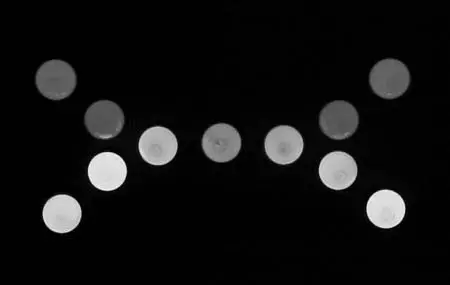
Like a portrait artist who studies a face while engaged in conversation with its owner, like the landscape artist who walks around taking notes on his surroundings, Ballesteros relates to the world from a clear and distinct place —an accumulation of interests, passion, and expectations. Fascinated since childhood with the theory and practice of scientific discourse, once a certain amount of information has been incorporated, the artist can not be naïve about what’s around him: he perceives correspondences between the simplest of phenomena and their expert justifications; he discovers, seeks, and confirms relationships that, despite obsessing him (or maybe because they do), nourish him as an artist.
Ballesteros’ position among his colleagues is the uncomfortable position of someone whose body of work is generally outside the scope of art. He doesn’t arrive at the image by the investigation of formal problems or by the development of a conceptual proposition; he has not “appropriated” a specific material or technique, nor does he present himself as a geometrical or sensorial abstractionist. Nonetheless, his extremely rational work always leaves room for expressive pleasure, and in that sense, it’s clear he could not have been anything other than an artist.
Ballesteros’ ideas flow from one material to another, using different techniques without the intention of presenting themselves as “the new thing,” or even “the weird thing.” The works shown at Duplus were not sophisticated technological pieces, but, on the contrary, simple electrical devices that create the illusion of movement. Turned on in sequence, the small bulbs generate a kinetic effect that, for the artist, confirms “the particle-wave duality of matter, the fact that everything around us is nothing more than pure energy,” in his own words. As a corollary to the waving illusion created by light, Ballesteros added to these pieces a nostalgic homage to Buenos Aires disappeared marquees, which for many years enlivened the fronts of theaters and stores throughout the city.
The figures traced and vanished along light’s path, or the colors that mix and then drift part, are attractive visual complements for an experience anchored more on logic than on lyricism. With this new show, Ballesteros confirms his reputation as an artist whose values, themes, and interests are singular in the context of his generation, firmly involved in a line of formal investigation. To begin to imagine the artist’s future offerings, let’s add that he’s currently working on a series of nocturnal photographs of the sky, in which he applies his knowledge of astronomy and seeks to capture the remote luminosity of the stars.
EVA GRINSTEIN