
Whoever has seen the work of Argentina’s geometrical painters and knows Graciela Hasper’s (Buenos Aires, 1966) provenance, is forced to acknowledge the aesthetic emotion generated by this young and solid author’s recent exhibition. There is more than one motive to permeate this intellectual space with remembrance and homage; we will enunciate two of them. The first one has to do with the fact that the powerful generation of geometrical painters active before the great extermination caused by the dictatorship, could not gesture with enough liberty to continue generating visible options. This generation, although almost dismantled, was still active at the time of the great debacle of the 1980s —when irresponsible speculation within the art market drove prices up wildly only to see them drop precipitously afterward — that ruined numerous artists, collectors, and honest dealers (but too few of the other kind). Hasper infuses new life into that group of Argentine geometrical painters who created very good works but arrived at dead ends. And she does so with a personal style, a sense of humor, and a delicate irony. In this exhibition, her second at Nosei’s, Hasper reaffirms this revitalizing and informal spirit with ten untitled works that can be classified into two groups, based on the dominant elements in each of them: planes and strips. With these two visual elements, the artists create works where either circles, squares and rectangles, horizontal or vertical ellipses (which relate to the “hula-hop” and urban-architectural “loops”), graphic elements resembling continuous belts (related to the form of the musical key of G and to the Moebius strip), as well as parallel epipedons and ‘points.’ In the aerial spaces, white or of a watercolor-like coloration, Hasper consolidates geometrical ideas. Her one-dimensional bodies, as much as those drawn in the form of strips, interrelate —they superimpose to, obstruct, or illuminate each other. In Sin título (Untitled), 1999, 58” x 58”, on an orange background, the author contrasts her one-dimensional treatment of color with geometrical bodies that seem to emerge from the canvas like boomerangs directed at the spectator, until some “pleasant” lines calm things down.
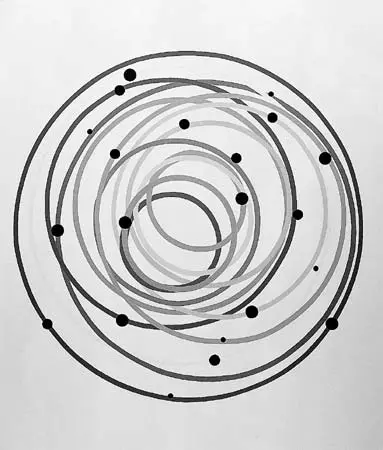
In her work with ellipses, these forms seem superimposed, interrelated, and symmetrical. However, although their geometries are centered, they orient themselves, shoot out, or gather asymmetrically, and the number of components isn’t generally even. These are works in acrylic on canvas that, nonetheless, look like watercolors, because the material was very diluted at the time of its application. There are two driving contradictions nestled within these works: to contradict the usual reference to the corporeal character and perfection of geometry, and the fact that everything is hand-painted since Hasper wants that to be noticed. “I want geometrical painting to have organic qualities, and because of that as well as for economic reasons I never use a project.” We also perceive subtle architectural qualities (neither massive nor rigid). The artist wants to change the location of her pieces, either turning them on their axis or relocating them within the gallery. We find in this Argentine author a light, a positive sign in an era of high-intensity anguish; her palette turns to vibrant colors, charged with light, even among the grays and the pastel tones. If remembrances are stimulated by their narration, Graciela Hasper narrates without nostalgia; her vision is a positive one, and her perspective has been stated.
GRACIELA KARTOFEL