
Estar y no estar (Being There and Not Being There) is the title of the recent show of work by the sculptor, Helen Escobedo, at the Museo Universitario de Ciencias y Arte (MUCA) at UNAM. The recipient of the prestigious Guggenheim Fellowship, among other awards, and creator of urban sculptures in Mexico, Helsinki, Belgium, Jerusalem, and Quebec, Escobedo is the former director of the Museo de Arte Moderno in Mexico City. She was showered with accolades when, during her directorship, she organized such notable exhibitions as the now mythic show of sculptures by Henry Moore, with whom she studied in London.
The exhibition at MUCA ranges from denunciation to humor, from the ingenious to the dismal, and from the obvious to the exquisite. If we tried to establish precise categories for her subject matter, we would find subtle complicities mingled and interwoven into the works.
El Bicivocho, for instance, is the back half of a Volkswagen sedan with a bicycle attached to the front as the only source of locomotion. Oxygen bags like those on airplanes are suspended above the passenger seats, and a metal tower projects out from the driver’s handlebars. This seductive object is an assemblage that is part of popular Mexican imagery and at the same time pays humble homage to those who ferry tourists and passers-by around in very similar vehicles. At the same time, the piece sharply criticizes environmental pollution, overpopulation, and the recycling culture, not as ecological salvation but as a basic means of survival.
Moda papalotera (Kite Fashion) is a sculptural piece that hangs in segments from the ceiling. Its rhythmic placement suggests a series of falling or flying objects, and though most of them are pieces of clothing, a few whimsical shapes do remind us of the old kites that now share the sky with shirts, trousers, and vests no one uses any more except to fly them.
El piso verde (The Green Floor) is executed with a healthy dose of humor. Escobedo literalizes the expression, ‘painting one’s self into a corner.’ Only the culprit’s shoes remain in the unpainted corner of the room, suggesting that perhaps he flew away or simply evaporated into something we can no longer see.
In homage to the old masters, the piece, Esto no es un rifle, es un caballo (This is Not a Rifle, It’s a Horse) goes beyond simple assemblage to a plane where the title given the piece plays a key role. Huarabotas, (a hybrid of huarache sandals and boots) works along these same lines, as does Guajimplora (a fusion of a sucker and a canteen), and the marvelous Gorrombrero, a cross between a cap and a hat. This section is called, Indumentaria para la guerra y la paz (Clothing for War and Peace), and clearly proposes the integration of the military and the peasants through the clothes both groups wear.
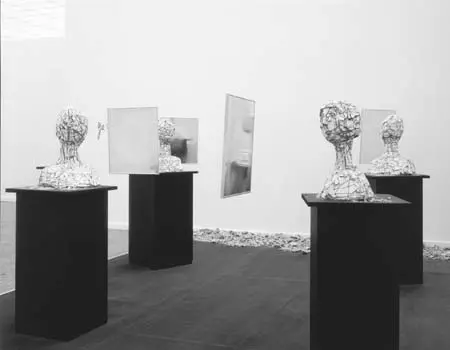
Somewhere beyond the playful is the piece, Muerte sin fin en este valle de lágrimas en donde de aquellos 3 millones de habitantes ya tan sólo quedan 20 millones de sobrevivientes (Death Without End in this Valley of Tears Where of the 3 Million Inhabitants there are only Twenty Thousand Survivors). The work consists of 18 bodies, shrouded with bedding, and covered with earth. Escobedo placed the piece in front of a conservative mural of the Valley of Mexico by Nicolás Moreno. Escobedo incorporated the mural, which is on permanent display at MUCA, into her piece, placing a scrim in front of it to diffuse it and achieve the effect of distance, and allowing the bodies to be weakly illuminated by light from the mural to simulate a humble peasant funeral.
Bad News is in the same vein and consists of four bodies of indistinct form placed on hospital or morgue beds. These eerily human bodies are covered with newspapers announcing disastrous events. El Cuarto hundido (The Sunken Room) consists of ordinary pieces of typical Mexican furniture, whose bottom halves have been sawed off. The floor is covered with half a ton of volcanic ash from Popocatépetl. The mood of this room, which cannot be entered (unlike the other installations), is chaotic and tragic.
Also on display in Being There and Not Being There are some of Escobedo’s graphic works, which harmonize with the sculptural work. It is often impossible to translate these works on paper into three dimensions, but they are splendid and clearly the work of an accomplished draftsman. This work is atypical of the contemporary Mexican plastic arts panorama.
Escobedo is an artist whose international
mobility and her collaborations with artists like Mathias Goeritz, Marta Palau, and Manuel Felguérez, to name a few, infuses her work with a knowing visual awareness that leads her, without complications and by whatever route necessary, to express feelings that affect us all. In the press release put out by MUCA, the biographical section on Escobedo reads: “She swears she will never again hold a bureaucratic position, inside of a museum or outside of one.” Fortunately, we have her as a full-time artist.
SANTIAGO DE LOS MONTEROS