
John Castles’ (1946) latest show is a continuation of the work this abstract sculptor has been carrying on since 1996. If we take into account the periodicity sketched by Luis Fernando Valencia in the catalog edited in 1998 by the Pereira Art Museum on the occasion of the Intersecciones (Intersections) show, we need to point out that the artist’s work is still insisting on the same problems and principles present five years ago, when his art was shown as part of the Luis Caballero Award sponsored by the Institute for Culture and Tourism of the District of Bogota.
Valencia establishes that Castles’ work has evolved through three different stages. First, a period marked by the construction of a radically modern abstract sculpture, where attaining autonomy for the work of art is the main objective. Then it came, at the end of the 1970s and through the intentional suppression of pedestals, an approach to what Rosalind Krauss calls sculpture’s expanded field. In losing the pedestal, the border between them and space, Castles’ sculptures began to relate to their immediate context, without abandoning their self-referential character. Finally, in the 1990s there appeared a third period, in which Castles’ works initiated an open dialogue with space, even transforming it: his pieces now emphasize space, calling the spectator’s attention to the room in which they are placed.
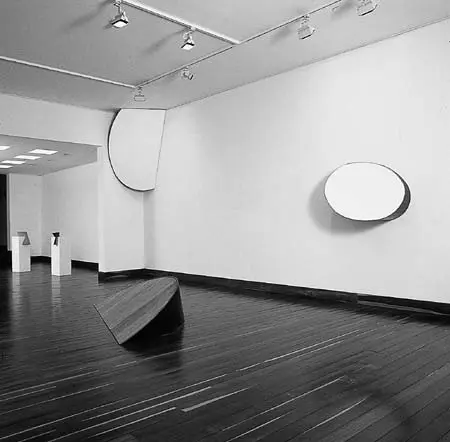
This latest interest in Castles’ is what structured the artist’s show at Diners Gallery this past September. Castles showed steel sculptures made between 1998 and 2000, and through them, he calls to our attention the relationships between the work and its space. Large volumes joined to the corners of the room, or small pieces ironically invading the pedestal that supports them, weave over and over again their own “place.”
Castles’ large volumes bring three elements into their relationship with space: gravity, tension, and balance. Given the location of these pieces within the gallery, each element is the condition of the possibility of the next. Suspended above the upper part of the walls, these works seem to levitate, defying gravity. Their location is the product of the tension between and the balance of several forces.
Additionally, in some of these sculptures—or axiomatic structures, as Valencia calls Castles’ works of this
period— we find an extra element: irony. The irony here is constructed through the size and location of each work. It would seem that Castles has sought to repel Barnet Newman’s negative but also ironic definition of sculpture, back in the fifties (“Sculpture is what you hit as you step back to appreciate a painting”). Castles’ work invades walls and corners, subverting the minimal spatial organization that serves the famous critic to establish the borders between painting and sculpture. Irony is also present in the smaller pieces. These sculptures underline the relationship of their volume to the surrounding space through the base supporting them. Apparently, each piece rests calmly on a pedestal, but if we look carefully we discover that their resting is made dynamic by the volume planes that extend downwards. These small pieces do not contain in themselves all their meaning; they are not absolutely autonomous. Instead, they move towards the space that holds them and that they themselves transform, acknowledging their existence
through architectural experience, through the experience of space.
WILLIAM LÓPEZ