
José Gurvich’s show at the Museum of Latin American Art, Los Angeles has the characteristic of being a retrospective exhibition with a historical value that increases in meaning and attractiveness as one walks through it. Gurvich is not an artist whose work has been diminished by the passing of time; it has maintained the freshness, vehemence, and sense of humor that has long characterized his work and personality. His then-young widow’s wise and self-sacrificing decision of not distancing herself from his work has been a lesson to us. To this, we must add the labor of classification and conservation, which are fundamental to the oeuvre and can survive and be presented in shows such as the one being reviewed in this space.
José Gurvich (Lithuania, 1927 – New York, 1974) came to Uruguay at the age of five. He became interested in music, a discipline he studied and thought to be his calling until he met with Joaquín Torres-García. He entered Torres-García’s Taller and his life made a definite turn toward fine art. During the first year’s struggles, his work was heavily influenced by Torres-García’s grids in terms of the relationships between symbols, ways of drawing and painting, and the representation of the human figure. But Gurvich did many other things in his short life. Undoubtedly, the impact of such an influential teacher and workshop remains the legacy of Taller’s technical and thematic approaches, but to it, we must add this indefatigable worker’s jovial spirit and intellectual freedom.
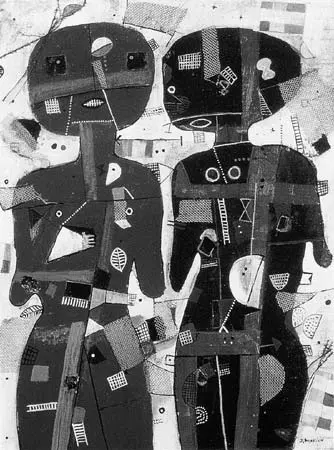
By the time Gurvich was 29, he had already exhibited on his own, and with the Taller in Uruguay. He traveled through Europe en route to Israel where he worked and painted in a Kibbutz for two years. Afterward, he returned to Montevideo. There he exhibited frequently while also teaching at the Taller, and painting murals. The successive geographic distances he sojourned—several trips to the Old World and the Holy Land—are equivalent to the aesthetic worlds he unites, interrelates, or separates in his artistic work. From the grid he moves on to paintings completely devoid of it, he grazes abstraction without quite embracing it, all while he makes the paired human figure his fundamental subject. >>From the orthogonal and Torres-García-like order, he will reach the diverse types of baroque style we see in his works with Judaic themes, in those with cosmic preoccupations, in the ones with urban elements, in some of the monument projects, and in those dealing with the “new man.” Gurvich is in a way representative of European immigrants who reach Latin America or the United States. This doesn’t negate, I insist, the Taller Torres-García’s importance; rather, it points toward the individual who dares to emancipate in several ways (which is not what one always wants or achieves with such a great teacher); his trips, the search for Judaica to finish commissioned pieces, his restlessness to work in ceramic and jewelry outside the Taller, confirm this statement, which is something that the visitors to the MoLAA show could have perceived. It is opportune to point out here that the previous stop of this itinerant show was the Museo José Luis Cuevas in Mexico City, where all these aspects were also highlighted. In Los Angeles, Gurvich’s drawings are displayed at the Jewish Cultural Center, whereas in Argentina, Brazil, and Mexico—the previous stopovers —those drawings were integrated into the rest of the show. Whether the paintings are shown by themselves or accompanied by other technical manifestations, the variety of the author’s creative facets and productive impulses are clear; the curatorship and the museographic options under Alicia Haber make evident what has been said up to now. This artist’s work sustains itself in all its facets of classic modernism. Haber is also the author of the Catalogue Essay, a complete publication that joins the ranks of the always-welcomed books on Latin American art.
The works under the most constructive order are dense and motivational. When Gurvich goes after the cosmic man, he also exposes the magnitude of his human and esthetic interests. In some oil paintings on canvas or wood, as is the case of Hombre construido en rojo (Man Built in Red, 1960), the Torres-García grid survives with Gurvich’s expansions. The line is the verbose vector in his work. In Pareja con rayitas (Couple with Stripes), in the various and notable pieces with “wedges” (be it in drawings or paintings) of the same decade, and in Pareja cósmica (Cosmic Couple), among other pieces, the author’s free and associative intelligence is put to action. Kibbutz and ¡Qué pesado es ser judío! (How Heavy it is to be Jewish!)—both from the first years of the 1970s—concretize the crowding of different-size figures within frameworks with symbols, landscapes, and animals, much in the style of the popular Hebrew sagas of persecuted towns that were immortalized by Marc Chagall. From the same period, there are pieces such as Collage en naranjas (Collage in Oranges) mixed technique of informalist ascendance, a tendency fashionable during those years. In this piece, humans and object mix with stains and drawings, and with certain textures that are more visual than physical. In New York the artist lived a conflicting and contrasting period; emotions opposed preoccupations; skyscrapers and architecture in general amazed him, as well as empty zones and urban sculptures, while at the same time, he was deeply nostalgic for Uruguay. In these last stages, we notice a monumental conception through drafts, works, and notes for possible public monuments.
GRACIELA KARTOFEL