
The 20th Century showed, with Duchamp, that to be selected by an artist and, especially, to be exhibited, gave something the quality of a work of art. At a time when consumerism is consuming itself, it is people who have begun to exhibit themselves. For that, technological and scientific advances are able to negotiate with the passing of time or help resolve physiological nonconformity — or with the body in general. If the romantic films of the mid-twentieth century commented on the scandal of divorce, this was also called “to switch spouses as if switching blouses.” Of course, there was always the ironic divorcée who told us that “to renew oneself is to live,” or that the whole thing was just “a change of skin” (referring, perhaps, not to one’s own skin but to the sensual relationship between a couple’s dermis.) Nicola Constantino seems to have shortened the distance between those situations and the more recent experiences of cloning, arriving at one of the more eloquent points of the modern spectacle. People or embalmed animals are exhibited as works of art; “the spectacle” itself is exhibited, its value being the very fact that it is there to be exhibited.
Plastic surgery is today as common as drinking tea —and it is much more than just nose jobs. If we think about it, when blood flows through our veins there is another, parallel vessel through which money flows; one current of “air” sucks in money, another drives the flow of oxygen, yet another controls…what? We are yet to reach the point where it is possible to control the aging process, but the visualization of time can be slowed down. As some people say: “Surgery is not only for myself, it’s also for the people who will then be looking at something more beautiful.” The spectacle’s autonomy has accumulated value, and that value is moving up throughout the world Nicola Constantino works these themes from his vision of skin, to arrive at the place of oxymoron. Human skin, animal skin, and bodies, the simile of human skin as dress and of “masses” of animal bodies; all of this creates a complex installation, at times encrusted on the walls and at times as free-standing pieces.
Within a generally luminous range, light, subtly roughened, with skin colors that go from whitish beiges to brown, the exhibition had two sections: the “house of fashions” and the “art gallery.” The first one offered dresses, bustiers, handbags, shoes, and jackets. Some of these pieces of clothing and accessories had ornaments resolved in spectacular full heads of natural hair. A work with textures occupies all of Constantino’s clothes. Extreme enlargements of wrinkled human skin with constant nuclei refer to human and animal nutrition through the nipple. Visual and tactile textures coincide. In the second section, both the artist and the gallery owner, Deitch, joined a fashionable trend to add temporary walls, costly assemblages, and museum-like museography.
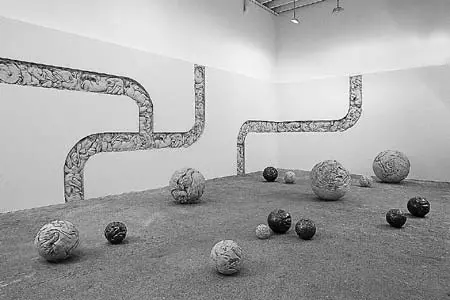
All of these are coherent with Nicola Constantino’s work, and it’s coherent with the theme at hand —spectacle itself. In the “art gallery” section, pieces were mounted on walls around the whole gallery. The artist encrusted low-relief works in polyester resin depicting bunched figures of animal (pigs, sheep)
fetuses. On the floor, there were different types of balls, in three different sizes, with pig feet sections, accumulations of skin, and other effects. From each type we found no less than three, grouped and
placed intermittently on the gallery floor. With a personal and laborious technique, Constantino recovers the eschatological and sadomasochist aspects, producing surprising mural decorations
with these relies, straight or curved, in continuous bands.
GRACIELA KARTOFEL