
This is the common, generic name with which the M&M projects identified the group of shows and art events that took place in San Juan, Puerto Rico, from Monday, 9 October, to Sunday, 15 October, which were preelection dates on the island.
Michy Marxuach, gallery owner and director of this respite in the city did not see this as an entirely commercial idea, nor even adequate for the habitual and dogmatic parameters of the curatorial practices in use, but perhaps even the opposite: a contaminated and promiscuous strategy whose open proposal was to liberate the original initiatives of the fraudulent conventions that the official art institutions censure before the independent curatorial work of our day takes place. The conditions perhaps were not the most outstanding and optimal, since it was no longer about a museum, nor even public money, but the favorable terms were unthinkably generous accomplices. Everyone involved in the organization in one way or another was able to observe something quite unusual these days—at least in Spain—namely, that artists were being given the possibility to do what they wanted, beyond economic considerations, space, aesthetic transgression, political discomfort, or for no reason at all. Not having to battle with the arbitrary institutional limits or the totalitarian manias of some museum directors is at least a relief in view of the embalming strategies that are woven together everywhere in the face of the degenerate new art that is approaching us from all sides. In my opinion, to label this art in this fashion is a real honor, not only on account of its historical and political references but also because it entails recognizing the fact that galleries, although reservedly, are beginning to express new social strategies foreign to the market in order to attend to these artists who are uncomfortable both in the museum and in the white cube of the galleries, already obsolete for the art of the twenty-first century and the times that pass in search of new spaces of expression. It seems logical that, however the art that we are talking about may be out of the ordinary and restricted by precisely what the market emulates, new gallery dynamics begin to flourish at the pace of the art of the new century, which elude the conventional gallery designs. But this nevertheless incipient resistance movement to art’s status quo must still overcome many difficulties in order to avoid conflict —which seems to be its aim—with the factual cultural powers, quite sensible to the legitimation of everything that does not understand beyond language. I have witnessed the criticisms of the Museum as a funeral and mortuary institution by Antonio Martorell in his participation in the first panel of “conversations in parentheses,” and they received a dreadful reception among the board of directors of the Museum of Art of Puerto Rico, where those conversations took place. Was Martorell perhaps casting stones over his own roof, putting his own integrity in danger? Where was he carrying out his participation/performance and exhibiting a hanging curtain embroidered by many hands that covered the stage? Was his stage, his referential frame, his context, not a museum? Was it appropriate to speak of the rope at the home of the hanged man?
But let us begin the visit of this respite by considering the respite itself, at night, and still unfinished. For several consecutive years, the artists Julio Suárez and Charles Juhasz Alvarado have put on an elaborate meal after the courses of the School of Plastic Arts, and it is known that both are culinary fanatics. This time, the first act of PR’00 on Monday the ninth, consisted of a dinner at the home/studio of Charles Juhasz, which I am sorry I did not attend, so I cannot say anything about his steaming dishes. It was not just another dinner, nor a way to round off the event, nor an epilogue. On the contrary, it was the very opening.
In the late afternoon of the next day, Fortress 302 turned into a “besieged and seized” place. According to the organizers of M&M projects, it was a matter of squatting, if I may use the expression, in an alternative space in order to present the artistic production that artists in contemporary societies are creating today. An intervention in “undefined” or “neutral” spaces in diverse artistic structures, like the museum itself, is capable of generating new artistic spaces. This was the basic concept through which all the floors of the building would be articulated.
At the entrance, still out in the street, the visitor had “open mike” switches from Ignacio G. Lang, which amplified the message that each person emitted live throughout the entire neighborhood. The tiny piece was posted on a grand scale on one of the neutral sides of the building by a microphone that looked like a radio station billboard. This outside piece formed part of Urban Interventions, curated by Michelle Marxuach and Dean Daderko.
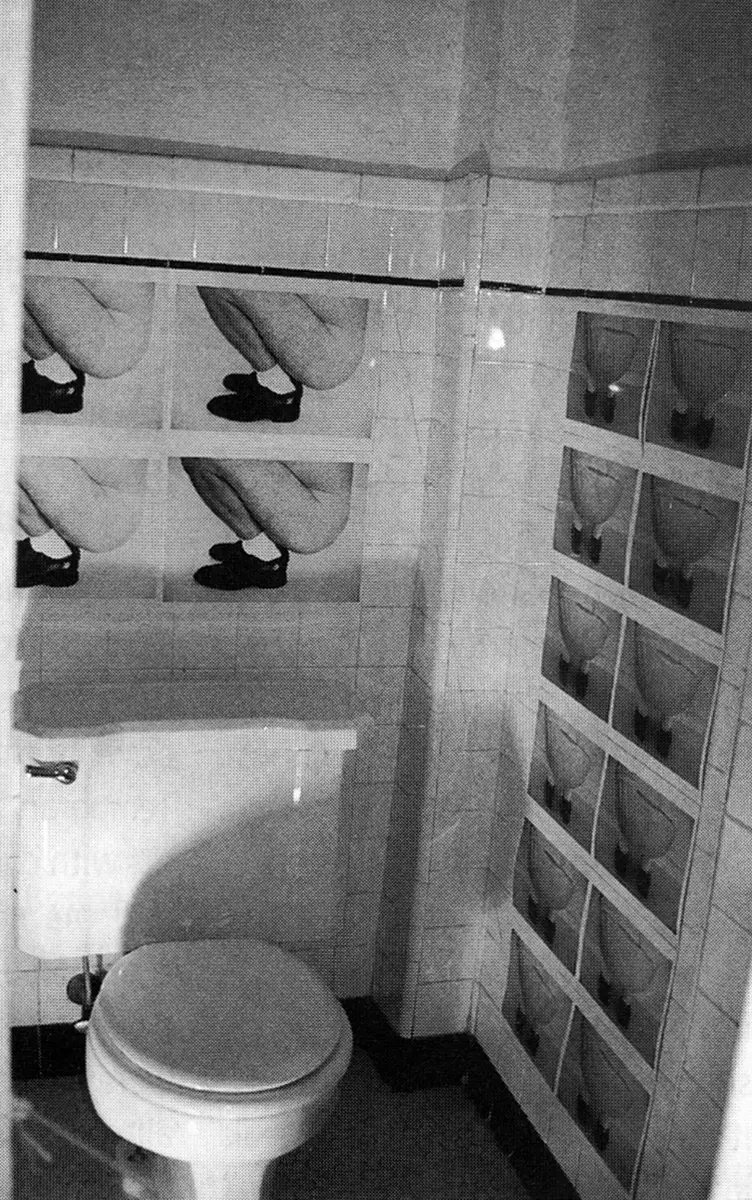
Going up the stairs, we find the first interior piece by Ana Tiscornia, who also participated in the first of the corresponding panels. It is installed along the sinuous and never-ending handrail of the stairway and in some of its corners, created in black felt with texts printed in white. This piece belongs to Escenificando la/puesta, curated by Michelle Marxuach. Other pieces belonging to this group included works by Carlos Rivera, Chemi Rosado Seijo, Aaron Salabarrias, Liliana Porter, Temporary Service, Ernesto Pujol, and N55, all in various formats and media, the majority of which were installed on the roof, an old bar with a bathroom included. This last space housed a homoerotic photographic installation by Ernesto Pujol, very appropriate for the bathroom, with a complete staging of adequate and intimate positions that were not at all abrupt. It was the end of the line, the peak in the staged, corrected, and enlarged Duchampian toilet, to which we shall return later, wisely perfumed by Ernesto Pujol. When you came out of the bathroom you returned to the piece by Chemi Rosado, the revelation. This is a very novel work that will set people talking on account of its cutouts installed in the Museum of Art of Puerto Rico in another show that we shall discuss later,1 and its Diving board, but let’s not get ahead of ourselves with details from this laboratory/labyrinth. Chemi Rosado has preserved or altered every piece from the old bar, the only space respected out of the old interior architecture of the building’s six floors. Including the music. I was going to say that, between Ernesto Pujol’s perfume outside the bathroom and the Caribbean music of Chemi Rosado’s vinyl records, the space was able to alter and daze us to the point that we truly did not know if the free clothes that hung on the windows of the group from Chicago, Temporary Service, and their pockets with condoms and magazines, and the manuals of the Danish group N55, or the tunnel of Brazilian artist Ana Maria Tavares, were leading us toward some reality outside art and outside life, or if they were returning it to us since we have forgotten on account of the neurotic habits that our ego imposes on us in the big cities. Among the unexpectedly large number of guests, some anonymously handed out food and drinks, also free, like the condoms of Public Dispenser, the piece by Chicago’s Temporary Service. Yes, that was also a party where I could catch a glimpse of Mendive. A good sign.
Trying to leave the roof, going down to the fifth floor, there was a street video by artist Brooke Alfaro arranged on the landing that blocked the stairway going up. The video drew us into a plaza and its usual human landscape, the drunkard on duty and the barber.
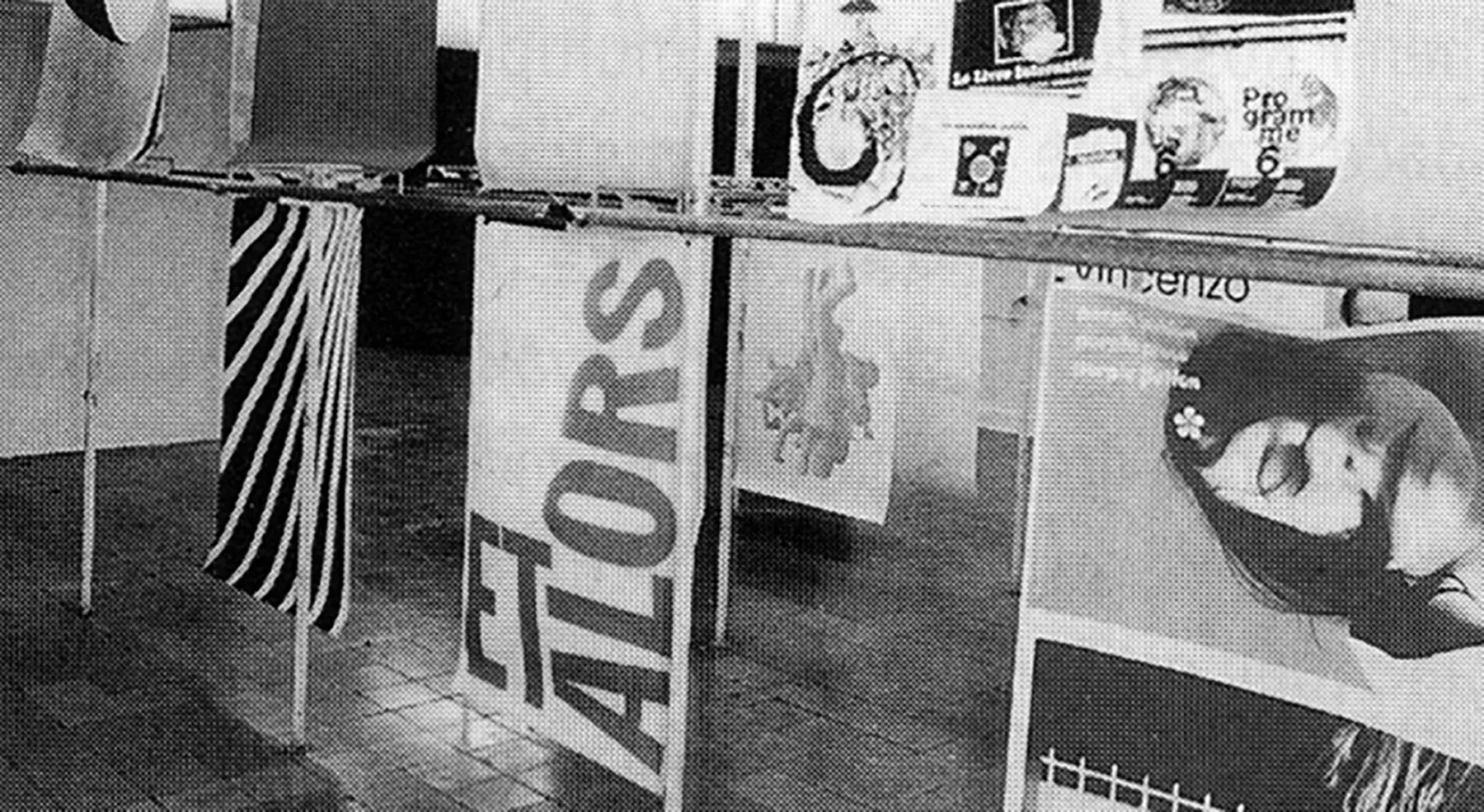
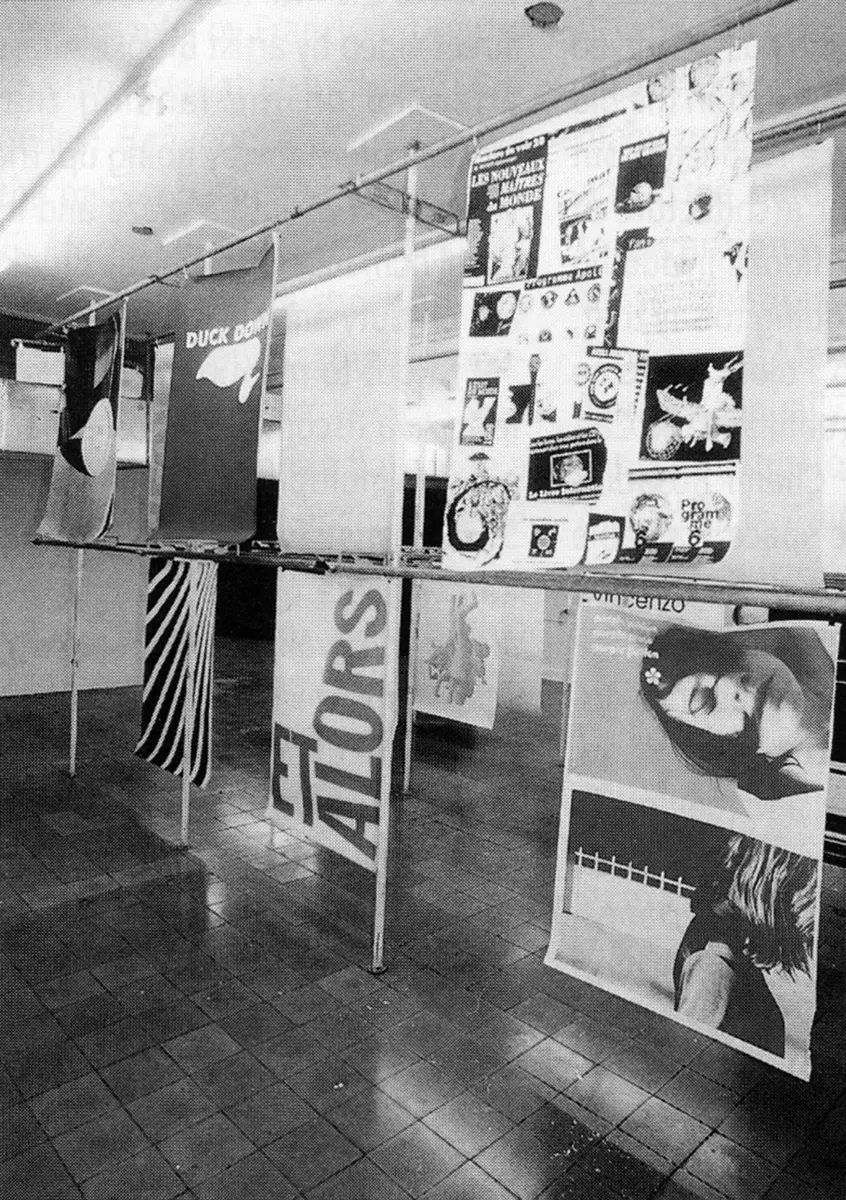
I forgot to mention that, parallel to Ana Tiscornia’s Logos, a magnificent multiple sports center by Swiss artist Fabrice Gygi titled Parcous Vita by JPR-Editions ran along the walls of the stairway space. The work acted as a huge tail for the first show of the second floor, Multiple/Papers, curated by María Inés Rodríguez, a Colombian who lives in Paris, presented to us through Point d’ironie, Sommaire, In Vitro, Valdez, and the Center Genevois de Gravure Contemporaine. Buro de video. BDV, diverse structures that propose exhibition spaces and participation alternatives to the artists in the form of multiple editions, videos, art books, posters, and other papers.
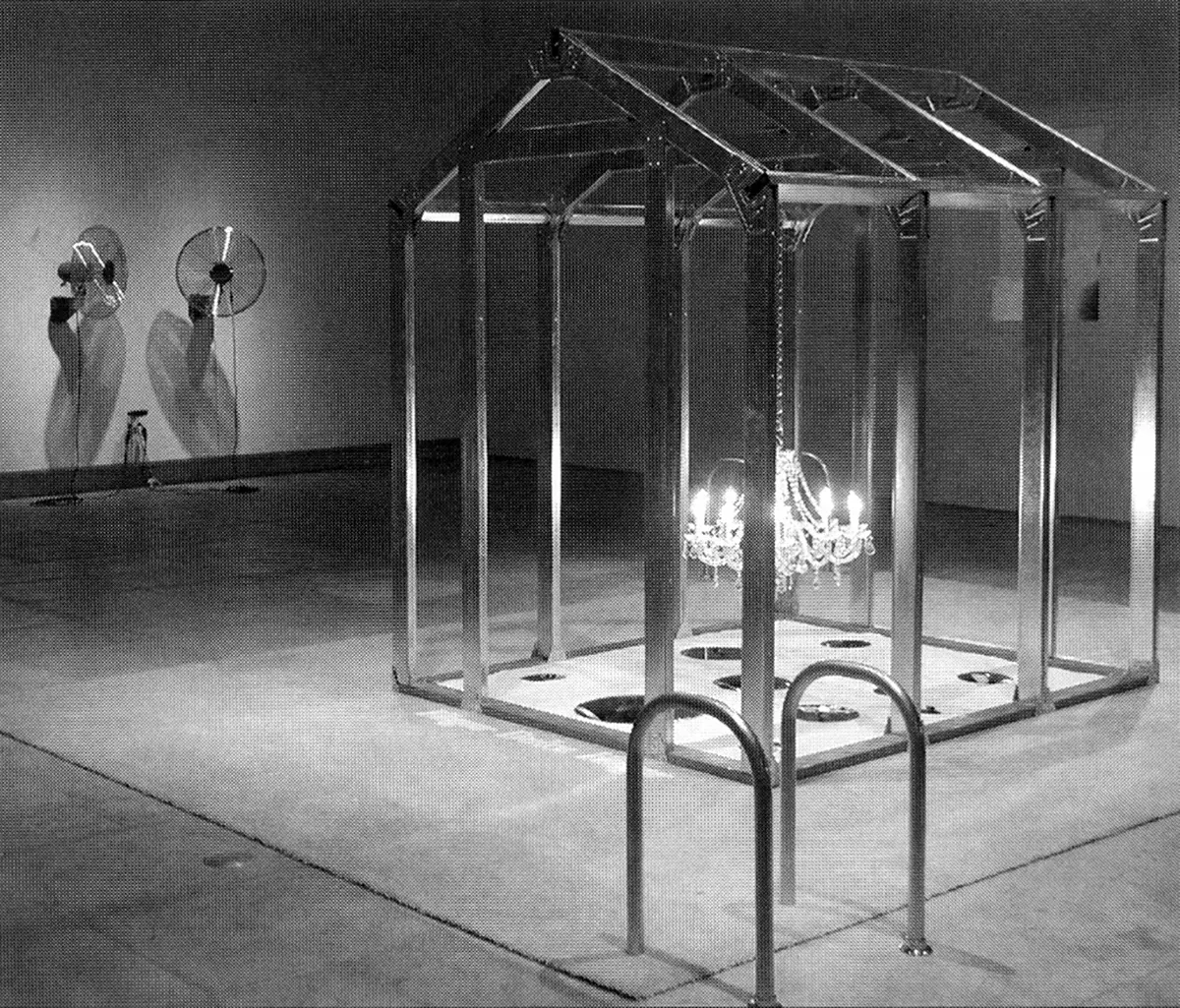
From the third to the sixth floor, three exhibitory proposals were expressed: 1) the aforementioned Escenificando la/puesta by Michelle Marxuach, completed with the spectacular work in progress that is assembly, hybrid, and collage, by Carlos Rivera, titled Bullets & Trajectory, and a video by Liliana Porter, Solo de tambor (Drum solo), which we saw again in the 7th Havana Biennial; 2) Multiple Images, curated by Virginia Pérez Ratton from Costa Rica, with the aforementioned Brooke Alfaro who closed this proposal at the end of the stairway, an installation with multiple toilets, and a video installation by Joaquín Rodríguez del Paso titled Cuentos chinos, Las lecciones de cómo maquillarse ((Tall tales, Lessons on how to apply makeup), a video by Costa Rican Priscilla Monge, and her magnificent Bailarina (Dancer) made of cast bronze with a drill, and Rocío Con Hong with her breakfast (end of the respite) at the home of Michelle Marxuach, and her recurring cartelas dispersed along the facing ruins in Costa Ricas y Puerto Ricos by Pérez Ratton and Marxuach; and 3) Disidencias y Rupturas (Dissidences and ruptures), curated by María Llüisa Borrás, a bold and plural group show of video artists of various nationalities of Spain.
Contra el Muro (Against the wall), curated by Mexico’s Guillermo Santamarina, was located on the fourth floor. In my opinion, this may be the most solid, compact, and complete project, along with Marxuach’s Urban Interventions, both on account of its radicalism without concessions as well as its anger. Teresa Margolles, Damián Ortega, Ismael Merla Cosío, Santiago Sierra, Andrea Ferreyra, Javier Dueñas, Iñaki Bonillas, and Francisco Ugarte are the artists included in this show. Santiago Sierra, a Spaniard living in Mexico, presented a video with a literal title: Línea de 190 pulgadas rasuradas sobre las cabezas de dos junkies (190 inch line shaved over the head of two junkies). Damián Ortega showed two masterpieces: Ojo (Eye), an egg yolk in a toilet bowl, and 100 dólares de dieta (100 dollar diet), the sum paid by the organizers for expenses, which the artist changed for pennies to form a monetary snake that rested on the floor.
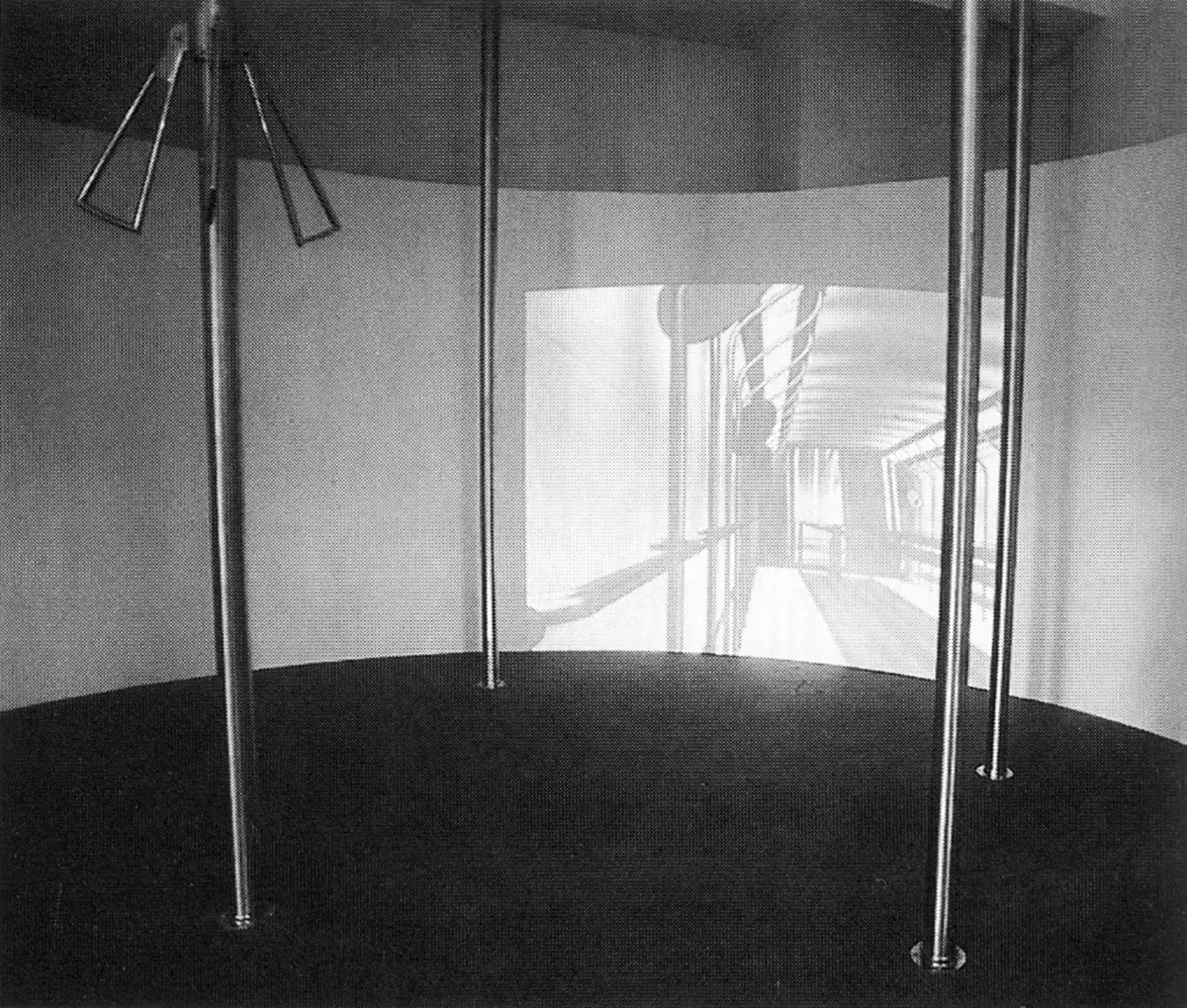
Also noteworthy was the installation by Iñaki Bonillas titled Light Room, with empty watertight compartments like private dressing rooms, and his pieces Clear and The Light of Flash Illumination, like Andrea Ferreyra’s boxing video, who also participated in a long intervention tour in the street, under the rain, and in the sea, dressed as a boxer. Also, the various landscapes, projections, and photographs by Francisco Ugarte, and the installation by Teresa Margolles, Bañando al bebé (Giving the baby a bath) and Secreciones El Muro (El Muro secretions), as terrible as they are shocking, but in no way showy, rather the opposite. In Bañando al bebé, the artist gives the baby a bath with a prickly brush in an uncomfortable washbowl that is smaller than the baby. The viewer has the sensation that more than one bath is a full-blown torture. The second piece, the installation, consists of an empty room with a bucket arranged with human fat and a brush with which we notice that they have casually painted the walls on account of the disagreeable stench that is breathed inside.
On the fifth floor, curated by Exit Art of New York (Papo Colo & Jannette Bergman), 60 large-scale images of performance history were presented. This show takes on the study of resistance, both physical and mental, as well as the spiritual resistance of the body. The work is investigated through the documentation of the artists (Vito Acconci, Yoko Ono, Gilbert &George, Joseph Beuys, Oppenheim, Paul McCarthy, Flanagan, etc.).
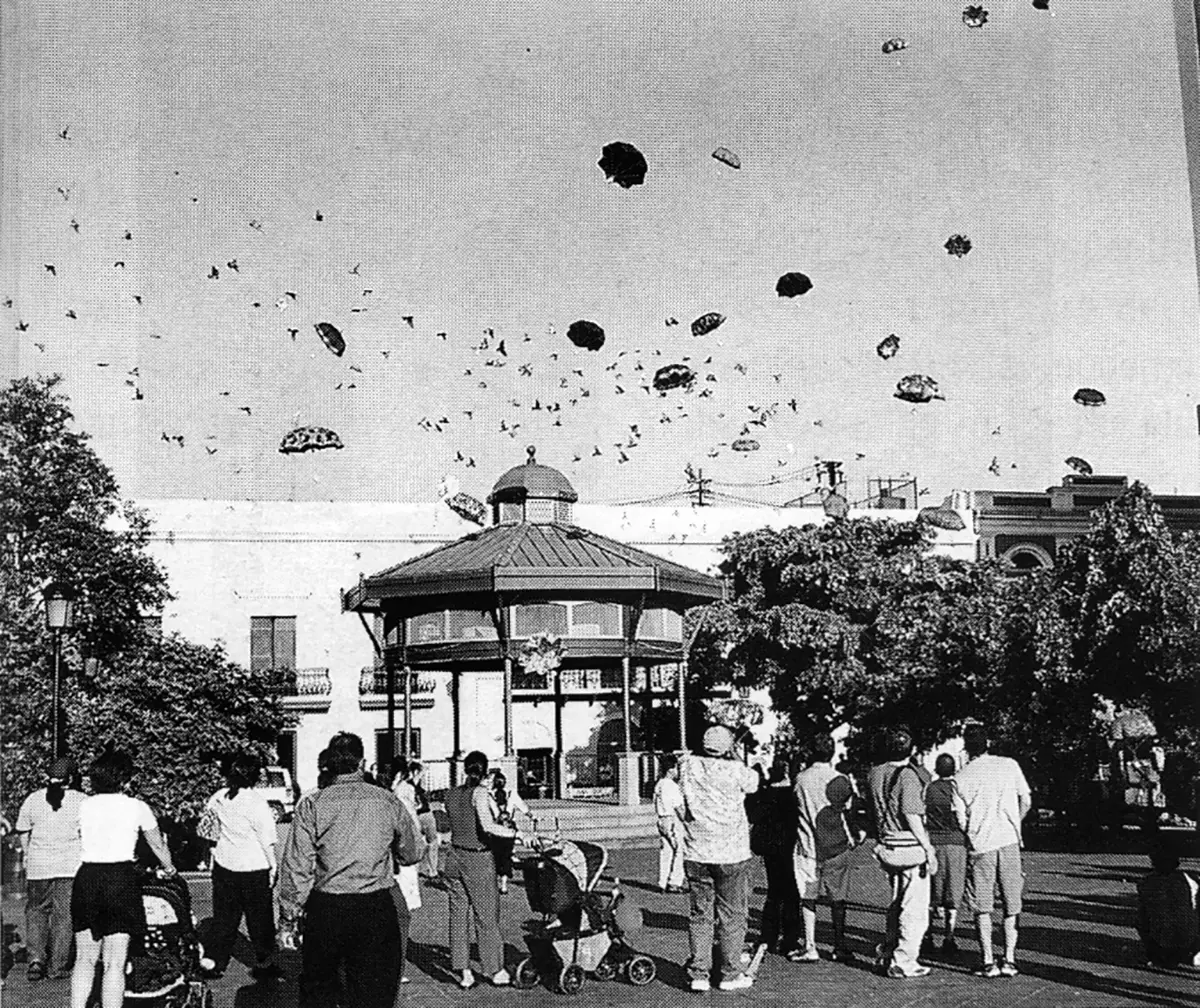
Outside of Fortress 302, the headquarters for PR’00, the exhibitory proposals were completed by 1. Un Oasis en el desierto azul (An oasis in the blue desert) by Michelle Marxuach in the Museum of Art of Puerto Rico, five projects by Puerto Rican artists (Charles Juhasz Alvarado, Chemi Rosado, Ignacio Lang, Adam de la Croix, and Dhara Rivera) who formed part of the cycle of Espai 13 at the Joan Miró Foundation in Barcelona (1999-2000), “refocused” (according to the program) by the Museum’s director, Mercedes Trelles; 2. U/topistas (U/topians), in the Art Gallery of the University of the Sacred Heart, with a catalog designed by Aaron Salabarrias, and the participation of models and projects by Rosa Irigoyen, Ernesto Pujol, and many other Puerto Rican artists; and 3. the aforementioned Urban Interventions. In addition to those mentioned by Temporary Services and Mexican artist Andrea Ferreyra, equally noteworthy are the contributions by Allora & Calzadilla in Call Me, printing gift T-shirts with ads dictated by passersby who decided to stop by their stand installed in a plaza of Old San Juan. Chemi Rosado, with his magnificent Trampolín in solid iron for the boys of San Juan’s Dos Hermanos Bridge, of which Michelle, as well as its creator and others, and even myself, made urgent use by diving off before it was stolen, in spite of its considerable weight; Paracaídas (Parachutes) by Jorge Rivera, with hundreds of clustered parachutes falling from the sky; Raimond Chaves and Carolina Caycedo (from the Cambalache group, which they form with Federico Guzmán), and Bogota’s Museo de la Calle which creates a crossing in the plazas of Old San Juan and 24 hours of drawing in the street; Regina Silveira with her Super Hero, projecting itself with a laser on the buildings of San Juan’s nightlife; the videos in the commercial establishments of Lana Lin, Chris Sollars, Sharon Hayes, and Anissa Mack; the spectacular boxing soirée in useless combat (in the Museum of Art of Puerto Rico) between Charles Juhasz and the Spaniard Domingo Sánchez, refereed by the Spanish artist Paco Cao, and curated by the Spaniard Fernando Castro and the omnipresence of the international performer Freddie Mercado as well as Teo Freytes, the blind man who sees everything.
I wish to add just the two panels that took place in the Museum of Art of Puerto Rico. In the first, the involvement in the art space was tackled, with the participation of Kevin Power, Yu Yeom Kim, Ana Tiscornia, Evelynne Jouanno, Antonio Martorell, and Virginia Pérez Ratton. The second, organized by María Inés Rodríguez, centered on the world of editions, with the presence of Verónica Bachetta, Pierre Legiullon, Lucas Ospina, Carrie Pilto, and María Inés Rodríguez herself.
Thus, more than a respite, a tireless week of art without excuses, that should be convoked annually as seems to be the intention of the organizers, noteworthy among whom is Luisa Rosado, Michelle Marxuach’s right hand, and M&M projects.
NOTE
1. “Tapando para ver." Espai 13. fundación Miró. Barcelona, Spain, 2000.
ANTONIO ZAYA