
Every modern city is made of the basic contradiction between order and chaos, between an Apollonian desire to correct nature by submitting it to a grid, and the inevitable tendency of everything human towards corruption and decadence. Modern cities are basically human settlements erected around meshes of lines laid on the ground. Lines have given sense and meaning to our universe since the time we became sedentary and discovered the potential and permanence of drawing as gestures, ideas, and emotions frozen in time. Men represented herds of animals in the caves of Altamira with lines. During the seventeenth century, René Descartes created a system of three orthogonal lines capable of defining the position and dimensions of any object in space. Gilles Deleuze and Claire Parnet wrote in their essay “Politics,” “As individuals and groups we are made of lines, lines that are very diverse in nature.” Deleuzian lines are segmentary (family/profession, work/vacation, family/school), molecular (they trace changes, highs, depressions, and irreversible processes), and the line that carries us towards unknown destinations: the line of gravity.
The group show Re-drawing the Line, is a reflection upon what the curator, Monica Amor, defines as the “crisis of linearity” in contemporary art, a crisis that "was felt in the emphasis on the hybridity between artistic practices, the dispersal of materials and compositional structures, the dismissal of conventional surfaces, accompanied by a proclivity for architectural supports and radical incorporation of space that brought to the work a diffusion of the classical models of spectatorship." Amor tries to map the subversive qualities of the line through the work of eight artists born between 1959 and 1970.
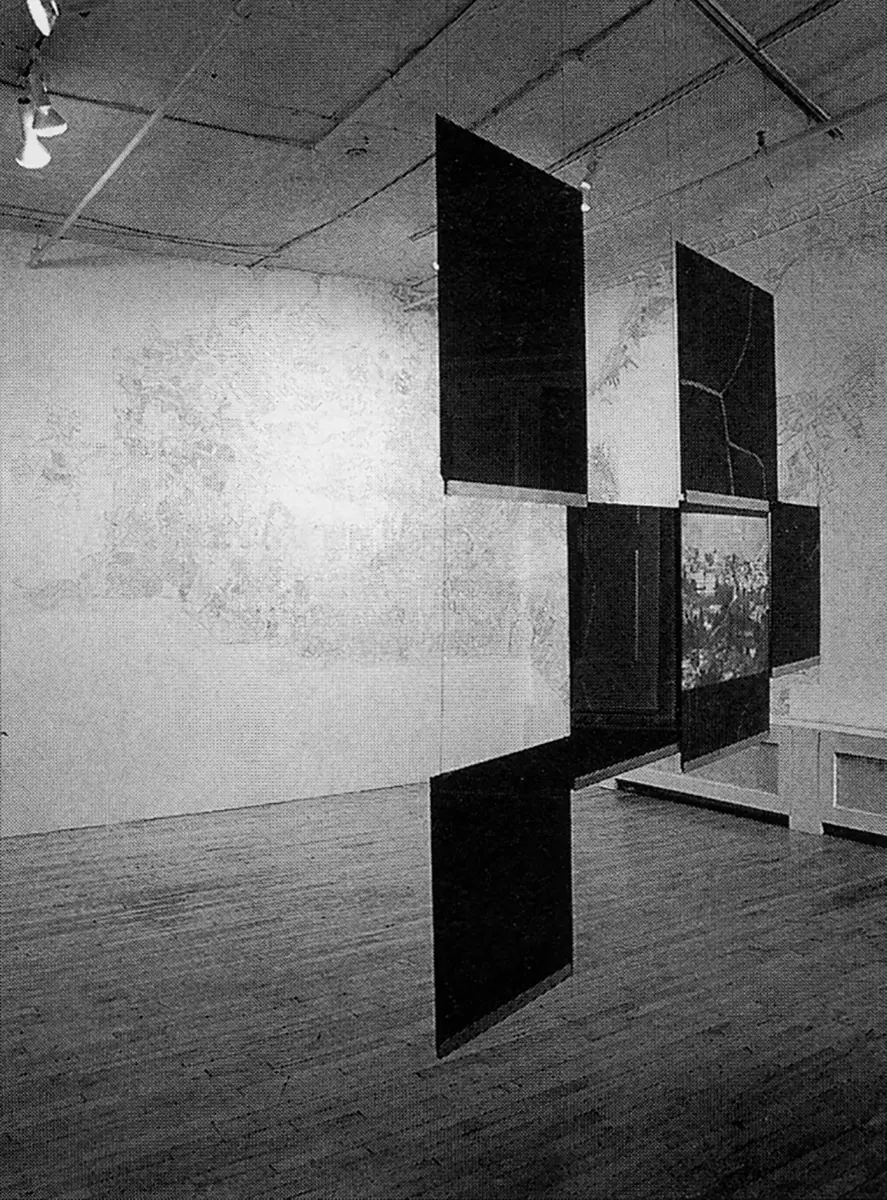
Peter Wegner strips the line of its authoritative power by erasing with white paint the printed lines that represent streets in maps. In works like Brooklyn (1999-2000), part of this borough of New York is shown as a spectral city in which either there are no streets or the whole is a huge and meaningless street that goes nowhere. Wegner’s elimination of the graphic information in a map could be seen as the imposition of the esthetic over the pragmatic. But at the same time, by effacing the streets, he evokes one of the cruelest experiments of human engineering: the demented city killing perpetrated by the genocidal Khmer Rouge regime in Cambodia, which in one of their purifying acts, erased all the street names of Phnom Penh to turn it into a featureless and impersonal urban vacuum, an authentic ghost town.
While Wegner paints over streets, on maps Belgian-born Francis Alÿs paints on the actual streets on his Paseos, a series of urban strolls in the neighborhood where the gallery is located. Here Alÿs walks with a punctured can of paint whose thin stream leaves a trace of color over the asphalt in The Leak (1995-2000). For this artist, a walk or a paseo is a thread of sights, ideas, things, and places, but it is also a search for the unexpected and the creation of a sketch. The terrain becomes the map through a performance and marks that are neither totally controlled nor completely random, but somewhere in between, have appropriated the space.
Los Angeles artist, Mungo Thompson, is also fascinated by the concept of the Random Walk (1998-1999). But instead of actually strolling, Thompson creates virtual wanderings with the help of a computer algorithm that connects lines in a diversity of patterns and then prints them as intriguing highway signs. Here, like in Wegner’s work, the functionality of urban graphic language is hijacked for an aesthetic purpose. The irony is that the randomness of the walk is institutionalized through official-looking signs that transform spontaneous wandering into an authoritarian imposition. Along with these rigidly established walks, Thompson presents the series, A Mutable Object (1998-2000): tangles of 100 plastic zip ties of different diameters. Here the element of control is tangled in a messy knot and submitted to the control of the artist.
Venezuelan artist Alessandro Balteo centers his work on a prominent and emblematic building of Caracas, the Torre Miranda, a blue-tinted glass skyscraper that embodies the premature decadence of the dreams of modernity in the developing world. The blue glass of the facade has deteriorated because moisture has discolored and cracked the blue vinyl film sandwiched between two pieces of glass. Balteo uses some of these blue panes, a video, and a map of Caracas in his piece Courtaing-Wall (1998-2000). Balteo conforms the urban sprawl to a non-orthogonal pattern created with the unpredictable lines of the decrepit blue glass.
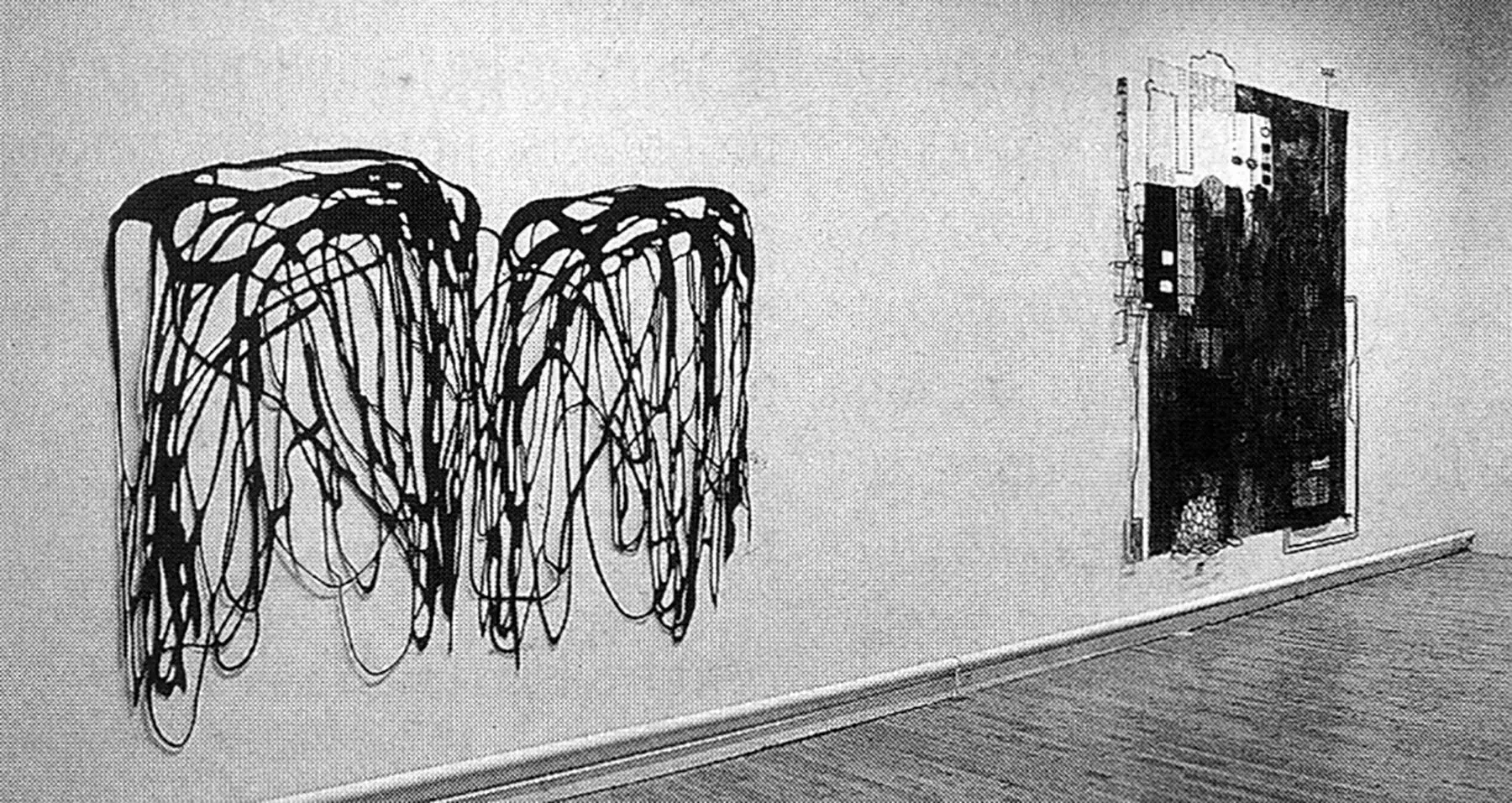
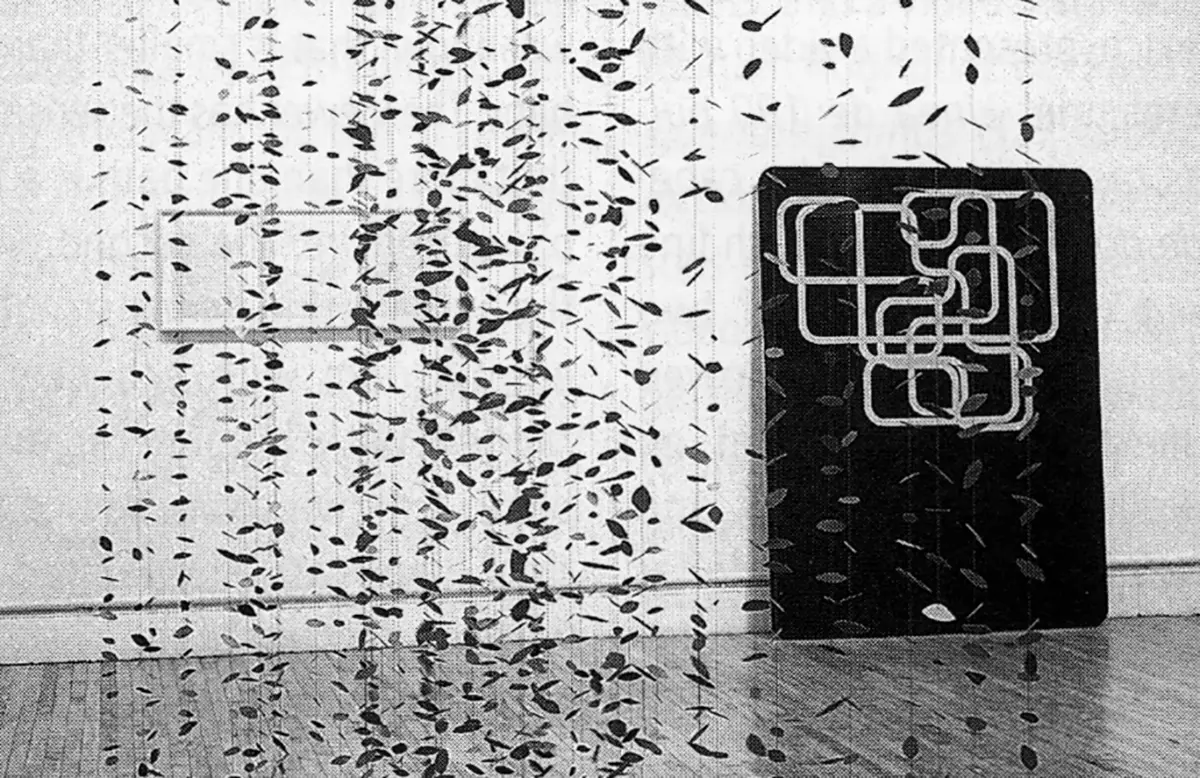
While these four artists deal with drawn lines and the city, the rest of the artists in the show take a different approach to the line. Sophie Tottie plays with the trompe l’oeil by using horizontal lines of obsessively repeated images on the wall and in this way creates an illusion of distorted space. Regrettably, her piece, Reel (2000), seems incomplete and the chosen images are too large and distracting to create the desired effect. Just as Tottie uses the horizontal line, Pae White employs the vertical line in her piece Hobo Woods / Tears of Vietnam (1998); a collection of threads with colored papers that seem to float. Arturo Herrera weaves meaning in his felt piece Untitled (1998) by bending the line into chaotic patterns that are vaguely reminiscent of Islamic art. Finally, Diana Cooper erects what could be conceived as three-dimensional drawings in which the line turns into a menacing presence capable of sneaking out of the surface, acquiring volume and literally capturing the viewer.
NAIEF YEHYA