
For a long time, the directors of Fundación Telefónica and the managers of their galleries hoped to bring to Chile a great retrospective exhibition of Roberto Matta. The last one, which took place in 1991 at the Museo de Bellas Artes as a celebration of the artist’s 80th birthday, left much to be desired. This new effort is a definite improvement. Over 100 pieces—paintings, sculptures, drawings, engravings, and ceramics— filled the exhibition halls for nearly three months, attracting a massive and gigantic public. Massive in the sense that it brought together people from all social strata. Gigantic, because of the herds of young, adult, and elderly visitors that crammed the halls —a sight rarely seen in this city. Three weeks before its closing, the exhibition registered almost 200,000 visitors.1
The renowned artist’s exhibition constitutes a very interesting social experiment in a difficult moment for Chilean democracy. Assimilating the recent past has not been an easy task, and, in order to survive, Chile is going through the painful experience of rewriting its official history. It seems as if this slow affirmation still requires national heroes, much in the fashion of the caudillos who fought the Latin American wars for independence. That’s why the Matta exhibition, understood as an inarguable symbolic referent, sociologically speaking is very important. I don’t think its organizers ever anticipated this dimension. Nor do I think that the public at large is too aware of it, either. On the contrary, the issue was to commemorate the year 2000 with a memorable exhibition, and undoubtedly an exhibition on Matta, Chile’s foremost 20th-century artist, would be a grand way to celebrate. And it has been so.
Under the direction of Germana Ferrari Matta and Alain Sayag, the curatorial brief was for a body of work covering as far back as the 1930s. Almost all of the pieces come from European collections. The show generally respects the idea of a retrospective, grouping the works by decade though the sculptures were divided by the space occupied rather than chronologically. Accompanying the show is a richly illustrated brochure that includes a text by Luisa Ulibarri, eight short texts written by the artist, several interviews done at various stages of the artist’s life, poems by Neruda, critical texts by Breton and Duchamp, biographical data, and a bibliography that references the works displayed. It does not, however, provide a complete list of the works in the show.
Large-format paintings are the main dish in the building’s central atrium. Two internal halls house tightly the most recent works. The drawings were grouped into two blocks, which contained the most recent pieces. These groups do not follow a strict chronological sequence. Nor chromatic, nor thematic nor serial. Juxtaposed in two united levels, it is difficult to see each work as an individual piece. Does the arrangement respond perhaps to the curators’ implicit wish to emphasize the close link between Matta’s graphic language and that of cartoon strips? The engravings are represented by two series around the Quijote and are displayed in the same hall where the videos and recent digital works are being projected. The videos are educational, targeting an audience largely unfamiliar with the artist. Cybernetic Matta is completely devoid of transcendence. A brief text titled “Yo soy” (I am) tells how, in 1985 in London, Matta discovered the “graphic palette” and how he “could not do very much with it.”2
There is a single example of an artist’s book, encased in a Plexiglas box. The central atrium’s side glass showcases hold some small ceramics, sculptures, and paintings. Also, approximately thirty bronze pieces are distributed in the Telefónica’s spaces. From the filiform works evoking certain periods of Giacometti and Calder —in my opinion, the best executed of all— to the totems rooted in pre-Columbian, Hindi, or African cultures, they all freeze the aperture achieved in the canvas. The forms quit flowing, and their relationship with the space is nonexistent. They remind us of the excesses of the Spanish churrigueresco or the Mayan steles —superficial ornamentation and non-sculptural language. The great Matta is not Matta the sculptor.
Thus, this is not a retrospective exhibition with a rigorously historiographical character, but a show illustrating somewhat randomly several aspects of the artist’s huge production.
The works from the 1930s and 40s are in a small lateral space opening to the main central hall. They are little more than ten, but they illustrate the moment in which a young architect educated at the Universidad Católica decides to become a painter. He had been living in France for several years, working in Le Corbusier’s office. But the great architect’s modern rationalism is not Matta’s, nor would it be the abstract geometric expression. The Chilean’s work spawns from the dream and the dreamlike, from intuition and the poetic; from an expressive will viable to the artist but not for the architect who constructs. That’s the reason why we cannot deny his relationship with the surrealists, those impertinent escapists who proposed an alternative to reality and rationalism.
The oldest piece shown is from 1936, a medium-sized drawing with colored pencils and graphite. As stated in the brochure and other biographic materials on the artist,3 1938 is marked as the year in which he began to paint. But this piece, presumably not the only one from the period, seems to defy this chronology. Even if it isn’t a work of oil, it is a painting. A series of shapes that suggest standing human figures huddle in a space that can still be seen as a landscape. There’s a distant relationship with Tanguy’s shores. Regardless of the media used, the language is pictorial, not graphic.
The biomorphic forms already appear in those early pieces, possible bodies from an invented organic world. Two or three years later, those shapes began to populate unknown and unmeasurable spaces. This imaginary biology is one of the keys to the artist’s work. He calls them “psychological morphologies,” a concept he began to elaborate in 1938. Another key throughout his work is the one referring to the mechanical world: many of his shapes clearly evoke gears, command controls, cogwheels, and pieces of machines —all imaginary. With this language, Matta reacts to all the morphology created by the sci-fi buffs long before scientists begin to unravel the mysteries of the heavens. Biology and mechanics —not the sciences as we know them but the artist’s peculiar vision of them, sometimes as individual languages, others as combined— place themselves in environments that escape the usual perception of space. They evoke the interstellar universe while at the same time providing a microscope’s field of vision, sidereal spaces, or abysmal depths. This way of resolving the spatial problem is another key to the artist’s work. The oblique and diagonal planes, the web-like strokes superimposed on an indefinite background, define in a few years the language that characterized him almost six decades ago.
Color is manipulated as explosions, and from the onset, it declares its autonomy from formal configurations. Matta does not paint chromatic objects; he paints color ambits over which (or from which) he inserts his morphologies. It is a constant that appears without interruption up to his most recent works. Color space, ambit space. One color, all colors. To the point where a good deal of the palette has become increasingly gray since the mid-1980s. The gray of cobwebs, of impositions, of contamination. Just by glancing at the show, we can infer that the artist has a fascination with blatantly artificial colors, removed from the solar spectrum. Greens pinks yellows and purples suggest neon lights or the shiny hue of synthetic fiber. A generous resource for the person who moves in the world of the imaginary, not of the real. Hard not to pinpoint here is the richness of techniques that Matta uses to make his paintings. From the direct, steady, precise stroke to the amalgams created by rubbing, scratching, or dripping. The stain is as important as the trail it leaves behind, the brush’s explosions on the canvas are also important, or the insuperable way in which transparencies are created and diluted.
Color and penmanship have existed since the beginning. We could say that Matta’s work is drawn rather than painted. Color proposes new ambits or it falls as accidental stains in strategic points around the canvas. The strokes—which range from the thick contour to the delicate line evoking spider webs—are given the task of populating the surfaces, all surfaces. And it is this graphic system that confers the idea of extreme dynamism, of perpetual movement, of displacement. Because in Matta’s work, everything is mobile and dynamic. The energies released by the art range from the potential of a seed to the explosion of a star, among which we find, of course, psychic forces and eroticism.
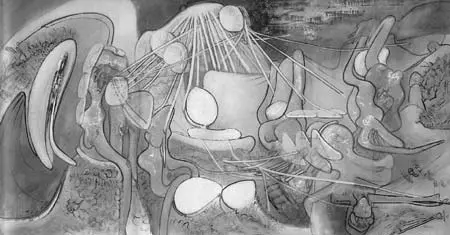
What's really uncommon is the fact that this dynamism doesn’t seem to be dated. Time does not exist in Matta’s work, although as an artist he is clearly inserted in the first half of the 20th century. Starting from the 1960s, his works are variations ad infinitum of a language that was consolidated in the years following the Second World War. We recognize his tune, and we are never bored by it. The subtlest modification is the progressive loss of any narrative. From his own fantastic stories, from a reference to important historical events such as the Vietnam War or the coup in Chile, or from several mythologies freely interpreted, Matta has reached an expression that borders abstraction. The show closes with El Año De Los Tres 000 (The Year of the Three 000s), a huge painting (2 meters x 3 meters) dominated by white, black, and gray, a universe of imagined forms where the organic and the mechanic are completely integrated. There are shapes and strokes, stains and veils: an organized chaos. An educated, cosmopolitan greeting to our times from one of the last great modernists.
NOTES
1. This information was given to me by the guides accompanying the visitor at his or her request.
2. Exhibition brochure, p. 59.
3. For example, Edward Lucie-Smith in Latin American Art (Thames and Hudson,
1993), p. 89.
MARÍA ELVIRA IRIARTE