
Relationships involving feelings always include games of tension and distension, of harmony and imbalance. They establish themselves from vital interactions dragging plural expectations, and they do not always avoid confrontation. Within the frame of these options, Rolando Peña has marked a long journey cohabiting with and experiencing the reality of crude oil. He has drawn from the wealth of upstream currents associated with exploration processes and has exploited all that has been related downstream to the production and refinement of hydrocarbons.
With his current video installation presented at the Museo Jacobo Borges, Peña centers himself concretely in the petroliferous reality, i.e., the place from which the product is extracted: El pozo (The Well). From a purely technical perspective, a well is understood as an orifice drilled to a certain depth in the earth’s crust in order to draw hydrocarbons to the surface. When there’s enough pressure in these sites, the oil flows and wells, creating the all-encompassing sensation of its most crude and tangible presence. Within this focus of intense environmental resonance, Peña concentrates all his investigative capabilities. His intention is to dwell more and more into the most secretive, enigmatic, and challenging aspects of oil. But here, as on other occasions, his relationships of tension and distension with crude oil translate into the reiteration of a two-way enrichment: he supports himself on petroleum to generate his creative speculation and, at the same time, oil finds in Peña the esthetic prolongation of its visual effects. Something similar to what Michel Seuphor sentenced happens in the order of this reciprocity: “The scream fertilizes the style, and the style makes the scream endure.”
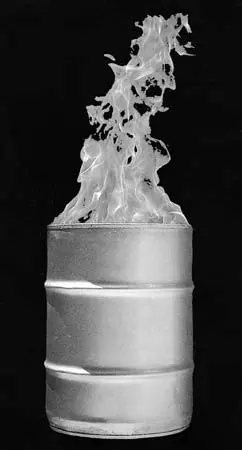
El pozo is conceived as a video installation relying on three levels of readings. The first one is assumed from an upper floor, which tackles the issue from above, promoting contact with a video whose images reproduce the sort of fires found during the Persian Gulf War. Later, the spectator has the possibility of entering the well to be surrounded by its boiling nucleus. In this environment, the elements’ expressive forces are accented due largely to the rustic sensations of heavy oils reflecting the video effects and the repercussions of light and shadow invading the atmosphere. Temperature also feeds itself with the combination of sound stimuli produced by the suggestive and mysterious load of combustion coming from the disturbing dimensions of the fire. A third plane resolves the work; it is the one that activates when the perceptive effects of the video are seen from below, which suggests a sort of suspended fire emerging from the earth’s entrails to take possession of the atmosphere. This mixture of sensations releases in us raging fulgurations, as well as impacts of irritation and asphyxiation. Explosions and resonance create a rarefied atmosphere, invading the whole space and surrounding the spectator.
These three planes are integrated into two expressive dimensions. One comes from understanding oil in its passive stage and its heavy, liquid condition. The other, from facing the potential of its most aggressive power. Such extremes allow the release of those surprising and suspicious risks inherent in all energy resources. To increase these potentials, the artist integrates expressive elements and media resources into a compendium recovering the meaning of an installation. Indeed, in this work, one can breathe and experience being inside a niche promoting an intimate relationship with an animated and pulsating environment. This allows the work to be seen and felt inside and from within.
The conjugation of these attributes makes us understand that Peña’s intent is not to capture or describe the anodyne presence of an oil well. On the contrary, his interest veers toward converting crude oil into something more than what it is, something higher than what it means, different from what it appears to be. His focus is not conditioned by complacent innocence, but it isn’t pushed by strident denunciation, either. What he’s searching for is a way to extend oil’s resonance beyond its material existence and empirical meaning.
In this analysis, we cannot omit the presence of the barrel. In this particular work, as it has been with all his other works, Peña resorts to this object without pretending nor hiding the fact that it represents the most eloquent visual piece of information and the most encompassing sensory stimuli of his esthetic discourse. Here we should note that the barrel is the container in which crude oil was stored and transported. Today the mechanisms have changed, and the barrel has been relegated to an occasional use, and also to the representation of the unit of measure used in oil negotiations, and it is the equivalent of 42 gallons (159 liters). This meaning, tied to its historical background, has turned the barrel into the most representative symbol of the world’s oil industry. Peña uses it, intervenes in it, and manipulates it in its amplest and most heterodox potentials. First, he conceives it as a self-sufficient form affirming itself as a real presence. The barrel turns into an expression of a sensitive focus ranging from the explicit to the most secretive. It is a symbol equally representing the riches of the black gold and the impact it has on contamination. It is also the metaphor that says something different from what it seeks to say, or the allegory promoting the repercussion of the other metaphors spawning from it. Finally, the barrel is the concept that sediments and questions the deepest meanings of the artist’s creative restlessness.
This convergence of the barrel’s meanings proves that Peña departs from the referential but is not circumscribed to the anecdotal. His sequence can be synthesized as an effort unfurling between the sensitive piece of information and its most speculative interpretation. It’s not redundant to say here—borrowing from Octavio Paz— that “representation is the distance between the total presence and our gaze.” El Pozo’s design and esthetic definition occur within this path. In this space, things are shown in order to quit being what they are and assume the supreme meaning of their polyvalence.
Again, with Octavio Paz’s help, we can underscore that the multiple meanings an artist assigns to his or her work reflect “the opening from which we enter things and the opening from which our being escapes from them.” We can say that, as with the majority of Peña’s works, a strange reproduction/presentation/reversion takes place, as does an interaction between reality and imagination. His work has moved solidly within this pendular environment, always with a solidity far removed from effective radicalism and vehement fundamentalism. Peña’s work is closer to the problem than the pamphlet, and that’s why his approaches to the topic of oil are characterized by their understanding, not their judgment.
In closing, we feel the need to recognize that in this particular work, the artist promotes simultaneously the meanings of seduction, contradiction, speculation, and fiction surrounding the world of oil. The interesting thing is that all these appreciations mix and mash in a compendium that is planned and full of synergy, where the whole is much more than the sum of its parts. From such appreciations, it is impossible not to transcribe a meditation that Gastón Bachelard wrote in Fragment d’una Poétique du Feu, his 1988 posthumous book and whose content revives El pozo’s most pressing essence. There we read: "What do you hide from me when you show me this image? He who shows does not prove. He who proves despises showing. The brighter the image, the more disquieting its ambiguity. For the image is the ambiguity of the depth. And whatever arises hides the forces of the depth."
VÍCTOR GUÉDEZ