
The Six Feet Under project, presented by White Box, served the double aim of continuing to introduce its new space in Chelsea and carrying out the summer experiment of showing relatively simple projects that last for one week. As part of the project, and given that the gallery was essentially closed during the summer, the public could only see the works outside of the gallery through the window. The series included six artists proposed by six curators. As generally happens in new spaces, the artists seized the opportunity by incorporating architectural and design elements of the space for the presentation of their works. The first work in the entire series, by Antonio Muntadas, may just summarize the general aim of the program, and it serves as an adequate prologue: Warning: perception requires involvement. It consists of a simple vinyl signpost displayed in the gallery as an emergency sign. Muntadas touches the sore spot of the perceptual problem, questioning an artistic system that assumes that the viewer deserves immediate compensation from the work without having to make an effort to really understand it, and especially to identify intimately with it. With all the intentional irony of the event, the text is presented to us as an emergency sign, given the fact that we are supposedly so numbed by predigested art that something different could seem dangerous. Brazilian artist Sergio Bessa showed a computer animation titled Contraction, made up of a projection on the wall with variations on the word “act.” Bessa continues a path influenced by concrete poetry, but especially by the use of text and context. Through the animation that makes the root of the word separate and hook up with new endings, Bessa creates simultaneous references to architecture and art (“contractor,” as in a building contractor, but also with its reference to performance art, “contra-actor”).
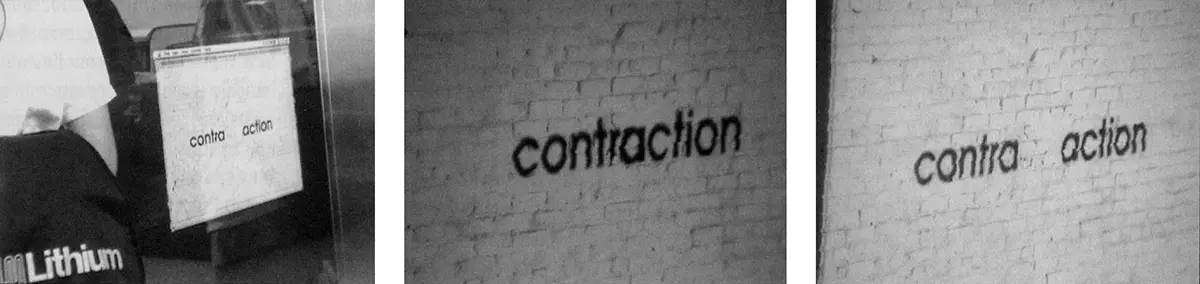
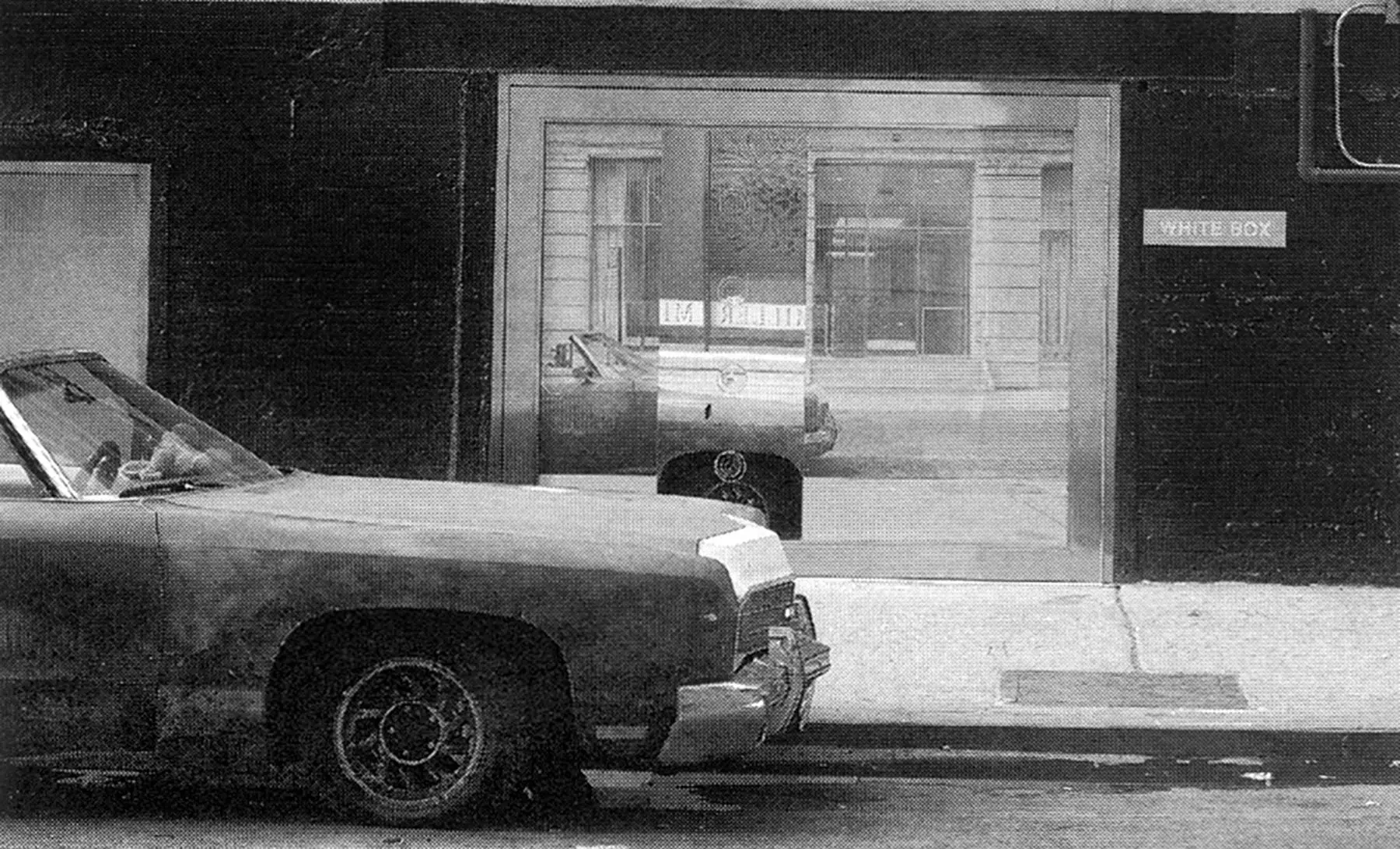
Moreover, the act of construction and destruction of phrases in animation is, in a way, an execution of the same processes to which the text refers, that is, the phrases are constructed and deconstructed, and at the same time, they operate like a performance. Muntadas’s warning becomes particularly effective in connection to the project presented by Leandro Erlich and Judi Werthein Both artists, whose work is also an analysis of perception, took a black and white photograph of the street in front, and covered the entire window of the gallery with this image, thus creating the illusion of a mirror reflection. In addition, the presence of a window strip with a real mirror made the passersby see themselves reflected and, therefore, experience a moment of confusion upon seeing themselves only partially reflected on the surface. The work incites reflection, among other things, on the theme of the reality of partial perception. In other words, what we take for granted when we have only a partial view of reality and the way in which this incompleteness tends to become our only grounds for recognizing and/or playing with something that in reality we have not seen.
Artist Arnaldo Morales, for his part, made the most of the fact that the works could not be appreciated
except from the street, and through the gallery window by creating an interactive system from a distance. The interaction was achieved by placing controls outside, which activated two kinetic sculptures (called the Electrobjects located inside the gallery). Once activated by the viewers from outside, these sculptures moved their arms in order to forcefully hit a column, and the noises were amplified through outside horns. Morales’ works are characterized by almost always having an element of interactivity, but in this case, an interesting emphasis could be appreciated in his usual cause/effect equation due to the distance between the interior and exterior elements of the work. Kara Hamilton presented a multiple video projection titled Ant, which made a connection with her continued interest in drawing, due to its immediate nature, and the fact that the artist seeks to use the most direct videographic material possible, without mediating or altering it. On the multiple screens, Hamilton presents the image of an ant on a frenzied route across the pavement that, in addition to emphasizing the space, has a hypnotic effect on the viewer, who tends to focus on the ant as a principal character and tries to find meaning or direction to a movement that really does not have one. Finally, Jan Kopp, who also works in video, showed a piece that consisted of a double projection titled Taming the Alien. This work includes a selection of fifteen minutes of television material, ranging from Clinton’s presidential report to movies and sitcoms, although it resynchronizes the voices of each segment and thus recontextualizes them into
one single sequence. Kopp’s work has something of the frenzied and random search displayed by the ant in Hamilton’s piece but it can also be seen as an attempt at defense and understanding in the face of the media invasion to which we are subjected on a daily
basis.
PABLO HELGUERA