
After three years without exhibiting his latest work, Arnaldo Roche returns with a series of pieces finished mostly in the last months. Under the generic title of El jardín de mi padre (My Father’s Garden), he presents a wounded (and wounding) meditation on being and its circumstances, always mediated by the presence of painting, an authentic protagonist that ends up absorbing any attempt at narrative or analytical discourse. Here painting itself is the master narrative, its colors carried to the most intense vibration, its matter as if sculpted, its tactile presence, its eternal contradiction between real surfaces and fictitious depth, its images referring back to painting: José Campeche, Francisco Oller, Ramón Frade, Puerto Rican painters, and Van Gogh, symbol of limitless abandon to art.
In this new production, Roche frequently uses meta-discourse, painting within the painting as in Entre sentimientos y culpas; Déjenme tirar la primera piedra; La mitad de la mesa; Y ahora, ¿qué? (Amidst Feelings and Guilt; Let me Cast the First Stone; Half of the Table; And Now, What?)—in these instances other artist’s paintings, but in other instances his own. Roche brings to memory and into play some of his earlier works: the foregrounded table in Aquí sólo puedes entrar descalzo; Cuídate del lobo de tu ignorancia (Here You can Enter Only Barefooted; Beware of Your Ignorance’s Wolf) comes from Isla Vacía (Empty Island) and El Sacrificio (The Sacrifice), among others. Painting within the painting is a device already present in Bajo Eclipse Total De So (Under Total Eclipse of the Sun).
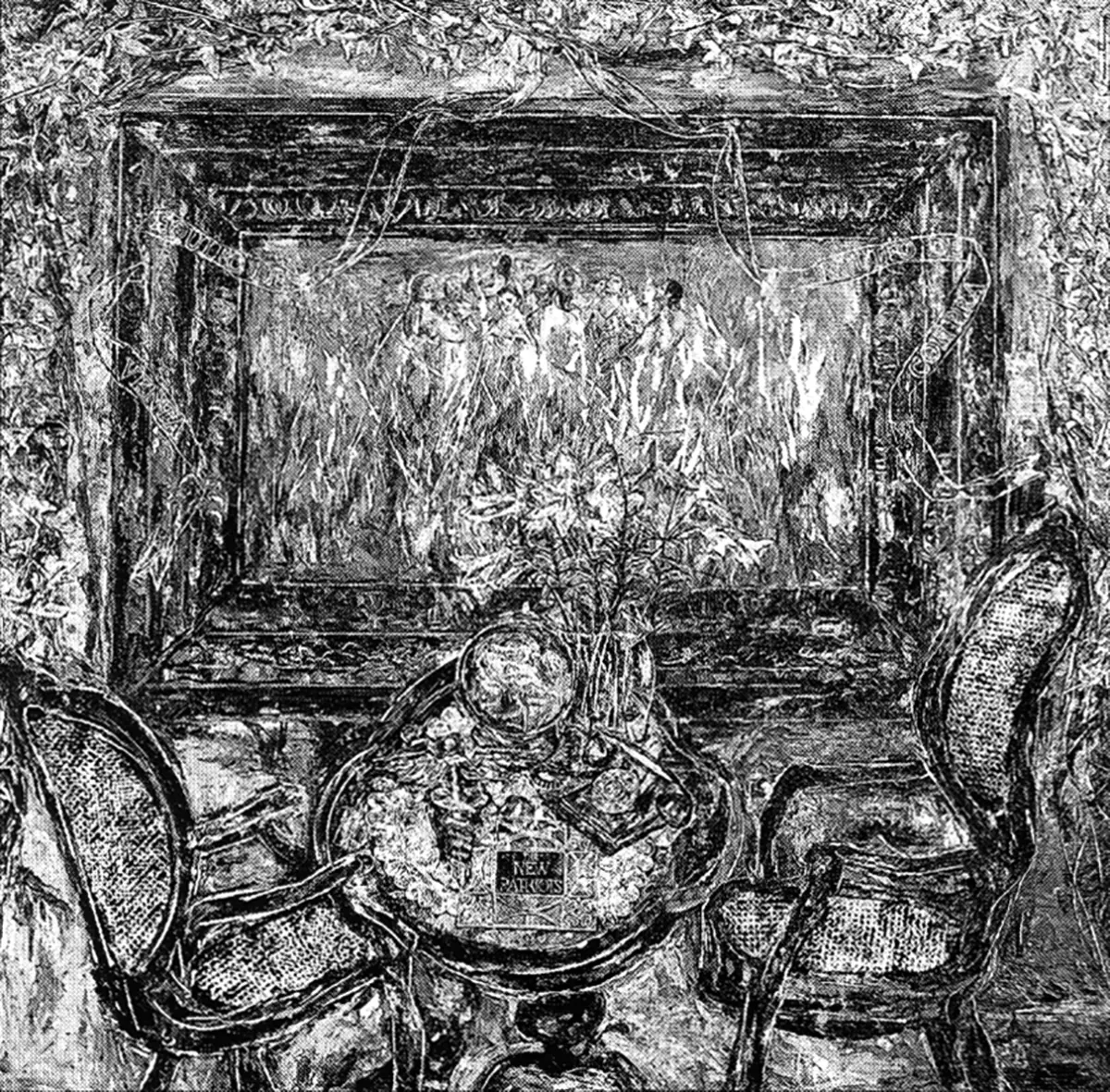
Other elements attesting to the cohesive continuity in Roche’s work are, at the iconographic level, the representation of Puerto Rican interiors with their furniture and their lace and the nightscapes of San Juan—everything as a reaffirmation of what is inescapably one’s own. At the formal level, there is a preponderance of the close-up, the accumulation of elements and details, and the abundance of colors and materials. The new Roche can be recognized at first glance under the light of his previous trajectory, and at the same time, he reinvigorates and expands his work with the ability to sustain an overwhelming intensity. An intensity that, in turn, can only ameliorate the artist’s irony, its distancing effect, through which seeps a considerable amount of irreverence.
La Mitad De La Mesa is a representative piece. In a cold spectrum of greens and blues, unusual for him, the artist uses caustic humor (sacrilege, some would say) one of the most emblematic images of Puerto Rican identity; he turns around the well-known jíbaro from Ramón Frade’s painting El pan nuestro (Our Bread). The character is looking at a map of the United States. Behind this painting we see, framed by a window, a view of Old San Juan.
Another work of incisive irony and even greater drama than La mitad de la mesa, since it involves personal circumstances, is En el jardín de mi padre. A painting within the painting symbolizes the United States with the image of the Capitol Building. The father, a disjointed doll proud of his blue eyes, tries to enter this picture while the artist and the mother observe, enveloped by the island’s vegetation, mimetized with it. Roche’s haunting series of uncompromising new portraits also deserves notice. Placed as an installation in one of the gallery’s halls, the portraits challenge from the shadows the blue gaze of the father.
Arnaldo Roche assumes his painting as a committed art. His message is now more direct, of greater impact, and at the same time filtered through the interiorization of discourse—his commitment is above all personal and existential—and through visual devices carried to their most dramatic expression This exhibition makes clear that the empty space left by Roche between Campeche and Oller in Entre sentimiento y culpas, belongs now, deservedly, to Roche himself.
FEDERICA PALOMERO